Patients
8 per 100,000 people
Deaths from air pollution, Canada, 2019 (World Bank).
Compare every country on the Public Health Dashboard Canada
Updated
 Reviewed by Chandani Patel
Canada Heat-Health Early Warning Systems Market Industry Trends and Forecast to 2034: Segmented by (Component, User, Region) - Growth, Market Size, Future Prospects & Competitive Analysis, 2024-2034
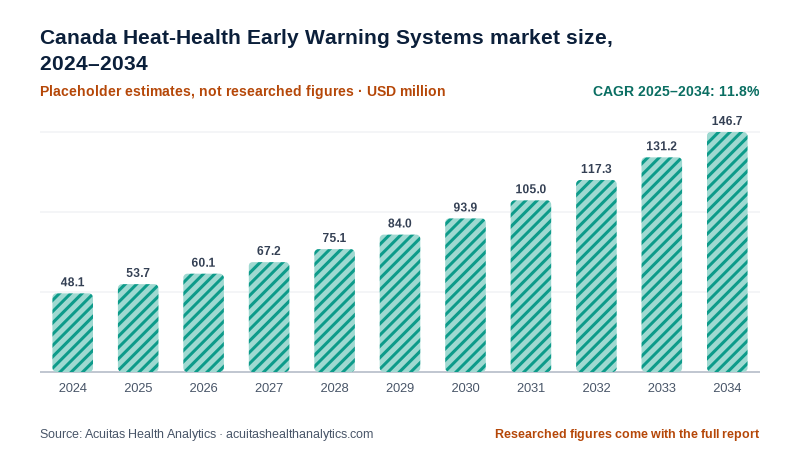
Canada · 2024–2034 · placeholder estimates
Values shown here are placeholder estimates, not researched figures. Researched 2024 historical, 2025 base-year and 2026–2034 forecast values are prepared with the full report.

 US at $308.4 Mn. Canada (this report) at 11.8% a year.
Source: Acuitas Health Analytics. Full methods, sources and usage terms come with report purchase.
$92.9 Mn total, 2026–2034
| Year | Market size | Change that year | Since 2025 |
|---|---|---|---|
| 2024 (estimate) | $48.1 Mn | — | — |
| 2025 (base) | $53.7 Mn | +$5.7 Mn | — |
| 2026 (forecast) | $60.1 Mn | +$6.3 Mn | +11.8% |
| 2027 (forecast) | $67.2 Mn | +$7.1 Mn | +25% |
| 2028 (forecast) | $75.1 Mn | +$7.9 Mn | +39.7% |
| 2029 (forecast) | $84.0 Mn | +$8.9 Mn | +56.2% |
| 2030 (forecast) | $93.9 Mn | +$9.9 Mn | +74.7% |
| 2031 (forecast) | $105.0 Mn | +$11.1 Mn | +95.3% |
| 2032 (forecast) | $117.3 Mn | +$12.4 Mn | +118.3% |
| 2033 (forecast) | $131.2 Mn | +$13.8 Mn | +144.1% |
| 2034 (forecast) | $146.7 Mn | +$15.5 Mn | +172.9% |
Placeholder estimates. Each year is projected from our earlier market estimate and its CAGR. Researched values come with the full report.
US
$308.4 Mn
 China
$67.0 Mn
Canada (this report)
$53.7 Mn
 Japan
$47.5 Mn
 Germany
$30.1 Mn
 UK
$20.4 Mn
 Brazil
$20.4 Mn
 Italy
$18.3 Mn
 France
$17.9 Mn
 Spain
$15.6 Mn
 India
$16.1 Mn
 Ecuador
$15.0 Mn
 Saudi Arabia
$13.6 Mn
 Mexico
$13.0 Mn
 Australia
$9.3 Mn
 Russia
$6.4 Mn
 New Zealand
$6.3 Mn
 South Africa
$4.5 Mn
 UAE
$3.3 Mn
 Egypt
$2.2 Mn
 Philippines
$1.7 Mn
 Hong Kong
$1.4 Mn
 Malaysia
$1.1 Mn
 Singapore
$0.9 Mn
 Thailand
$0.8 Mn
 Kenya
$0.5 Mn
| Market size, 2025 | $53.7 Mn placeholder estimate |
|---|---|
| Forecast, 2034 | $146.7 Mn placeholder estimate |
| Growth (CAGR), 2025–2034 | 11.8% placeholder estimate |
| Years | 2024 historical · 2025 base year · 2026–2034 forecast |
| Segments | Component and user (see all) |
| Key players | IBM, Esri, Climate Central, Willis Towers Watson, Microsoft (see all) |
| Regulator in Canada | Health CanadaSource: Health Canada. Checked 14 Nov 2026. |
| Formats | PDF, PPTX, XLSX |
Sizes and growth here are placeholder estimates, not researched figures. Researched figures come with the full report.
Heat-health early warning systems combine weather forecasts with health data to warn people and health services before dangerous heatwaves.
Key segments of the heat-Health Early Warning Systems market include component (Forecasting Platforms, Alert Systems and Health Response Planning) and user (Governments, Cities and Health Systems).
More heatwaves, air pollution, floods and the spread of climate-sensitive diseases are driving the heat-Health Early Warning Systems market. Health systems are under pressure to cut their own emissions.
Early warning systems, greener hospitals and climate-resilient supply chains give the heat-Health Early Warning Systems market strong room to grow.
Limited dedicated funding, unclear responsibility between agencies and lack of local data hold back the heat-Health Early Warning Systems market.
The heat-Health Early Warning Systems market is moderately concentrated. Leading companies compete on product innovation, clinical evidence, pricing and geographic reach, and use partnerships and acquisitions to expand their portfolios.
Software that meets the definition of a medical device needs a Health Canada licence, based on its risk class.[1] Each province and territory runs public health insurance under the Canada Health Act, which covers medically necessary hospital and doctor services.[2] Deaths from air pollution: 8 per 100,000 people in 2019, the latest World Bank figure for Canada.[3]
[1] Health Canada. Checked 14 Nov 2026.
[2] Health Canada. Checked 14 Nov 2026.
[3] World Bank Open Data, Deaths from air pollution (per 100,000 people). Retrieved 24 Nov 2026.
Rules on software as a medical device, data privacy (such as HIPAA and GDPR) and telehealth reimbursement shape the heat-Health Early Warning Systems market. Government digital health programs in Canada are speeding up adoption.
What doctors and scientists are doing in Heat-Health Early Warning Systems right now, from free public sources.
8 per 100,000 people
Deaths from air pollution, Canada, 2019 (World Bank).
Compare every country on the Public Health DashboardSources: PubMed (US National Library of Medicine), ClinicalTrials.gov, World Bank. Fetched 24 Nov 2026. Papers and trials are found by search words, so the counts are a guide. Titles only; read each paper at its source.
[1] World Bank Open Data, Deaths from air pollution (per 100,000 people). Retrieved 24 Nov 2026.
[2] World Bank Open Data, Health spending per person (US$ per person). Retrieved 24 Nov 2026.
[3] World Bank Open Data, Doctors (per 1,000 people). Retrieved 23 Nov 2026.
Canada · 1 shared keyword
Canada · 1 shared keyword
Canada · 1 shared keyword
Canada
Canada
Canada
Medical Devices · Canada
Medical Devices · Canada
Healthcare Services · Canada
Public Health · Global
Public Health · Global
Public Health · Global