Online Appointment Booking
Middle East · 1 shared keyword
Updated
 Reviewed by Chandani Patel
Middle East Femtech Market Industry Trends and Forecast to 2034: Segmented by (Type, Product, End User, Region) - Growth, Market Size, Future Prospects & Competitive Analysis, 2024-2034
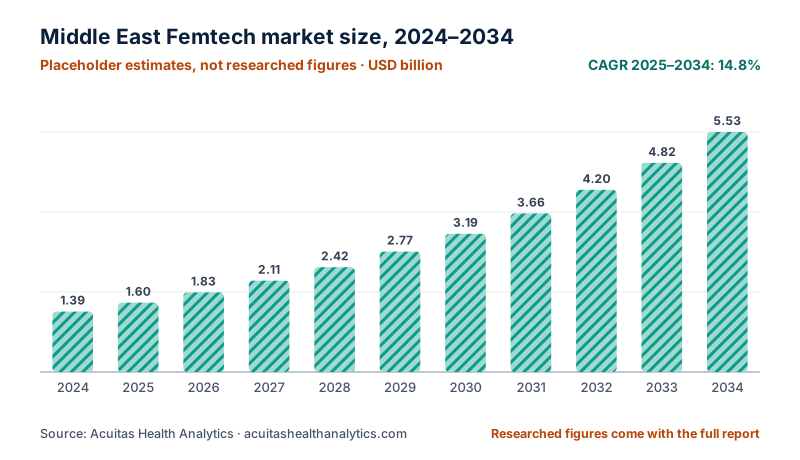
Values shown here are placeholder estimates, not researched figures. Researched 2024 historical, 2025 base-year and 2026–2034 forecast values are prepared with the full report.
Source: Acuitas Health Analytics. Full methods, sources and usage terms come with report purchase.
$3.94 Bn total, 2026–2034
| Year | Market size | Change that year | Since 2025 |
|---|---|---|---|
| 2024 (estimate) | $1.39 Bn | — | — |
| 2025 (base) | $1.60 Bn | +$206.0 Mn | — |
| 2026 (forecast) | $1.83 Bn | +$236.4 Mn | +14.8% |
| 2027 (forecast) | $2.11 Bn | +$271.4 Mn | +31.8% |
| 2028 (forecast) | $2.42 Bn | +$311.6 Mn | +51.3% |
| 2029 (forecast) | $2.77 Bn | +$357.7 Mn | +73.7% |
| 2030 (forecast) | $3.19 Bn | +$410.7 Mn | +99.4% |
| 2031 (forecast) | $3.66 Bn | +$471.4 Mn | +128.9% |
| 2032 (forecast) | $4.20 Bn | +$541.2 Mn | +162.8% |
| 2033 (forecast) | $4.82 Bn | +$621.3 Mn | +201.7% |
| 2034 (forecast) | $5.53 Bn | +$713.3 Mn | +246.3% |
Placeholder estimates. Each year is projected from our earlier market estimate and its CAGR. Researched values come with the full report.
 US
$13.86 Bn
 China
$3.37 Bn
 Canada
$3.05 Bn
 Japan
$2.06 Bn
 Germany
$1.15 Bn
 France
$1.12 Bn
 UK
$952.3 Mn
 Italy
$872.1 Mn
 Ecuador
$804.7 Mn
 Brazil
$788.0 Mn
 Saudi Arabia
$718.3 Mn
 India
$666.9 Mn
 Spain
$604.7 Mn
 Mexico
$611.9 Mn
 Russia
$400.9 Mn
 Australia
$406.1 Mn
 New Zealand
$352.7 Mn
 South Africa
$273.6 Mn
 UAE
$190.6 Mn
 Egypt
$104.5 Mn
 Philippines
$87.3 Mn
 Malaysia
$64.0 Mn
 Hong Kong
$52.0 Mn
 Singapore
$44.2 Mn
 Thailand
$38.2 Mn
 Kenya
$22.6 Mn
| Market size, 2025 | $1.60 Bn placeholder estimate |
|---|---|
| Forecast, 2034 | $5.53 Bn placeholder estimate |
| Growth (CAGR), 2025–2034 | 14.8% placeholder estimate |
| Years | 2024 historical · 2025 base year · 2026–2034 forecast |
| Segments | Type, product and end user (see all) |
| Key players | Flo Health, Clue (BioWink), Maven Clinic, Elvie (Chiaro), Natural Cycles and 1 more (see all) |
| Formats | PDF, PPTX, XLSX |
Sizes and growth here are placeholder estimates, not researched figures. Researched figures come with the full report.
Femtech covers apps, devices and services built for women's health, from period tracking to fertility, pregnancy, menopause and pelvic health.
Key segments of the femtech market include type (Period and Fertility Tracking, Pregnancy and Nursing Care and Pelvic Health) and product (Apps, Wearables and Connected Devices).
Greater awareness of women's health needs, more funding for female-focused research, later pregnancies and an ageing female population are driving the femtech market. New products designed around women's biology and digital care are improving access.
Femtech, personalised care and new treatments for under-served conditions open strong growth for the femtech market, especially as employers and payers add women's health benefits.
Under-diagnosis, stigma around some conditions, limited insurance coverage and a long history of under-research in women's health hold back the femtech market.
The femtech market is moderately concentrated. Leading companies compete on product innovation, clinical evidence, pricing and geographic reach, and use partnerships and acquisitions to expand their portfolios.
How care is paid for in some of these countries: free public care and CHI-regulated insurance (Saudi Arabia)[1] and mandatory health insurance (UAE)[2].
[1] Council of Health Insurance. Checked 14 Nov 2026.
[2] Ministry of Human Resources and Emiratisation. Checked 14 Nov 2026.
Rules on software as a medical device, data privacy (such as HIPAA and GDPR) and telehealth reimbursement shape the femtech market. Government digital health programs in Middle East are speeding up adoption.
What doctors and scientists are doing in Femtech right now, from free public sources.
Sources: PubMed (US National Library of Medicine), ClinicalTrials.gov. Fetched 12 Nov 2026. Papers and trials are found by search words, so the counts are a guide. Titles only; read each paper at its source.
From our blog
Middle East · 1 shared keyword
Middle East · 1 shared keyword
Middle East · 1 shared keyword
Middle East · 1 shared keyword
Middle East · 1 shared keyword
Middle East
Pharmaceuticals · Middle East
Healthcare Services · Middle East
Pharmaceuticals · Middle East
Medical Devices · Middle East
Public Health · Middle East
Pharmaceuticals · Middle East