Preclinical CRO
Africa
Updated
 Reviewed by Chandani Patel
Africa Virtual Primary Care Market Industry Trends and Forecast to 2034: Segmented by (Model, Service, End User, Region) - Growth, Market Size, Future Prospects & Competitive Analysis, 2024-2034
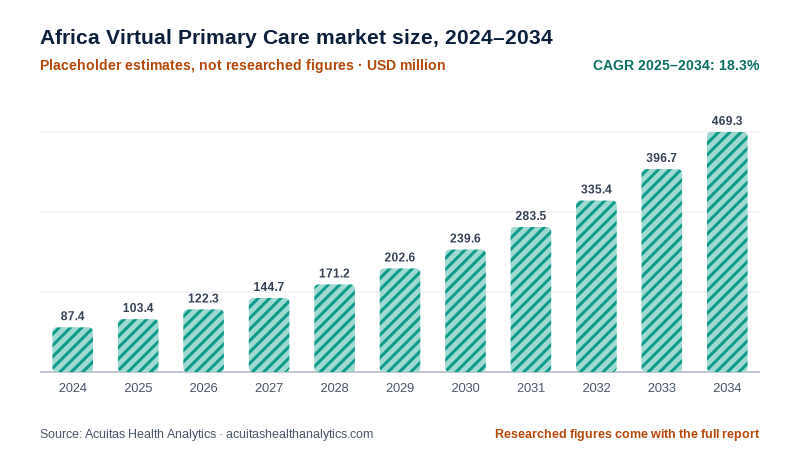
Values shown here are placeholder estimates, not researched figures. Researched 2024 historical, 2025 base-year and 2026–2034 forecast values are prepared with the full report.

Source: Acuitas Health Analytics. Full methods, sources and usage terms come with report purchase.
$365.9 Mn total, 2026–2034
| Year | Market size | Change that year | Since 2025 |
|---|---|---|---|
| 2024 (estimate) | $87.4 Mn | — | — |
| 2025 (base) | $103.4 Mn | +$16.0 Mn | — |
| 2026 (forecast) | $122.3 Mn | +$18.9 Mn | +18.3% |
| 2027 (forecast) | $144.7 Mn | +$22.4 Mn | +39.9% |
| 2028 (forecast) | $171.2 Mn | +$26.5 Mn | +65.6% |
| 2029 (forecast) | $202.6 Mn | +$31.3 Mn | +95.9% |
| 2030 (forecast) | $239.6 Mn | +$37.1 Mn | +131.7% |
| 2031 (forecast) | $283.5 Mn | +$43.9 Mn | +174.1% |
| 2032 (forecast) | $335.4 Mn | +$51.9 Mn | +224.3% |
| 2033 (forecast) | $396.7 Mn | +$61.4 Mn | +283.6% |
| 2034 (forecast) | $469.3 Mn | +$72.6 Mn | +353.8% |
Placeholder estimates. Each year is projected from our earlier market estimate and its CAGR. Researched values come with the full report.
 US
$2.89 Bn
 Canada
$687.8 Mn
 China
$569.4 Mn
 Japan
$524.8 Mn
 Germany
$243.2 Mn
 UK
$199.8 Mn
 Italy
$186.9 Mn
 France
$185.8 Mn
 Brazil
$167.9 Mn
 Spain
$154.1 Mn
 Ecuador
$142.1 Mn
 India
$133.7 Mn
 Saudi Arabia
$123.2 Mn
 Mexico
$97.9 Mn
 Russia
$88.3 Mn
 New Zealand
$86.1 Mn
 Australia
$83.1 Mn
 South Africa
$44.1 Mn
 UAE
$43.7 Mn
 Egypt
$22.5 Mn
 Philippines
$15.9 Mn
 Hong Kong
$11.5 Mn
 Malaysia
$10.5 Mn
 Thailand
$8.5 Mn
 Singapore
$8.0 Mn
 Kenya
$5.2 Mn
| Market size, 2025 | $103.4 Mn placeholder estimate |
|---|---|
| Forecast, 2034 | $469.3 Mn placeholder estimate |
| Growth (CAGR), 2025–2034 | 18.3% placeholder estimate |
| Years | 2024 historical · 2025 base year · 2026–2034 forecast |
| Segments | Model, service and end user (see all) |
| Key players | One Medical (Amazon), Teladoc Health, Firefly Health, Included Health, Amwell (see all) |
| Formats | PDF, PPTX, XLSX |
Sizes and growth here are placeholder estimates, not researched figures. Researched figures come with the full report.
Virtual primary care gives patients an ongoing family doctor relationship online, with video visits, messaging and home tests.
Key segments of the virtual Primary Care market include model (Employer-Sponsored, Health Plan and Direct-to-Consumer) and service (Preventive Care, Chronic Care and Urgent Care).
Patient demand for care closer to home, staff shortages, lower costs than hospital stays and better remote monitoring technology are driving the virtual Primary Care market. Payment rules for virtual care have become more supportive.
Hospital-level care at home, chronic disease programs and virtual specialist services give the virtual Primary Care market strong room to grow.
Uneven reimbursement, rules on licensing across borders, poor internet in some areas and the need for strong clinical oversight hold back the virtual Primary Care market.
The virtual Primary Care market is moderately concentrated. Leading companies compete on product innovation, clinical evidence, pricing and geographic reach, and use partnerships and acquisitions to expand their portfolios.
How care is paid for in some of these countries: universal health insurance (Egypt)[1], the SHA (Kenya)[2], planned National Health Insurance (South Africa)[3] and out of pocket and the NHIA (Nigeria)[4].
[1] Universal Health Insurance Authority. Checked 14 Nov 2026.
[2] Social Health Authority. Checked 14 Nov 2026.
[3] National Department of Health. Checked 14 Nov 2026.
[4] National Health Insurance Authority (NHIA). Checked 19 Nov 2026.
Licensing, quality standards and payment models from public and private payers shape how virtual Primary Care services are delivered and paid for in Africa. Government health programs and insurance coverage are key to access.
What doctors and scientists are doing in Virtual Primary Care right now, from free public sources.
Sources: PubMed (US National Library of Medicine), ClinicalTrials.gov. Fetched 12 Nov 2026. Papers and trials are found by search words, so the counts are a guide. Titles only; read each paper at its source.
From our blog
Africa
Africa
Africa
Africa
Africa
Africa
Digital Health · Africa
Digital Health · Africa
Digital Health · Africa
Digital Health · Africa
Medical Devices · Africa
Digital Health · Africa