Hong Kong Biomaterial Wound Dressing Market Industry Trends and Forecast to 2034: Segmented by (Product, Dressing Type, Application, End-user, Region) - Growth, Market Size, Future Prospects & Competitive Analysis, 2024-2034
Overview
Market Dashboard
Hong Kong · 2024–2034 · placeholder estimates
Values shown here are placeholder estimates, not researched figures. Researched 2024 historical, 2025 base-year and 2026–2034 forecast values are prepared with the
full report.
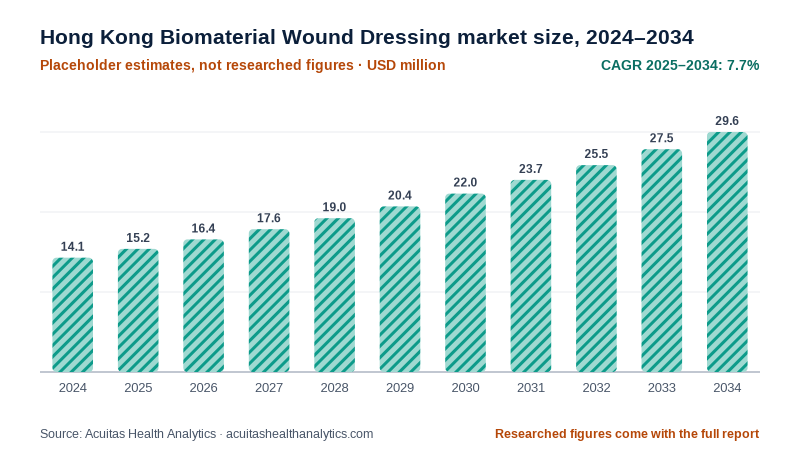
Estimate 2024$14.1 MnPlaceholder estimate
Estimate 2025$15.2 Mn0.2% of the global market
Projected 2034$29.6 Mn 95%Adds $14.4 Mn over 9 forecast years
CAGR 2025–20347.7%Faster than 19% of 114 Healthcare Services markets here
Hong Kong Biomaterial Wound Dressing Market Analysis at a glance
Market size, 2025
$15.2 Mn placeholder estimate
Forecast, 2034
$29.6 Mn placeholder estimate
Growth (CAGR), 2025–2034
7.7% placeholder estimate
Years
2024 historical · 2025 base year · 2026–2034 forecast
Segments
Product, dressing type, application and end user (see all)
Key players
3M Company, ConvaTec Inc., DermaRite Industries LLC, Mölnlycke Health Care AB, Smith & Nephew and 5 more (see all)
Active clinical trials
1 in Hong KongSource: ClinicalTrials.gov, Studies recruiting, active or not yet recruiting, in Hong Kong. Retrieved 9 Nov 2026.
Formats
PDF, PPTX, XLSX
Sizes and growth here are placeholder estimates, not researched figures. Researched figures come with the full report.
The Hong Kong Biomaterial Wound Dressing Market Analysis Executive Summary
Biomaterial wound dressings are specialized materials utilized to cover and safeguard wounds while enhancing the healing process. These dressings are engineered to establish an ideal environment for wound recovery by regulating moisture levels, allowing for gas exchange, preventing infections, and encouraging tissue regeneration. They are essential in contemporary wound care, offering a supportive framework for tissue repair, alleviating pain, and reducing the likelihood of complications such as infections and scarring.
The development of innovative materials, such as hydrogels and nanofibers, is enhancing the effectiveness of wound dressings by improving moisture management and promoting faster healing. The emergence of smart wound dressings equipped with sensors to monitor wound conditions in real-time is revolutionizing patient care, allowing for timely interventions. There is a growing trend towards incorporating antimicrobial agents into dressings to reduce the risk of infection and improve healing outcomes. The shift towards personalized medicine is influencing the design of wound dressings tailored to individual patient needs, considering factors such as wound type and healing stage. Increasing awareness of environmental issues is driving the demand for biodegradable and eco-friendly wound dressings, aligning with global sustainability goals.
Hong Kong Biomaterial Wound Dressing market size, 2024–2034. Placeholder estimates; researched figures come with the full report. Source: Acuitas Health Analytics.
Hong Kong Biomaterial Wound Dressing Market Dynamics
Market Growth Drivers
The increasing prevalence of chronic wounds is a significant driver of market growth in the wound care sector. Recent data highlights that approximately 10.5 Mn Medicare beneficiaries in the U.S. are affected by chronic wounds, marking an increase of 2.3 Mn since 2014. This condition impacts around 2.5% of the U.S. population, emphasizing the extensive reach of chronic wounds. Additionally, global statistics indicate that between 9.1 to 26.1 Mn cases of diabetic foot ulcers occur annually, further illustrating the widespread nature of this issue. The rising incidence of burn injuries also contributes to the demand for specialized wound dressings, with around 450,000 burn injuries reported in the U.S. each year, according to recent findings. The combination of these factors underscores the urgent need for effective wound care solutions.
Another crucial factor driving market growth is the aging population, which is more susceptible to chronic conditions that compromise skin integrity, such as diabetes and peripheral vascular diseases. Reports indicate that about 95% of adults aged 60 and above have at least one chronic condition, with many having multiple chronic issues. This demographic shift is expected to increase the demand for wound dressings significantly. Furthermore, advancements in wound care products, such as the recent launch of innovative antimicrobial wound gels, are set to enhance treatment efficacy and patient comfort. As these advanced products replace traditional wound care solutions, they are anticipated to boost market growth by improving healing rates and patient compliance.
Market Restraints
The biomaterial wound dressing market faces several restraints that could hinder its growth. One of the primary challenges is the lack of proper reimbursement in developing regions. Many healthcare systems do not provide adequate coverage for advanced wound care products, which can limit patient access and reduce market potential. This financial barrier can discourage healthcare providers from utilizing innovative wound care solutions, thereby stunting market expansion.
Additionally, the high cost of treatment associated with biomaterial wound dressings poses a significant challenge. Advanced wound care products often come with elevated price tags, making them less accessible for patients and healthcare facilities, especially in regions with limited healthcare budgets. This situation is compounded by increasing regulatory scrutiny regarding the safety and efficacy of medical devices, which can lead to delays in product approvals and additional costs for manufacturers. As companies navigate these regulatory landscapes, they may face increased operational costs that could further impact market growth.
Competitive Landscape for Biomaterial Wound Dressing Market in Hong Kong
DuPont Launch: In October 2025, DuPont introduced a new soft skin adhesive (SSA), DuPont Liveo MG 7-9960, designed for use in wound care dressings. This adhesive offers enhanced adhesion and lower cyclic silicone, facilitating extended wear time and easier removal of medical devices.
JeNaCell Product Introduction: In June 2025, JeNaCell launched the epicite balancing wound dressing in Germany. This dressing is tailored for managing chronic wounds with low to medium exudation, including diabetic foot ulcers and venous leg ulcers.
Collagen Matrix FDA Clearance: In June 2022, Collagen Matrix received 510(k) clearance from the FDA for its Fibrillar Collagen Wound Dressing, aimed at treating wounds with moderate to extensive fluid exudation and controlling mild bleeding.
Healthcare Policies and Regulatory Landscape for Biomaterial Wound Dressing Market in Hong Kong
Biomaterial Wound Dressing in Hong Kong: payment and research
Public hospitals and clinics, run by the Hospital Authority, are heavily subsidised by the government.[1] ClinicalTrials.gov lists 1 study on Biomaterial Wound Dressing that is recruiting, active or about to start in Hong Kong.[2]
[2]ClinicalTrials.gov, Studies recruiting, active or not yet recruiting, in Hong Kong. Retrieved 9 Nov 2026.
The healthcare policies and regulatory landscape for the biomaterial wound dressing market is shaped by various factors that influence the development, approval, and adoption of these products.
Government initiatives play a crucial role in promoting wound care treatment, recognizing the significant healthcare and economic burdens associated with chronic wounds. Many governments prioritize wound management within their public health agendas, investing in research, education, and awareness campaigns. This support often includes reimbursement and coverage for biomaterial wound dressings, particularly in countries with universal healthcare systems, making advanced wound care options more accessible to patients and healthcare facilities. Regulatory bodies also establish standards and guidelines for wound care, which can encourage healthcare providers to adopt biomaterial dressings as preferred treatment options in specific clinical situations.
Additionally, advancements in technology and materials science are influencing the regulatory landscape. New biomaterials are being developed that offer improved therapeutic properties, prompting regulatory agencies to adapt their guidelines to ensure safety and efficacy. The continuous evolution of these standards is essential for fostering innovation in the biomaterial wound dressing market while ensuring that patient safety remains a priority. As healthcare systems worldwide continue to evolve, the regulatory environment will likely adapt to accommodate new technologies and approaches in wound care management.
8.2 Government Initiatives / Intervention programs
The biomaterial wound dressing market can be segmented into several categories, reflecting its diverse applications and product types. The main segments include:
Other companies that free public records show in this market: trials they lead, US approvals and WHO prequalification. They are not part of our key players research. Each count opens its source.
Also active in this area, from free public records
Source: ClinicalTrials.gov, Active studies (recruiting, about to start or running) each company leads, found with this market's trial search, worldwide. Retrieved 13 Nov 2026.
Source: FDA 510(k) and PMA databases, 510(k) clearances and PMA approvals since 2015 for devices whose name has this market's words. Retrieved 13 Nov 2026.
Beyond the market numbers
Research, trials and patients
What doctors and scientists are doing in Biomaterial Wound Dressing right now, from free public sources.
Sources:PubMed (US National Library of Medicine),
ClinicalTrials.gov,
World Bank.
Fetched 9 Nov 2026. Papers and trials are found by search words, so the counts are a guide. Titles only; read each paper at its source.
Public data, with sources
Biomaterial Wound Dressing in context
Hong Kong compared
People aged 65 and over: 23.7% of people (2025). World: 10.4% of people (2025). 2nd highest of the 18 countries we cover in APAC.[1]
[1]World Bank Open Data, People aged 65 and over (% of people). Retrieved 25 Nov 2026.
How big is the Biomaterial Wound Dressing market in Hong Kong?
Placeholder estimate: about $15.2 Mn in 2025, rising to about $29.6 Mn by 2034. These are early estimates, not researched figures; the researched values come with the full report.
How fast is the Biomaterial Wound Dressing market in Hong Kong growing?
Placeholder estimate: about 7.7% a year (CAGR, 2025–2034). The researched growth rate comes with the full report.
What segments does the Biomaterial Wound Dressing market report cover?
The report splits the market by product (Hydrocolloids, Alginate Dressings, Skin Substitutes, Other Products), dressing type (Primary Dressings, Secondary Dressings), application (Wounds, Burns, Ulcers, Other Applications) and end user (Hospitals, Clinics, Ambulatory Surgical Centers, Homecare).
Who are the key players in the Biomaterial Wound Dressing market?
Key players include 3M Company, ConvaTec Inc., DermaRite Industries LLC, Mölnlycke Health Care AB, Smith & Nephew and B. Braun Melsungen AG, among 10 companies the report profiles.
What is driving the Biomaterial Wound Dressing market?
The increasing prevalence of chronic wounds is a significant driver of market growth in the wound care sector. Recent data highlights that approximately 10.5 Mn Medicare beneficiaries in the U.S. are affected by chronic wounds, marking an increase of 2.3 Mn since 2014.
How is healthcare paid for in Hong Kong?
Public hospitals and clinics, run by the Hospital Authority, are heavily subsidised by the government. Source: Hospital Authority. Checked 14 Nov 2026.
How many clinical trials on Biomaterial Wound Dressing are running in Hong Kong?
1 study is recruiting, active or about to start in Hong Kong, according to ClinicalTrials.gov. Source: ClinicalTrials.gov, Studies recruiting, active or not yet recruiting, in Hong Kong. Retrieved 9 Nov 2026.
How much research is published on Biomaterial Wound Dressing?
PubMed lists 4,441 papers on Biomaterial Wound Dressing added since January 2021, worldwide. Source: PubMed, Papers added since 1 January 2021 matching this market. Retrieved 9 Nov 2026.
 Hong Kong



 China
 India
 US
 Canada
 Japan
 Germany
 France
 UK
 Brazil
 Italy
 Ecuador
 Spain
 Saudi Arabia
 Mexico
 Australia
 South Africa
 UAE
 Egypt
 Philippines
 Malaysia
 Singapore
 Thailand
 Kenya
 Molnlycke Health Care
 Geistlich Pharma AG