APAC Apheresis Equipment Market Analysis Industry Trends and Forecast to 2034: Segmented by (By Product Type, By Procedure, By Technology, By Application, By End User, By Region) - Growth, Market Size, Future Prospects & Competitive Analysis, 2024-2034
Overview
Market Dashboard
APAC · 2024–2034 · placeholder estimates
Values shown here are placeholder estimates, not researched figures. Researched 2024 historical, 2025 base-year and 2026–2034 forecast values are prepared with the
full report.
Estimate 2024$573.2 MnPlaceholder estimate
Estimate 2025$616.1 Mn21.5% of the global market
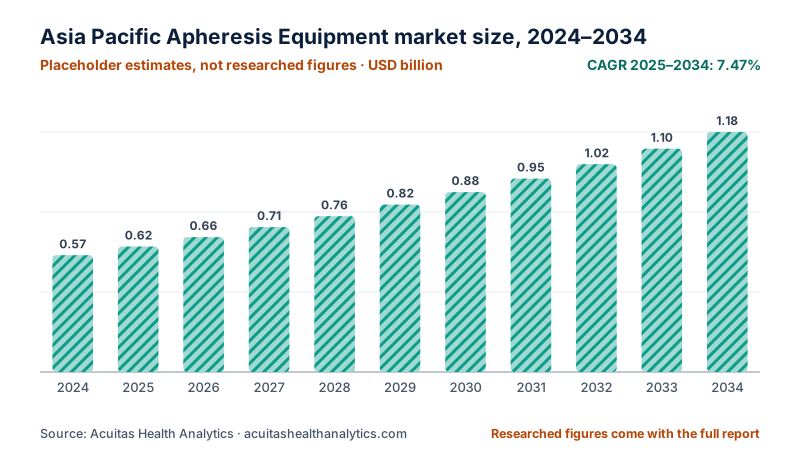
Projected 2034$1.18 Bn 91.2%Adds $562.1 Mn over 9 forecast years
CAGR 2025–20347.47%Faster than 17% of 173 Medical Devices markets here
APAC Apheresis Equipment Market Analysis at a glance
Market size, 2025
$616.1 Mn placeholder estimate
Forecast, 2034
$1.18 Bn placeholder estimate
Growth (CAGR), 2025–2034
7.47% placeholder estimate
Years
2024 historical · 2025 base year · 2026–2034 forecast
Segments
Product type, procedure, technology, application and end user (see all)
Key players
Fresenius Kabi AG, Terumo Corporation, B. Braun Melsungen AG, Haemonetics Corporation, Asahi Kasei Medical Co., Ltd. and 1 more (see all)
Active clinical trials
86 in Asia PacificSource: ClinicalTrials.gov, Studies recruiting, active or not yet recruiting, in Asia Pacific. Retrieved 9 Nov 2026.
Formats
PDF, PPTX, XLSX
Sizes and growth here are placeholder estimates, not researched figures. Researched figures come with the full report.
The APAC Apheresis Equipment Market Executive Summary
Apheresis is a procedure that enables healthcare providers to obtain or remove red blood cells, white blood cells, platelets and plasma for medical treatment. It’s also known as pheresis or hemapheresis. In apheresis, a centrifuge machine draws blood from your body and spins the blood to separate its elements. The machine sets aside certain elements and returns the remaining blood cells, platelets and plasma to your body.
The apheresis equipment market is expanding due to rising chronic diseases, technological advancements, and growing awareness of blood donation. Key drivers include the increasing need for blood components and improvements in apheresis technology. However, high costs and regulatory challenges may hinder growth. The market is segmented by product type, application, and end-user, with North America and Europe leading, while Asia-Pacific is expected to experience significant growth. Major players in the market include Terumo BCT, Fresenius Kabi, and Haemonetics Corporation. Overall, the market is set for growth with continued technological innovations and increased healthcare investments.
Asia Pacific Apheresis Equipment market size, 2024–2034. Placeholder estimates; researched figures come with the full report. Source: Acuitas Health Analytics.
APAC Apheresis Equipment Market Dynamics
Market Growth Drivers
As chronic diseases continue rising, so does the need for apheresis- a treatment that separates and eliminates specific unhealthy components in the bloodstream. There has been significant progress in technology regarding apheresis equipment, making the instruments safe and efficient. The demand for blood components has also risen as there is a growing awareness of blood disorders in developed regions, and the availability of favourable reimbursement policies. Furthermore, the development of healthcare facilities in the growth horns such as emerging markets also aid in increasing the usage of apheresis equipment.
Opportunity
Further development of apheresis equipment includes, new applications in regenerative medicine and gene therapies, looking at AI, ML, and IoT for improving apheresis equipment, cost-effective and portable machines to make them more accessible. Alliances and partnerships are also known to influence innovation and market advancement.
Market Restraints
High initial cost of capital which is likely to lead to low uptake and create budget constrains especially among the developing countries. Tough regulatory standards are often a hindrance to the fast approval of products and the integration of new technologies into the market. One of the challenges that can impede market adoption is a lack of qualified personnel able to operate apheresis equipment.
Competitive Landscape for Apheresis Equipment Market in APAC
September 2025, Sanguine Biosciences (Sanguine), a leader in connecting patients with biomedical researchers to accelerate precision medicine R&D, this week announced its opening of a blood donor centre in Los Angeles. The centre will specialize in collecting concentrated white blood cell biospecimens through apheresis from participants in Sanguine’s Patient Community network.
June 2022, NHS England Chooses Spectra Optia® Apheresis System as Part of MedTech Funding Mandate for Expansion of Sickle Cell Disease Treatment. Adoption of Terumo Blood and Cell Technologies’ Spectra Optia will Save the UK’s NHS an Expected GBP 13 Million per Year.
Healthcare Policies and Regulatory Landscape for Apheresis Equipment Market in APAC
Apheresis Equipment in APAC: rules, payment and research
In some of the countries we cover here, medical devices are regulated by TGA (Australia)[1], NMPA (China)[2], MDACS (Hong Kong)[3], CDSCO (India)[4], PMDA (Japan)[5], MDA (Malaysia)[6], Medsafe (WAND) (New Zealand)[7], FDA Philippines (Philippines)[8], HSA (Singapore)[9] and Thai FDA (Thailand)[10]. How care is paid for in some of these countries: Medicare and the PBS (Australia)[11], basic medical insurance (China)[12], the Hospital Authority (Hong Kong)[13], Ayushman Bharat PM-JAY (India)[14], public health insurance (Japan)[15], subsidised public care (Malaysia)[16], Pharmac (New Zealand)[17], PhilHealth (Philippines)[18], MediShield Life (Singapore)[19] and the Universal Coverage Scheme (Thailand)[20]. ClinicalTrials.gov lists 86 studies on Apheresis Equipment that are recruiting, active or about to start in APAC.[21]
[21]ClinicalTrials.gov, Studies recruiting, active or not yet recruiting, in APAC. Retrieved 9 Nov 2026.
Policy changes and Reimbursement scenario
Policies within the healthcare sector focusing on better technologies in medicine, as well as the management of chronic diseases, will exercise positive influence on apheresis equipment adoption. Less restrictive FDA regulations and increased emphasis on chronic diseases can drive market expansion. Hypothenar access, especially in areas such as North America, increases the utilization of apheresis procedures; however, inconsistencies in reimbursement practices around the world may affect adoption. Emerging markets have potential for better reimbursement conditions and availability of apheresis treatments when healthcare systems and related infrastructure evolve.
7.6 Terumo BCT, Inc. Product & Services, Strategies & Financials
8 Healthcare Policies and Regulatory Landscape
8.1 Policy changes and Reimbursement scenario
8.2 Government Initiatives / Intervention programs
The apheresis equipment market can be segmented based on several criteria, including product type, procedure, technology, application, end user, and region. Here's a detailed overview of the segmentation:
By Product Type
Apheresis Devices
Disposables
By Procedure
Automated Blood Collection
Therapeutic Apheresis
By Technology
Centrifugation
Membrane Filtration
By Application
Renal Disorders
Haematological Disorders
Neurological Disorders
Autoimmune Disorders
Metabolic Disorders
Cardiovascular Disorders
Other Disorders
By End User
Blood Collection Centres and Blood Component Providers
Other companies that free public records show in this market: trials they lead, US approvals and WHO prequalification. They are not part of our key players research. Each count opens its source.
Also active in this area, from free public records
Source: ClinicalTrials.gov, Active studies (recruiting, about to start or running) each company leads, found with this market's trial search, worldwide. Retrieved 13 Nov 2026.
Source: FDA 510(k) and PMA databases, 510(k) clearances and PMA approvals since 2015 for devices whose name has this market's words. Retrieved 13 Nov 2026.
Beyond the market numbers
Research, trials and patients
What doctors and scientists are doing in Apheresis Equipment right now, from free public sources.
Clinical trials
86 active trials in China, India, Japan, Australia, Hong Kong, Philippines, Singapore, Thailand, Malaysia, New Zealand, Bangladesh, Afghanistan, Indonesia, Myanmar, Nepal and Pakistan
Recruiting, about to start, or running now. Counted across the 16 countries we report on in APAC.
Sources:PubMed (US National Library of Medicine),
ClinicalTrials.gov.
Fetched 9 Nov 2026. Papers and trials are found by search words, so the counts are a guide. Titles only; read each paper at its source.
How big is the Apheresis Equipment market in Asia Pacific?
Placeholder estimate: about $616.1 Mn in 2025, rising to about $1.18 Bn by 2034. These are early estimates, not researched figures; the researched values come with the full report.
How fast is the Apheresis Equipment market in Asia Pacific growing?
Placeholder estimate: about 7.47% a year (CAGR, 2025–2034). The researched growth rate comes with the full report.
What segments does the Apheresis Equipment market report cover?
The report splits the market by product type (Apheresis Devices, Disposables), procedure (Automated Blood Collection, Therapeutic Apheresis), technology (Centrifugation, Membrane Filtration) and application (Renal Disorders, Haematological Disorders, Neurological Disorders, Autoimmune Disorders and more).
Who are the key players in the Apheresis Equipment market?
Key players include Fresenius Kabi AG, Terumo Corporation, B. Braun Melsungen AG, Haemonetics Corporation, Asahi Kasei Medical Co., Ltd. and Terumo BCT, Inc..
What is driving the Apheresis Equipment market?
As chronic diseases continue rising, so does the need for apheresis- a treatment that separates and eliminates specific unhealthy components in the bloodstream. There has been significant progress in technology regarding apheresis equipment, making the instruments safe and efficient.
How many clinical trials on Apheresis Equipment are running in Asia Pacific?
86 studies are recruiting, active or about to start in Asia Pacific, counted across the 16 countries we report on there, according to ClinicalTrials.gov. Source: ClinicalTrials.gov, Studies recruiting, active or not yet recruiting, in Asia Pacific. Retrieved 9 Nov 2026.
How much research is published on Apheresis Equipment?
PubMed lists 8,458 papers on Apheresis Equipment added since January 2021, worldwide. Source: PubMed, Papers added since 1 January 2021 matching this market. Retrieved 9 Nov 2026.



 US
 China
 Canada
 Japan
 Germany
 France
 UK
 Brazil
 Italy
 Ecuador
 Spain
 India
 Saudi Arabia
 Mexico
 Australia
 South Africa
 UAE
 Egypt
 Philippines
 Hong Kong
 Malaysia
 Singapore
 Thailand
 Kenya
 AstraZeneca
 Kaneka Corporation
 Johnson & Johnson