


Clinical trials
1 active trial in Indonesia
Recruiting, about to start, or running now.
- Smart Bandage With Telemonitoring vs Standard Care for Venous Leg Ulcer: Randomized Trial NCT07163195
 Indonesia
Updated
 Reviewed by Chandani Patel
Indonesia Negative Pressure Wound Therapy (NPWT) Market Industry Trends and Forecast to 2034: Segmented by (Product, Wound, End User, Region) - Growth, Market Size, Future Prospects & Competitive Analysis, 2024-2034
Indonesia · 2024–2034 · placeholder estimates
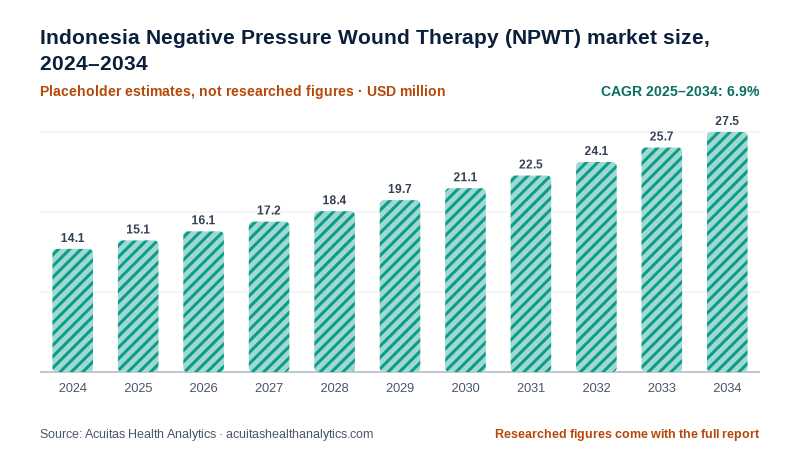
Values shown here are placeholder estimates, not researched figures. Researched 2024 historical, 2025 base-year and 2026–2034 forecast values are prepared with the full report.
 China at $301.8 Mn.
 India at 9% a year.
Source: Acuitas Health Analytics. Full methods, sources and usage terms come with report purchase.
$12.4 Mn total, 2026–2034
| Year | Market size | Change that year | Since 2025 |
|---|---|---|---|
| 2024 (estimate) | $14.1 Mn | — | — |
| 2025 (base) | $15.1 Mn | +$1.0 Mn | — |
| 2026 (forecast) | $16.1 Mn | +$1.0 Mn | +6.9% |
| 2027 (forecast) | $17.2 Mn | +$1.1 Mn | +14.3% |
| 2028 (forecast) | $18.4 Mn | +$1.2 Mn | +22.2% |
| 2029 (forecast) | $19.7 Mn | +$1.3 Mn | +30.6% |
| 2030 (forecast) | $21.1 Mn | +$1.4 Mn | +39.6% |
| 2031 (forecast) | $22.5 Mn | +$1.5 Mn | +49.2% |
| 2032 (forecast) | $24.1 Mn | +$1.6 Mn | +59.5% |
| 2033 (forecast) | $25.7 Mn | +$1.7 Mn | +70.5% |
| 2034 (forecast) | $27.5 Mn | +$1.8 Mn | +82.3% |
Placeholder estimates. Each year is projected from our earlier market estimate and its CAGR. Researched values come with the full report.
 US
$1.44 Bn
China
$301.8 Mn
 Canada
$291.1 Mn
 Japan
$220.9 Mn
 Germany
$135.6 Mn
 France
$96.0 Mn
 UK
$86.4 Mn
 Italy
$79.8 Mn
 Brazil
$73.4 Mn
 Ecuador
$72.4 Mn
 Spain
$65.0 Mn
India
$61.5 Mn
 South Korea
$59.7 Mn
 Saudi Arabia
$51.6 Mn
 Mexico
$49.2 Mn
 Netherlands
$41.4 Mn
 Switzerland
$37.4 Mn
 Australia
$39.3 Mn
 Russia
$35.3 Mn
 New Zealand
$31.8 Mn
 Sweden
$30.2 Mn
 Belgium
$24.4 Mn
 Argentina
$24.8 Mn
 Poland
$22.9 Mn
 South Africa
$22.6 Mn
 Turkey
$20.8 Mn
 Denmark
$18.1 Mn
 Israel
$18.2 Mn
 Chile
$15.7 Mn
Indonesia (this report)
$15.1 Mn
 UAE
$15.0 Mn
 Colombia
$12.5 Mn
 Egypt
$9.9 Mn
 Vietnam
$8.4 Mn
 Philippines
$8.2 Mn
 Nigeria
$6.6 Mn
 Hong Kong
$5.0 Mn
 Malaysia
$4.8 Mn
 Singapore
$3.7 Mn
 Thailand
$3.6 Mn
 Pakistan
$3.1 Mn
 Kenya
$2.6 Mn
 Qatar
$1.7 Mn
| Market size, 2025 | $15.1 Mn placeholder estimate |
|---|---|
| Forecast, 2034 | $27.5 Mn placeholder estimate |
| Growth (CAGR), 2025–2034 | 6.9% placeholder estimate |
| Years | 2024 historical · 2025 base year · 2026–2034 forecast |
| Segments | Product, wound and end user (see all) |
| Key players | Solventum, Smith & Nephew, ConvaTec Inc., Cardinal Health, Molnlycke Health Care and 1 more (see all) |
| Regulator in Indonesia | Ministry of HealthSource: Ministry of Health of Indonesia. Checked 19 Nov 2026. |
| Active clinical trials | 1 in IndonesiaSource: ClinicalTrials.gov, Studies recruiting, active or not yet recruiting, in Indonesia. Retrieved 28 Nov 2026. |
| Formats | PDF, PPTX, XLSX |
Sizes and growth here are placeholder estimates, not researched figures. Researched figures come with the full report.
Negative pressure wound therapy uses a sealed dressing and a gentle vacuum to draw out fluid and help hard-to-heal wounds close.
Key segments of the negative pressure wound therapy (NPWT) market include product (Conventional Systems, Single-Use Systems and Dressings and Canisters) and wound (Diabetic Foot Ulcers, Pressure Ulcers and Surgical Wounds).
An ageing population, more chronic wounds and vein and joint problems, and a shift to care at home are driving the negative pressure wound therapy (NPWT) market.
Smart sensors in devices, home use and demand in emerging countries give the negative pressure wound therapy (NPWT) market room to grow.
Patients not wearing or using devices as advised, uneven insurance cover and the cost of newer products hold back the negative pressure wound therapy (NPWT) market.
The negative pressure wound therapy (NPWT) market is moderately concentrated. Leading companies compete on product innovation, clinical evidence, pricing and geographic reach, and use partnerships and acquisitions to expand their portfolios.
Medical devices need a marketing authorisation from the Ministry of Health before sale.[1] The national health insurance scheme (JKN), run by BPJS Kesehatan, covers most of the population.[2] ClinicalTrials.gov lists 1 study on Negative Pressure Wound Therapy (NPWT) that is recruiting, active or about to start in Indonesia.[3] People aged 65 and over: 7.5% of people in 2025, the latest World Bank figure for Indonesia.[4]
[1] Ministry of Health of Indonesia. Checked 19 Nov 2026.
[2] BPJS Kesehatan. Checked 19 Nov 2026.
[3] ClinicalTrials.gov, Studies recruiting, active or not yet recruiting, in Indonesia. Retrieved 28 Nov 2026.
[4] World Bank Open Data, People aged 65 and over (% of people). Retrieved 28 Nov 2026.
Medical device rules, such as the US FDA 510(k) and PMA pathways and the EU Medical Device Regulation, govern how negative pressure wound therapy (NPWT) products are approved and monitored. Reimbursement codes and hospital purchasing policies decide how widely they are used in Indonesia.
What doctors and scientists are doing in Negative Pressure Wound Therapy (NPWT) right now, from free public sources.
1 active trial in Indonesia
Recruiting, about to start, or running now.
7.5 % of people
People aged 65 and over, Indonesia, 2025 (World Bank).
Compare every country on the Public Health DashboardSources: PubMed (US National Library of Medicine), ClinicalTrials.gov, World Bank. Fetched 28 Nov 2026. Papers and trials are found by search words, so the counts are a guide. Titles only; read each paper at its source.
[1] World Bank Open Data, People aged 65 and over (% of people). Retrieved 28 Nov 2026.
[2] World Bank Open Data, Health spending per person (US$ per person). Retrieved 28 Nov 2026.
[3] World Bank Open Data, Doctors (per 1,000 people). Retrieved 28 Nov 2026.
Indonesia
Indonesia
Indonesia
Indonesia
Indonesia
Indonesia
Public Health · Indonesia
Pharmaceuticals · Global
Healthcare Services · Global
Pharmaceuticals · Global
Pharmaceuticals · Global
Public Health · Global