Australia at a glance
- Population
- 27.6 million 2025
- Life expectancy at birth
- 83.1 years, 2024
- People aged 65 and over
- 18.1 % of people, 2025
- Health spending per person
- 6,980 US$ per person, 2023
- Doctors
- 4.09 per 1,000 people, 2022
 Australia
Updated
 Reviewed by Chandani Patel
Australia Lysosomal Storage Disease Treatment Market Industry Trends and Forecast to 2034: Segmented by (Disease, Treatment, End User, Region) - Growth, Market Size, Future Prospects & Competitive Analysis, 2024-2034
Australia · 2024–2034 · placeholder estimates
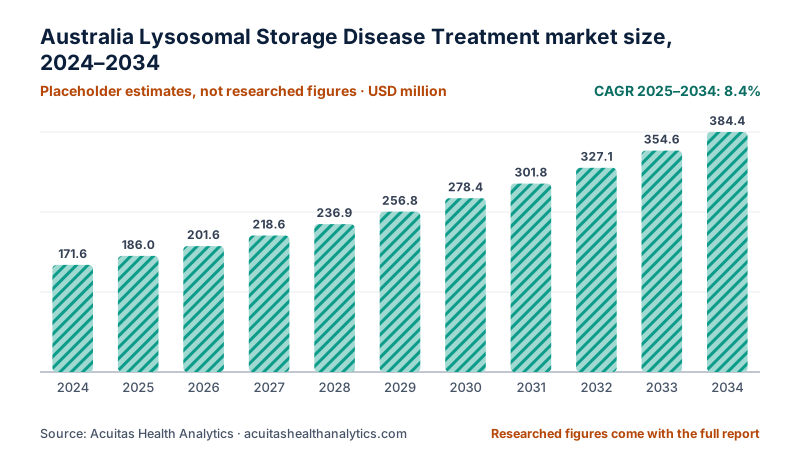
Values shown here are placeholder estimates, not researched figures. Researched 2024 historical, 2025 base-year and 2026–2034 forecast values are prepared with the full report.


 China at $1.12 Bn.
 India at 9.9% a year.
Source: Acuitas Health Analytics. Full methods, sources and usage terms come with report purchase.
$198.4 Mn total, 2026–2034
| Year | Market size | Change that year | Since 2025 |
|---|---|---|---|
| 2024 (estimate) | $171.6 Mn | — | — |
| 2025 (base) | $186.0 Mn | +$14.4 Mn | — |
| 2026 (forecast) | $201.6 Mn | +$15.6 Mn | +8.4% |
| 2027 (forecast) | $218.6 Mn | +$16.9 Mn | +17.5% |
| 2028 (forecast) | $236.9 Mn | +$18.4 Mn | +27.4% |
| 2029 (forecast) | $256.8 Mn | +$19.9 Mn | +38.1% |
| 2030 (forecast) | $278.4 Mn | +$21.6 Mn | +49.7% |
| 2031 (forecast) | $301.8 Mn | +$23.4 Mn | +62.2% |
| 2032 (forecast) | $327.1 Mn | +$25.4 Mn | +75.9% |
| 2033 (forecast) | $354.6 Mn | +$27.5 Mn | +90.6% |
| 2034 (forecast) | $384.4 Mn | +$29.8 Mn | +106.7% |
Placeholder estimates. Each year is projected from our earlier market estimate and its CAGR. Researched values come with the full report.
 US
$5.66 Bn
China
$1.12 Bn
 Canada
$963.6 Mn
 Japan
$909.7 Mn
 Germany
$440.6 Mn
 France
$422.4 Mn
 Italy
$352.3 Mn
 UK
$337.9 Mn
 Brazil
$326.0 Mn
 Ecuador
$318.0 Mn
 Spain
$274.4 Mn
India
$270.9 Mn
 Saudi Arabia
$251.9 Mn
 Mexico
$233.6 Mn
Australia (this report)
$186.0 Mn
 New Zealand
$158.7 Mn
 Russia
$156.5 Mn
 South Africa
$79.6 Mn
 UAE
$75.5 Mn
 Egypt
$36.6 Mn
 Philippines
$26.1 Mn
 Hong Kong
$22.9 Mn
 Malaysia
$20.0 Mn
 Singapore
$17.2 Mn
 Thailand
$14.4 Mn
 Kenya
$8.5 Mn
| Market size, 2025 | $186.0 Mn placeholder estimate |
|---|---|
| Forecast, 2034 | $384.4 Mn placeholder estimate |
| Growth (CAGR), 2025–2034 | 8.4% placeholder estimate |
| Years | 2024 historical · 2025 base year · 2026–2034 forecast |
| Segments | Disease, treatment and end user (see all) |
| Key players | Sanofi, Takeda Pharmaceutical Company Ltd, BioMarin, Amicus Therapeutics, Chiesi (see all) |
| Regulator in Australia | TGASource: Therapeutic Goods Administration. Checked 14 Nov 2026. |
| Formats | PDF, PPTX, XLSX |
Sizes and growth here are placeholder estimates, not researched figures. Researched figures come with the full report.
Lysosomal storage disease treatments help people with rare inherited conditions where cells cannot break down certain substances.
Key segments of the lysosomal Storage Disease Treatment market include disease (Gaucher, Fabry and Pompe) and treatment (Enzyme Replacement, Substrate Reduction and Gene Therapy).
Better genetic diagnosis, orphan drug incentives, patient advocacy and new gene and enzyme therapies are driving the lysosomal Storage Disease Treatment market. More countries now have national rare disease plans.
Newborn genome screening, gene therapies and access programmes in emerging markets give the lysosomal Storage Disease Treatment market strong growth.
Very small patient numbers, long diagnosis delays, high treatment prices and limited specialist centres hold back the lysosomal Storage Disease Treatment market.
The lysosomal Storage Disease Treatment market is moderately concentrated. Leading companies compete on product innovation, clinical evidence, pricing and geographic reach, and use partnerships and acquisitions to expand their portfolios.
Medicines must be included in the Australian Register of Therapeutic Goods (ARTG), run by the Therapeutic Goods Administration (TGA), before they can be supplied.[1] Medicare pays for public hospital care and many doctor visits, and the Pharmaceutical Benefits Scheme (PBS) subsidises listed medicines.[2]
[1] Therapeutic Goods Administration. Checked 14 Nov 2026.
[2] Pharmaceutical Benefits Scheme. Checked 14 Nov 2026.
Regulators such as the US FDA, the European Medicines Agency and national drug authorities set approval, pricing and safety rules for lysosomal Storage Disease Treatment. Reimbursement decisions by public payers and insurers shape how fast new therapies reach patients in Australia.
What doctors and scientists are doing in Lysosomal Storage Disease Treatment right now, from free public sources.
Sources: PubMed (US National Library of Medicine), ClinicalTrials.gov, World Bank. Fetched 12 Nov 2026. Papers and trials are found by search words, so the counts are a guide. Titles only; read each paper at its source.
[1] World Bank Open Data, Health spending per person (US$ per person). Retrieved 17 Nov 2026.
[2] World Bank Open Data, Doctors (per 1,000 people). Retrieved 18 Nov 2026.
[3] World Bank Open Data, People aged 65 and over (% of people). Retrieved 18 Nov 2026.
Australia · 1 shared keyword
Australia · 1 shared keyword
Australia · 1 shared keyword
Australia · 1 shared keyword
Australia · 1 shared keyword
Australia · 1 shared keyword
Digital Health · Australia
Healthcare Services · Australia
Healthcare Services · Australia
Medical Devices · Australia
Digital Health · Australia
Medical Devices · Australia