Remote patient monitoring (RPM) sends home readings, such as blood pressure, heart rhythm, oxygen and weight, to a care team. As more patients join, the data grow fast. A nurse cannot review every reading by hand. AI tools aim to help by spotting the readings and trends that matter.
How big RPM has become
In the US, Medicare RPM use increased dramatically from 2019 to 2022 [1]. Payments passed US$500 million in 2024 [2]. High blood pressure and diabetes are the most common conditions [1]. Each patient may send readings every day, which adds up to millions of data points.
What AI does in RPM
- Sorting alerts: ranking patients by risk so staff see the most urgent first.
- Spotting trends: noticing slow changes, such as rising weight in heart failure, before they become emergencies.
- Filtering noise: ignoring one-off odd readings caused by a loose cuff or a bad signal.
- Reading signals: analysing heart rhythm strips from wearables and patches.
- Predicting risk: estimating who may need a hospital visit soon.
Heart rhythm: the most mature use
Heart and brain devices are among the most common AI tools cleared by the FDA, after radiology. A 2026 study of the FDA's AI device list found that radiology, heart and brain devices made up 90.6% of records [3]. Many heart tools read ECG data from patches and watches to flag atrial fibrillation, an irregular heartbeat that raises stroke risk.
The alert problem
More data can mean more alerts, and too many alerts are ignored. OIG found that about 43% of Medicare RPM enrollees did not receive all three parts of the service, including treatment management [1]. If data are collected but not acted on, monitoring adds cost without benefit. Good AI should reduce, not increase, the number of alerts staff must handle.
Safety and trust
- AI should be tested on patients like those being monitored.
- Teams need to know why a patient was flagged.
- A human should decide on treatment changes.
- Missed alerts must be tracked and reviewed.
- Patient data must be stored and shared securely.
WHO's guidance on AI ethics stresses safety, transparency and accountability [4]. These matter even more when patients are at home and staff are not in the room.
Key numbers at a glance
- Medicare RPM payments: more than US$500 million (2024).
- 43% of Medicare RPM enrollees missed at least one service part.
- Radiology, heart and brain: 90.6% of FDA AI device records.
Questions for buyers
- Does the AI reduce the number of alerts staff handle?
- How was it tested, and on which patients?
- Can staff see why a patient was flagged?
- Who is responsible if a warning is missed?
Go deeper
Want the full picture? Our report covers market size, growth, segments, countries and the key companies. Read the report or get a free sample.
Why blood pressure data suit AI
High blood pressure is the most common reason for remote monitoring in Medicare [1]. WHO says 1.4 billion adults have it, but only 23% have it under control [5]. Home readings vary from day to day. AI can average readings, spot true rising trends and remind teams when it is time to change a medicine. This is simple, but at scale it can save a lot of staff time.
Heart failure and lung disease
Heart failure and COPD often get worse slowly before a hospital visit. Weight gain from fluid, lower activity, faster breathing or lower oxygen can be early signs. AI models that combine several signals may give earlier warning than any single reading. These uses are still being tested in trials.
Fairness
Some sensors, such as pulse oximeters, can be less accurate on darker skin. If AI learns from such data, it may miss problems in some groups. Testing tools across different populations is essential, in line with WHO's principle of inclusiveness and equity [4].
Questions for clinical teams
- How many alerts per nurse per day can we safely handle?
- Which alerts need a same-day call, and which can wait?
- How do we record what was done after each alert?
- How do we check that the AI is not missing patients?
Answering these before launch helps a programme grow without overwhelming staff.
What good looks like
A strong AI-supported monitoring programme shows fewer emergency visits, better control of blood pressure or blood sugar, and a manageable workload for staff. It also shows that patients stay engaged over months, not just weeks. These results, shared openly, are what payers and regulators will look for.
What this means
AI is becoming essential to run large home monitoring programmes. Its value lies in helping small teams focus on the right patients at the right time. The best tools will be judged by fewer hospital stays and better control of conditions, not by how much data they collect.
Where to read more
All figures in this article come from public sources listed below. For more detail, start with the HHS OIG reports on remote patient monitoring, the FDA AI-enabled device list and WHO's AI ethics guidance. Each is free to read online.
Explore on Acuitas
- Artificial Intelligence (AI) in Remote Patient Monitoring market report – size, growth and key players
- Artificial Intelligence (AI) in Remote Patient Monitoring statistics – key numbers, trials and research in one place
- Top 10 fastest-growing Digital Health markets
- Global Arrhythmia Monitoring Devices Market Analysis – related market
- Global Artificial Intelligence (AI) in Drugs Discovery Market Analysis – related market
- Global Artificial Intelligence (AI) in Healthcare Market Analysis – related market
- Get a free sample report or talk to our team
Topics: Remote monitoring and wearables · Artificial intelligence · Digital health
Sources
- HHS Office of Inspector General (Sep 2024): Additional oversight of remote patient monitoring in Medicare is needed
- HHS OIG data snapshot: Billing for remote patient monitoring in Medicare (2024 data)
- Golshani and Joseph (Cureus, 2026), via BioSpace: FDA AI device authorisations by specialty
- WHO (2021): Ethics and governance of artificial intelligence for health
- WHO fact sheet: Hypertension
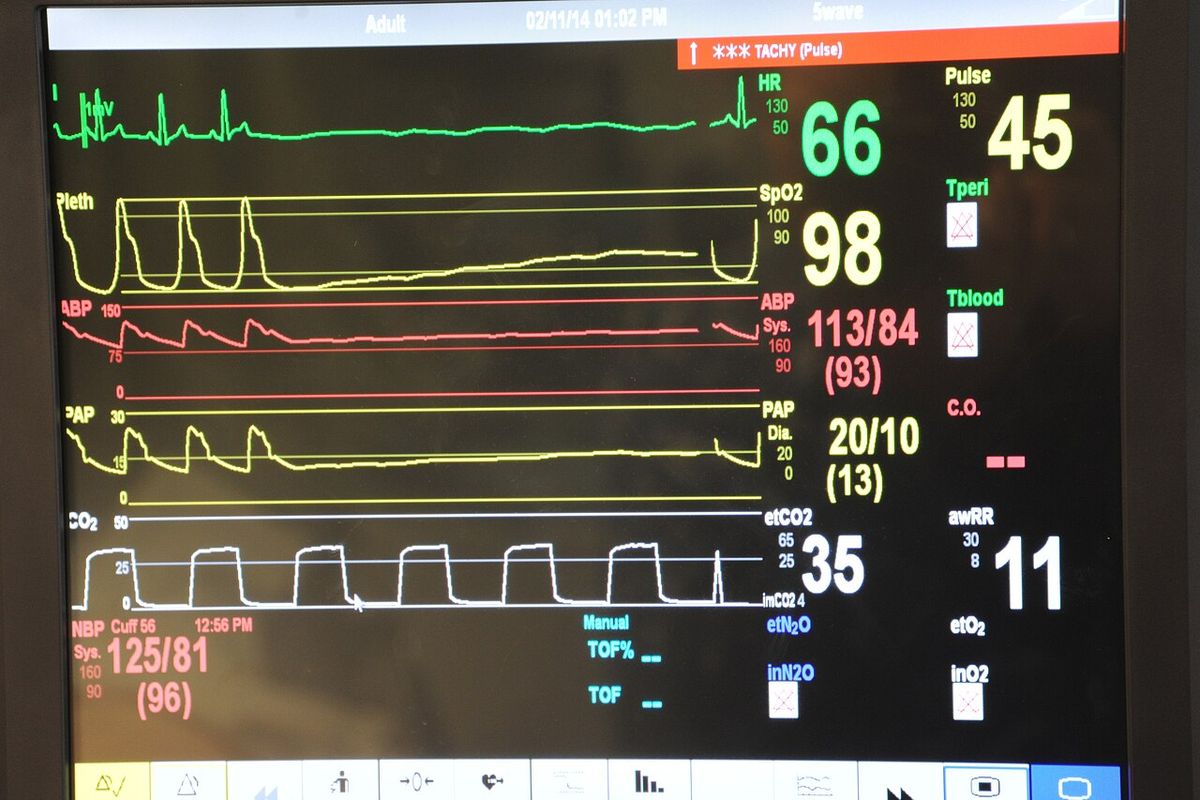
Banner image: Vital signs monitor display by Petty Officer 1st Class James Stenberg, Public domain, via Wikimedia Commons.
The data behind this story
Topics: Remote monitoring and wearables · Artificial intelligence · Digital health
Go deeper