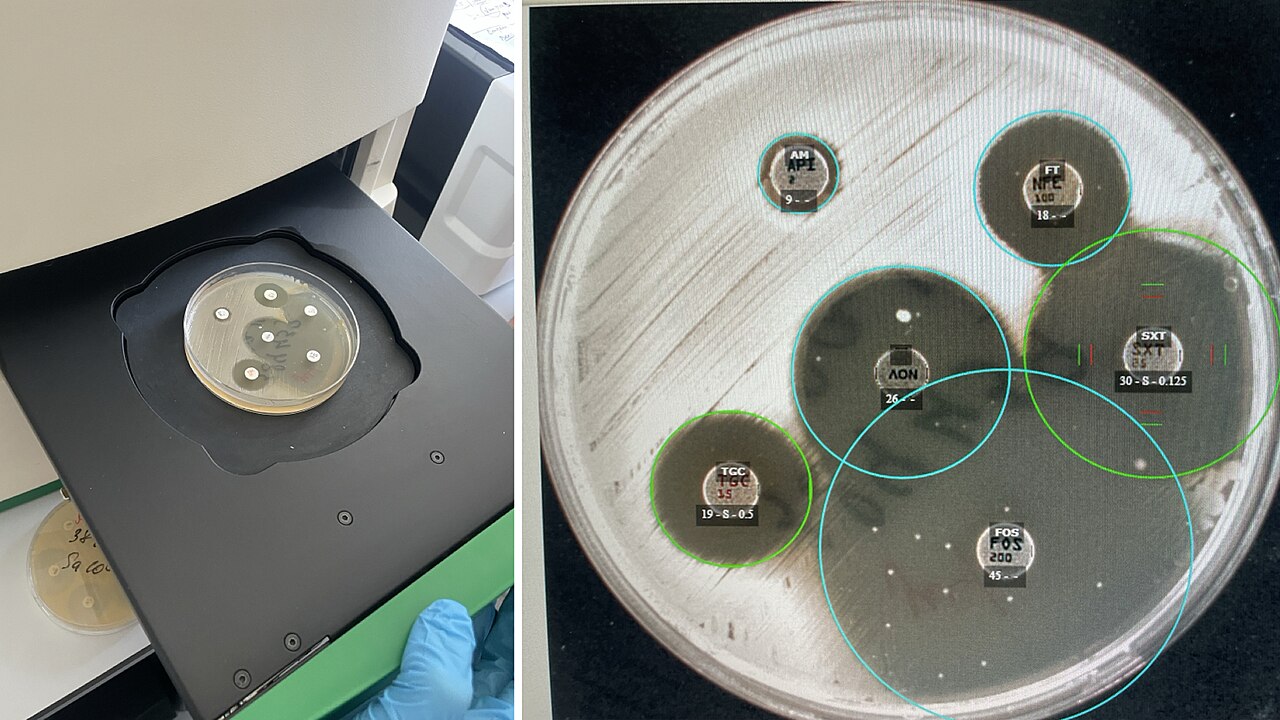
Antibiotics changed medicine. Now they are failing more often. When bacteria stop responding to the drugs meant to kill them, simple infections become dangerous. This is antimicrobial resistance (AMR), and it is one of the biggest health threats of this century.
How big is the problem?
The largest study of AMR so far, published in The Lancet in 2024, estimates that bacterial AMR was directly responsible for 1.14 million deaths in 2021, and played a part in 4.71 million deaths [1]. Without new action, it forecasts 1.91 million directly attributable deaths a year by 2050, and about 39 million deaths in total between 2025 and 2050 [1][2].
Resistance is rising, not just high
WHO's 2025 global surveillance report, built on more than 23 million confirmed infections from over 100 countries, found that one in six lab-confirmed bacterial infections in 2023 was resistant to antibiotic treatment [3][4]. Between 2018 and 2023, resistance rose in over 40% of the bug–drug combinations WHO tracks, often by 5–15% a year [5].
Why testing is part of the answer
When a patient has a serious infection, doctors often start a broad antibiotic before they know which bacteria they are fighting. Antimicrobial susceptibility testing (AST) shows which drugs will work. The sooner that answer arrives, the sooner a patient can move to the right, narrower drug.
- Better care: the right drug sooner can improve outcomes in serious infections.
- Less misuse: fewer days on broad antibiotics means less pressure on bacteria to become resistant.
- Better data: lab results feed national surveillance like WHO GLASS [4].
Traditional culture-based tests can take two to three days. Rapid methods, such as molecular tests and automated systems, aim to cut that time. The trade-off is cost and lab capacity, which are often weakest where AMR is highest.
Antibiotic use is part of the problem
WHO groups antibiotics into "Access" medicines, the first choice for most common infections, and "Watch" medicines, which carry a higher risk of resistance [6]. In 2022, Access antibiotics made up only about half of human antibiotic use [6].
In nearly one third of countries, Watch antibiotics made up more than 70% of use [6]. The global target is for at least 70% of use to come from the Access group by 2030 [6]. Faster tests help doctors pick a narrow, first-choice antibiotic with confidence.
Where resistance is worst
Resistance is highest in the WHO South-East Asia and Eastern Mediterranean regions, where 1 in 3 reported infections were resistant [6]. Between 2018 and 2023, resistance rose in more than 40% of the pathogen and antibiotic pairs WHO tracks, by 5–15% a year on average [6]. E. coli and K. pneumoniae are the leading drug-resistant bacteria in bloodstream infections [6].
Beyond bacteria
- Gonorrhoea: resistance to ciprofloxacin is very high, at 75% [6].
- TB: 3.2% of new TB cases and 16% of previously treated cases were drug-resistant in 2024 [6].
- Fungi: drug-resistant Candidozyma auris and Aspergillus are a growing concern [6].
- Malaria: partial resistance to artemisinin makes treatment choices harder [6].
The cost
With current action, treating resistant bacterial infections alone is expected to cost US$412 billion a year up to 2035, with another US$443 billion a year in lost productivity [6]. Resistant infections mean longer hospital stays, more intensive care and more tests [6].
The global plan
WHO's Global action plan on AMR 2026–2036 aims to help meet the 2024 UN target of cutting AMR-linked deaths by 10% by 2030 [6]. It uses a One Health approach, linking human, animal and plant health and the environment [6]. Stronger surveillance and lab networks are one of its six goals [6].
Key numbers at a glance
- More than 4.7 million deaths linked to bacterial AMR in 2021.
- 1 in 6 lab-confirmed bacterial infections resistant in 2023.
- 1 in 3 in South-East Asia and the Eastern Mediterranean.
- Access antibiotics: 53% of use, against a 70% target.
Where to read more
All figures in this article come from public sources listed below. For more detail, start with the WHO fact sheet on antimicrobial resistance and WHO's Global antibiotic resistance surveillance report 2025. Each is free to read online.
Six goals of the global plan
- Raise awareness and change behaviour to lower AMR risks [6].
- Strengthen surveillance systems and laboratory networks [6].
- Prevent infections in all sectors, cutting the need for antimicrobials [6].
- Ensure fair access to, good use of and safe disposal of antimicrobials and diagnostics [6].
- Speed up research and new products [6].
- Build governance, steady funding and accountability [6].
Goals 2 and 4 depend directly on diagnostic tests. Without labs that can identify bacteria and test resistance, countries cannot track AMR or use antibiotics well.
Animals, farms and food
Drug-resistant infections also affect animals and plants, and lower farm output, which threatens food security [6]. WHO links AMR to poor access to clean water, sanitation and hygiene, and weak infection control in homes, clinics and farms [6]. This is why the global plan covers human, animal and plant health together [6].
What this means
AMR is a health system problem, not only a drug problem. Prevention (clean water, vaccines, infection control), careful antibiotic use and strong labs all matter. For diagnostics companies and health systems, testing capacity in low- and middle-income countries is the big gap and the big opportunity.
Explore on Acuitas
- Antimicrobial Susceptibility Testing market report – size, growth and key players
- Antimicrobial Susceptibility Testing statistics – key numbers, trials and research in one place
- Top 10 fastest-growing Healthcare Services markets
- Global Acute Care Needleless Connectors Market Analysis – related market
- Global Alzheimers Dignostic Market Analysis – related market
- Global Aminoglycosides Market Analysis – related market
- Antibiotic use – free chart in the Public Health Dashboard
- Medicine sales: anti-infectives – free chart in the Public Health Dashboard
- Get a free sample report or talk to our team
Topics: Antibiotics · Infectious diseases · Diagnostics and lab testing
Sources
- GBD 2021 AMR Collaborators. Global burden of bacterial antimicrobial resistance 1990–2021, with forecasts to 2050. The Lancet, 2024
- IHME summary of the 2024 GRAM study
- WHO news release, 13 Oct 2025: Global antibiotic resistance surveillance report 2025 (GLASS)
- WHO. Global antibiotic resistance surveillance report 2025
- UN News, Oct 2025: Antibiotic resistance surges globally
- WHO fact sheet: Antimicrobial resistance
Banner image: Antibiotic Sensitivity Testing Plate reader by Bondarev.gal, CC BY 4.0, via Wikimedia Commons.
The data behind this story
Topics: Antibiotics · Infectious diseases · Diagnostics and lab testing
Go deeper