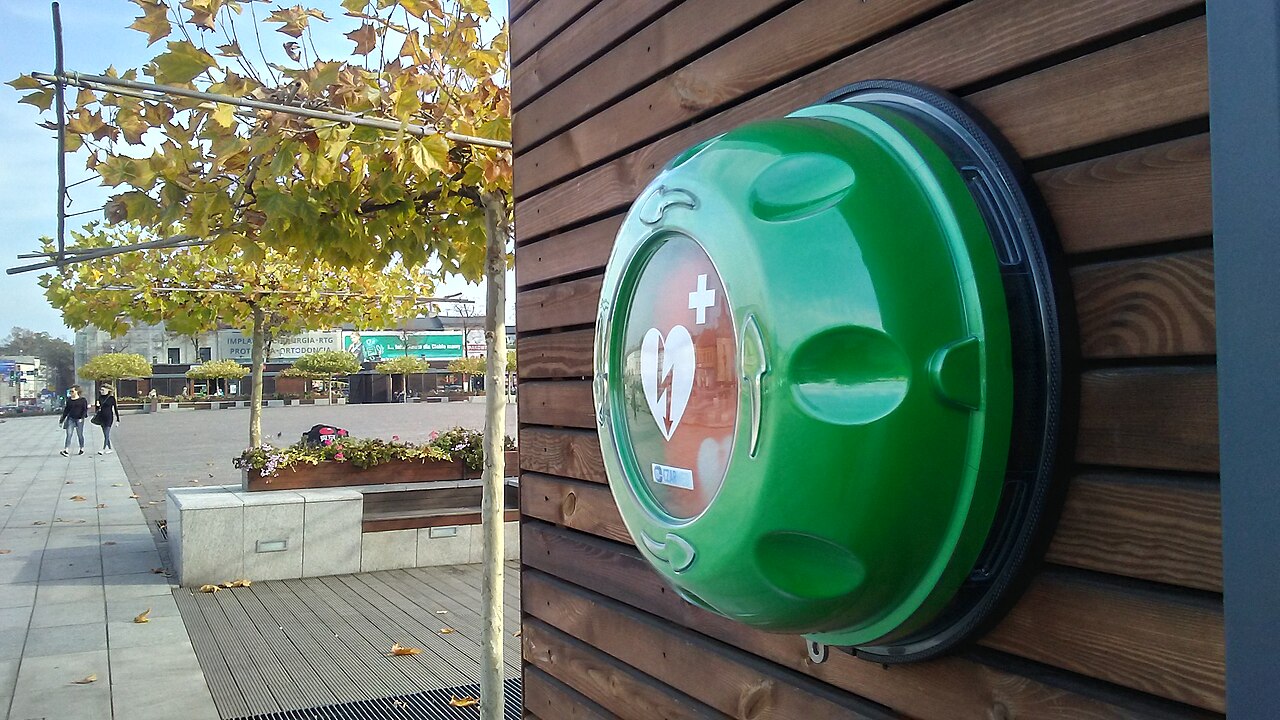
In a cardiac arrest, the heart suddenly stops pumping. Without help, a person dies within minutes. Two things save lives: someone starting CPR right away, and a shock from a defibrillator. Public-access defibrillators, called AEDs, are built so anyone can use them.
The numbers
The American Heart Association reports that only about 10% of people who have a cardiac arrest outside hospital survive [1]. CPR started right away can double or triple the chance of survival [1]. Yet in the US only about 40% of these patients get bystander CPR [2].
How an AED works
An AED talks the user through each step. It checks the heart rhythm and only gives a shock if one is needed. Pads go on the chest, and the device does the rest.
What makes programmes work
- AEDs in busy places: stations, airports, malls, offices, schools and sports grounds.
- Clear signs and a registry so emergency call takers can direct people to the nearest AED.
- CPR training for the public, including school children.
- Regular checks so batteries and pads are ready.
The AHA aims to double out-of-hospital survival from 9% to 20% by 2030, partly by expanding public AED use [3].
Go deeper
Want the full picture? Our report covers market size, growth, segments, countries and the key companies. Read the report or get a free sample.
The size of the problem in the US
The American Heart Association says more than 350,000 cardiac arrests happen outside hospitals in the US each year, and 90% are fatal [4]. More than 23,000 of these are in children, and 40% of those are linked to sport [4].
Survival is much higher in hospital, where staff and defibrillators are close by [5]. That gap shows what speed can do.
Every minute counts
The AHA says the chance of survival falls by about 10% for every minute without CPR while waiting for an ambulance [6]. Ambulances often take several minutes to arrive. A bystander who starts CPR and uses a nearby AED fills that gap.
AEDs in schools
The AHA reports that in schools with AEDs, about 70% of children survive cardiac arrest. That is about seven times the overall survival rate for children [7]. Some US states are moving to require schools to have cardiac emergency response plans, with AEDs, trained staff and practice drills [7].
New guidelines
The AHA published updated CPR and emergency heart care guidelines in 2025 [5]. They are built around a "formula for survival": good science, good training and good local systems all working together [5].
Steps anyone can take
- Call emergency services.
- Start chest compressions: push hard and fast in the centre of the chest.
- Send someone to get the nearest AED.
- Turn the AED on and follow its voice prompts.
- Keep going until help arrives.
Key numbers at a glance
- More than 350,000 out-of-hospital cardiac arrests a year in the US.
- Only about 10% survive.
- Survival falls about 10% per minute without CPR.
- About 70% of children survive in schools with AEDs.
Heart disease is the bigger picture
The AHA reports that between 2017 and 2020, 127.9 million US adults, or 48.6%, had some form of cardiovascular disease [8]. Heart disease and stroke caused more US deaths in 2022 than all cancers and chronic lung disease combined [8]. Cardiovascular disease cost the US about US$417.9 billion in 2020–2021 [8]. Many cardiac arrests happen in people with heart disease they did not know about.
Making AEDs easy to find
- Put AEDs in clear, signed places, near busy areas, and unlocked during opening hours.
- Register them so emergency call takers can tell callers where the nearest one is.
- Check batteries and pads on a set schedule.
- Train staff and drill the plan, just as for fire safety.
CPR training for everyone
Immediate CPR can double or triple the chance of survival [2]. The AHA wants many more people trained, through its Nation of Lifesavers goals [3]. Hands-only CPR is simple to learn. Short courses in schools and workplaces reach large numbers of people at low cost.
Children and sport
About 40% of cardiac arrests in US children are linked to sport [4]. Sports clubs, gyms and stadiums are key places for AEDs. Coaches and referees trained in CPR can act in the first minutes.
Where to read more
All figures in this article come from public sources listed below. For more detail, start with the American Heart Association's CPR facts and its 2025 heart disease and stroke statistics. Each is free to read online.
Questions to ask your health worker
- Where is the nearest AED at my work, school or gym?
- Who checks it and how often?
- Is there CPR training on site?
- Is our AED on the local emergency register?
Writing these down before a visit helps make the most of a short appointment.
What this means
Cardiac arrest survival is a test of a whole system: the public, call takers, ambulances and hospitals. For India and other countries building emergency care, public AEDs and CPR training are a low-cost, high-impact step.
Explore on Acuitas
- Defibrillator market report – size, growth and key players
- Defibrillator statistics – key numbers, trials and research in one place
- Top 10 fastest-growing Medical Devices markets
- Global Air Ambulance Life Support Solutions Market Analysis – related market
- Global Airway Management Devices Market Analysis – related market
- Global Alexipharmic Drugs Market Analysis – related market
- Chance of dying 30–70 from heart disease, cancer, diabetes or lung disease – free chart in the Public Health Dashboard
- Clinical trials: Heart and blood vessels – free chart in the Public Health Dashboard
- Get a free sample report or talk to our team
Topics: Cardiovascular · Emergency and acute care
Sources
- American Heart Association: Treatment of cardiac arrest
- American Heart Association: CPR facts and stats
- American Heart Association: Nation of Lifesavers goals
- American Heart Association newsroom: CPR & AED Awareness Week underscores need to fund HEARTS Act
- American Heart Association: 2025 Guidelines for CPR and Emergency Cardiovascular Care
- American Heart Association: AED implementation
- American Heart Association newsroom: Cardiac emergency response plans in schools
- American Heart Association: 2025 Heart Disease and Stroke Statistics – at a glance
Banner image: Automated external defibrillator (AED) Automatyczny defibrylator zewnętrzny, Tomaszów Maz… by Warszawska róg Szerokiej w Tomaszowie Mazowieckim w wojewód…, CC0, via Wikimedia Commons.
The data behind this story
Topics: Cardiovascular · Emergency and acute care
Go deeper