Tissue Engineering
Africa · 1 shared keyword
Updated
 Reviewed by Chandani Patel
Africa Wound Care Biologics Market Industry Trends and Forecast to 2034: Segmented by (Product, Wound, End User, Region) - Growth, Market Size, Future Prospects & Competitive Analysis, 2024-2034
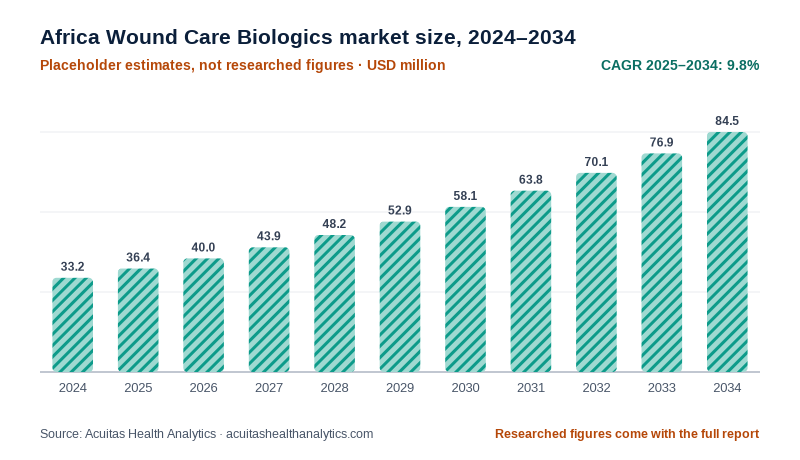
Values shown here are placeholder estimates, not researched figures. Researched 2024 historical, 2025 base-year and 2026–2034 forecast values are prepared with the full report.


Source: Acuitas Health Analytics. Full methods, sources and usage terms come with report purchase.
$48.0 Mn total, 2026–2034
| Year | Market size | Change that year | Since 2025 |
|---|---|---|---|
| 2024 (estimate) | $33.2 Mn | — | — |
| 2025 (base) | $36.4 Mn | +$3.2 Mn | — |
| 2026 (forecast) | $40.0 Mn | +$3.6 Mn | +9.8% |
| 2027 (forecast) | $43.9 Mn | +$3.9 Mn | +20.6% |
| 2028 (forecast) | $48.2 Mn | +$4.3 Mn | +32.4% |
| 2029 (forecast) | $52.9 Mn | +$4.7 Mn | +45.3% |
| 2030 (forecast) | $58.1 Mn | +$5.2 Mn | +59.6% |
| 2031 (forecast) | $63.8 Mn | +$5.7 Mn | +75.2% |
| 2032 (forecast) | $70.1 Mn | +$6.3 Mn | +92.4% |
| 2033 (forecast) | $76.9 Mn | +$6.9 Mn | +111.3% |
| 2034 (forecast) | $84.5 Mn | +$7.5 Mn | +132% |
Placeholder estimates. Each year is projected from our earlier market estimate and its CAGR. Researched values come with the full report.
 US
$1.10 Bn
 China
$211.5 Mn
 Canada
$203.9 Mn
 Japan
$144.6 Mn
 Germany
$101.0 Mn
 France
$77.6 Mn
 Brazil
$73.0 Mn
 UK
$57.3 Mn
 Ecuador
$58.8 Mn
 Italy
$53.2 Mn
 Spain
$46.4 Mn
 Saudi Arabia
$47.4 Mn
 India
$47.8 Mn
 Mexico
$41.2 Mn
 Australia
$33.0 Mn
 New Zealand
$28.6 Mn
 Russia
$26.0 Mn
 South Africa
$19.1 Mn
 UAE
$14.8 Mn
 Egypt
$7.6 Mn
 Philippines
$5.2 Mn
 Malaysia
$4.5 Mn
 Hong Kong
$3.9 Mn
 Singapore
$3.1 Mn
 Thailand
$2.9 Mn
 Kenya
$1.7 Mn
| Market size, 2025 | $36.4 Mn placeholder estimate |
|---|---|
| Forecast, 2034 | $84.5 Mn placeholder estimate |
| Growth (CAGR), 2025–2034 | 9.8% placeholder estimate |
| Years | 2024 historical · 2025 base year · 2026–2034 forecast |
| Segments | Product, wound and end user (see all) |
| Key players | Organogenesis, MiMedx, Smith & Nephew, Integra Life Sciences Corporation, Vericel (see all) |
| Regulator in Africa | AMASource: African Union, African Medicines Agency treaty. Checked 14 Nov 2026. |
| Formats | PDF, PPTX, XLSX |
Sizes and growth here are placeholder estimates, not researched figures. Researched figures come with the full report.
Wound care biologics use living or natural materials such as skin substitutes and growth factors to heal hard-to-heal wounds.
Key segments of the wound Care Biologics market include product (Skin Substitutes, Growth Factors and Amniotic Membranes) and wound (Diabetic Foot Ulcers, Venous Leg Ulcers and Burns).
More surgery and intensive care, rising infection risks, new specialty medicines and the growth of hospital pharmacy services are driving the wound Care Biologics market.
Ready-to-use formulations, biosimilars and supply security programmes give the wound Care Biologics market room to grow.
Drug shortages, price controls, generic competition and strict hospital budgets hold back the wound Care Biologics market.
The wound Care Biologics market is moderately concentrated. Leading companies compete on product innovation, clinical evidence, pricing and geographic reach, and use partnerships and acquisitions to expand their portfolios.
The African Medicines Agency (AMA) treaty covers medical devices and diagnostics as well as medicines; national regulators still approve products.[1] In some of the countries we cover here, medical devices are regulated by EDA (Egypt)[2], PPB (Kenya)[3], SAHPRA (South Africa)[4] and NAFDAC (Nigeria)[5]. How care is paid for in some of these countries: universal health insurance (Egypt)[6], the SHA (Kenya)[7], planned National Health Insurance (South Africa)[8] and out of pocket and the NHIA (Nigeria)[9].
[1] African Union, African Medicines Agency treaty. Checked 14 Nov 2026.
[2] Egyptian Drug Authority. Checked 14 Nov 2026.
[3] Pharmacy and Poisons Board. Checked 14 Nov 2026.
[4] South African Health Products Regulatory Authority. Checked 14 Nov 2026.
[5] NAFDAC. Checked 19 Nov 2026.
[6] Universal Health Insurance Authority. Checked 14 Nov 2026.
[7] Social Health Authority. Checked 14 Nov 2026.
[8] National Department of Health. Checked 14 Nov 2026.
[9] National Health Insurance Authority (NHIA). Checked 19 Nov 2026.
Medical device rules, such as the US FDA 510(k) and PMA pathways and the EU Medical Device Regulation, govern how wound Care Biologics products are approved and monitored. Reimbursement codes and hospital purchasing policies decide how widely they are used in Africa.
What doctors and scientists are doing in Wound Care Biologics right now, from free public sources.
Sources: PubMed (US National Library of Medicine), ClinicalTrials.gov. Fetched 12 Nov 2026. Papers and trials are found by search words, so the counts are a guide. Titles only; read each paper at its source.
From our blog
Africa · 1 shared keyword
Africa · 1 shared keyword
Africa · 1 shared keyword
Africa
Africa
Africa
Pharmaceuticals · Africa
Pharmaceuticals · Africa
Pharmaceuticals · Africa
Pharmaceuticals · Africa
Pharmaceuticals · Africa
Pharmaceuticals · Africa