UAE at a glance
- Population
- 11.5 million 2025
- Life expectancy at birth
- 83.1 years, 2024
- People aged 65 and over
- 1.8 % of people, 2025
- Health spending per person
- 2,402 US$ per person, 2023
- Doctors
- 2.99 per 1,000 people, 2023
 UAE
Updated
 Reviewed by Chandani Patel
UAE Anesthesia Monitoring Devices Market Analysis Industry Trends and Forecast to 2034: Segmented by (By Product Type, By End User, By Region) - Growth, Market Size, Future Prospects & Competitive Analysis, 2024-2034
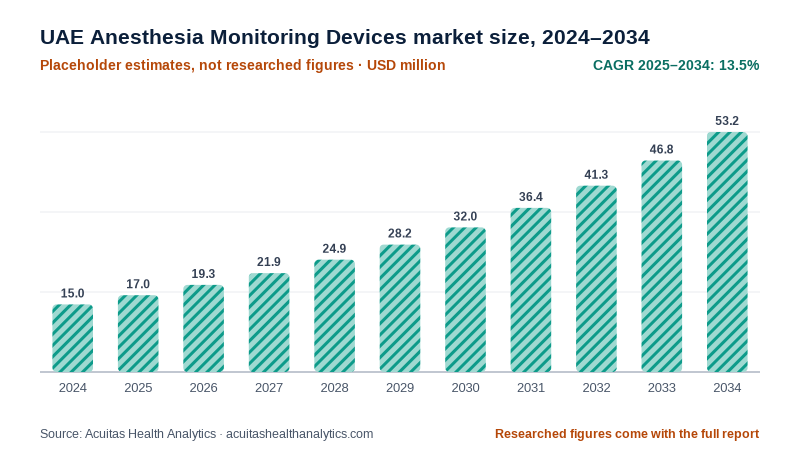
UAE · 2024–2034 · placeholder estimates
Values shown here are placeholder estimates, not researched figures. Researched 2024 historical, 2025 base-year and 2026–2034 forecast values are prepared with the full report.
 Saudi Arabia at $58.4 Mn. Saudi Arabia at 14% a year.
Source: Acuitas Health Analytics. Full methods, sources and usage terms come with report purchase.
$36.1 Mn total, 2026–2034
| Year | Market size | Change that year | Since 2025 |
|---|---|---|---|
| 2024 (estimate) | $15.0 Mn | — | — |
| 2025 (base) | $17.0 Mn | +$2.0 Mn | — |
| 2026 (forecast) | $19.3 Mn | +$2.3 Mn | +13.5% |
| 2027 (forecast) | $21.9 Mn | +$2.6 Mn | +28.8% |
| 2028 (forecast) | $24.9 Mn | +$3.0 Mn | +46.2% |
| 2029 (forecast) | $28.2 Mn | +$3.4 Mn | +66% |
| 2030 (forecast) | $32.0 Mn | +$3.8 Mn | +88.4% |
| 2031 (forecast) | $36.4 Mn | +$4.3 Mn | +113.8% |
| 2032 (forecast) | $41.3 Mn | +$4.9 Mn | +142.6% |
| 2033 (forecast) | $46.8 Mn | +$5.6 Mn | +175.4% |
| 2034 (forecast) | $53.2 Mn | +$6.3 Mn | +212.6% |
Placeholder estimates. Each year is projected from our earlier market estimate and its CAGR. Researched values come with the full report.
 US
$1.35 Bn
 China
$275.8 Mn
 Canada
$267.3 Mn
 Japan
$209.5 Mn
 Germany
$118.4 Mn
 France
$90.3 Mn
 UK
$83.8 Mn
 Brazil
$85.0 Mn
 Italy
$79.5 Mn
 Ecuador
$67.6 Mn
 Spain
$63.4 Mn
 India
$64.0 Mn
Saudi Arabia
$58.4 Mn
 Mexico
$50.3 Mn
 Australia
$41.2 Mn
 South Africa
$22.2 Mn
UAE (this report)
$17.0 Mn
 Egypt
$9.6 Mn
 Philippines
$7.4 Mn
 Hong Kong
$5.4 Mn
 Malaysia
$5.3 Mn
 Singapore
$4.1 Mn
 Thailand
$4.1 Mn
 Kenya
$2.3 Mn
| Market size, 2025 | $17.0 Mn placeholder estimate |
|---|---|
| Forecast, 2034 | $53.2 Mn placeholder estimate |
| Growth (CAGR), 2025–2034 | 13.5% placeholder estimate |
| Years | 2024 historical · 2025 base year · 2026–2034 forecast |
| Segments | Product type and end user (see all) |
| Key players | Mindray Medical International Limited, Drägerwerk AG & Co. KGaA, GE Healthcare, Koninklijke Philips N.V., Masimo Corporation and 1 more (see all) |
| Regulator in the UAE | EDESource: Emirates Drug Establishment. Checked 14 Nov 2026. |
| Formats | PDF, PPTX, XLSX |
Sizes and growth here are placeholder estimates, not researched figures. Researched figures come with the full report.
Factor that is integral to anesthesia care is the process of monitoring. All forms of anesthesia require clinicians to constantly observe patient’s physiologic status and the anesthesia equipment because the patient’s vital functions may be quickly and dramatically deranged by the surgery and/or the anesthetic. AMA is utilized to determine the appropriate dosage of anesthetic medication regarding patient’s conditions, maintain vital signs in normal ranges and prevent adverse effects in the patient, and to prevent life-threatening complications due to equipment failure.
The devices used to monitor anesthesia is a fast-growing market due to the growing technology and growing concern for patient safety. This market comprises devices such as anesthesia machines, monitoring devices, and delivery systems, and advanced features include AI and real-time data monitoring. Some of these include; portable devices and the increasing rigidity of the regulatory environment. North America has the largest share of the market; Europe and Asia-Pacific come next with other emerging markets also gaining ground. However, there are threats like high costs of operation and regulation that can be managed by opening up innovative technologies, integrating with other systems, and expanding into developing markets. The major players operating in the market are Medtronic, GE Healthcare, Philips Healthcare, Drägerwerk AG, and Mindray.
The global market for anesthesia monitoring devices is expanding because of increased surgeries, older patient population, client demanding more innovative technology, and wireless connectivity and enhanced sensing technology. The need to address patient safety concerns, the growth of healthcare facilities, and the growth of healthcare expenditure, especially in developing countries, are also contributing to market growth. Furthermore, the transition toward minimally invasive procedures that necessitate precise anesthetic tracking is another primary driver stimulating advanced anesthesia monitoring systems market.
Further growth prospects in the anesthesia monitoring devices market are advancement in the area of technology such as wireless capabilities and non-invasive monitoring, expanding markets in the developing nations with growing healthcare sectors, and convergence with telemedicine for remote control monitoring. Secondly, increasing consumer concern with patient safety, favourable legislation, and a growing proportion of the elderly who may require surgery are other factors that can unlock the growth of the market.
The market has some limitations and risks for its development, for example, high costs of anesthesia monitoring devices that can be out of reach for many hospitals, especially in the developing countries. Another factor is that expensive conventional methods are more affordable when compared to sophisticated systems. Further, the costs associated with personnel training and the issue of economic limitations affect investment in new technologies. Stringent regulations also add to the constraints since they can slow down the pace of innovation and access to the market.
 Mindray Medical International Limited
 GE Healthcare
 Koninklijke Philips N.V.
 Schiller AG
August 2025, Mindray Introduced Innovative Upgrades to A Series Anesthesia Systems for Enhanced Patient Safety and Efficiency.
April 2022, GE Healthcare Received FDA Approval of First-Ever Software to Help Automate Anesthesia Delivery and Reduce Greenhouse Gas Emissions During Surgery.
October 2021, Mindray launched the A9 anesthesia monitor, equipped with a large 15-inch high-definition display, advanced monitoring capabilities, and an intuitive user interface designed to improve patient safety and streamline workflow efficiency in the operating room.
The Emirates Drug Establishment (EDE), set up in 2023, is taking over the regulation of medical devices from the Ministry of Health and Prevention.[1] Since January 2025, basic health insurance has been mandatory for all private-sector employees and domestic workers in every emirate.[2]
[1] Emirates Drug Establishment. Checked 14 Nov 2026.
[2] Ministry of Human Resources and Emiratisation. Checked 14 Nov 2026.
The anesthesia monitoring devices market has dynamics in the form of evolving regulations that increases the safety of patients but at the same time slows product development. Governments are playing a crucial role in funding new technologies and improving infrastructures especially in developing nations. There is a special emphasis on the patient safety trend that is promoting the incorporation of more efficient monitoring equipment, due in part to beneficial reimbursement policies in the developed areas. However, the level of reimbursement in the developing world restricts the use of these technologies. COVID-19 highlighted the need for more sophisticated remote-monitoring capabilities, and the focus on value-based care means that device makers need to show that their products provide added value to achieve reimbursement.
What doctors and scientists are doing in Anesthesia Monitoring Devices right now, from free public sources.
Sources: PubMed (US National Library of Medicine), ClinicalTrials.gov, World Bank. Fetched 9 Nov 2026. Papers and trials are found by search words, so the counts are a guide. Titles only; read each paper at its source.
[1] World Bank Open Data, Health spending per person (US$ per person). Retrieved 22 Nov 2026.
[2] World Bank Open Data, Doctors (per 1,000 people). Retrieved 22 Nov 2026.
[3] World Bank Open Data, People aged 65 and over (% of people). Retrieved 22 Nov 2026.
From our blog
UAE · 2 shared keywords
UAE · 1 shared keyword
UAE
UAE
UAE
UAE
Digital Health · UAE
Digital Health · UAE
Healthcare Services · UAE
Healthcare Services · UAE
Pharmaceuticals · UAE
Pharmaceuticals · UAE