US Dental Diagnostic and Surgical Equipment Market Industry Trends and Forecast to 2034: Segmented by (Product Type, End-user, Region) - Growth, Market Size, Future Prospects & Competitive Analysis, 2024-2034F
Overview
Market Dashboard
US · 2024–2034 · placeholder estimates
Values shown here are placeholder estimates, not researched figures. Researched 2024 historical, 2025 base-year and 2026–2034 forecast values are prepared with the
full report.
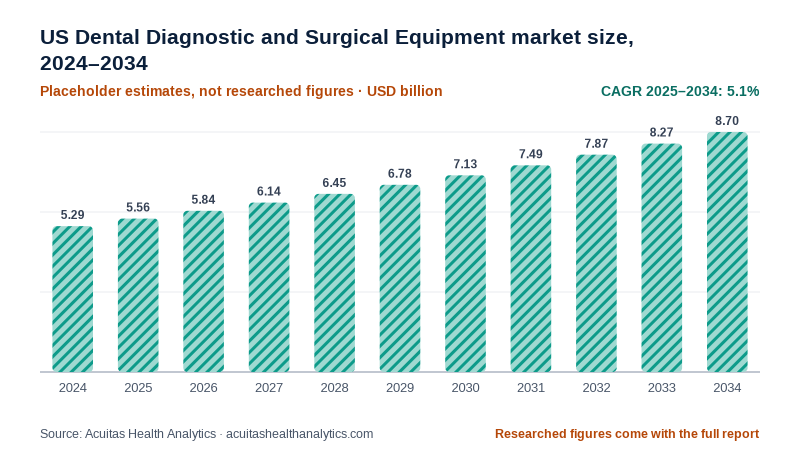
Estimate 2024$5.29 BnPlaceholder estimate
Estimate 2025$5.56 Bn40.4% of the global market
Projected 2034$8.70 Bn 56.5%Adds $3.14 Bn over 9 forecast years
CAGR 2025–20345.1%Faster than 35% of 215 Medical Devices markets here
Sizes and growth here are placeholder estimates, not researched figures. Researched figures come with the full report.
The US Dental Diagnostic and Surgical Equipment Market Analysis Executive Summary
The Dental Diagnostic and Surgical Equipment Market encompass a comprehensive range of tools and instruments essential for diagnosing and treating dental diseases and disorders. This market includes dental diagnostic equipment such as imaging systems (X-ray machines, Cone Beam Computed Tomography, and digital radiography), intraoral cameras for capturing high-resolution images, and various diagnostic tools like periodontal probes and caries detection devices. Additionally, it features dental surgical equipment, including surgical instruments for extractions and implants, laser dentistry tools for soft tissue surgeries, and ergonomically designed dental chairs that enhance patient comfort during procedures.
The industry is characterized by continuous technological advancements, with innovations such as artificial intelligence in diagnostics and the use of 3D printing for dental implants driving growth. There is also a growing trend toward minimally invasive procedures, which reduce recovery times and improve patient comfort, further boosting demand for advanced surgical tools. The rising popularity of aesthetic dentistry contributes to the need for sophisticated diagnostic and surgical equipment that enhances treatment outcomes. Moreover, the COVID-19 pandemic accelerated the adoption of tele-dentistry, increasing the demand for diagnostic tools that can be used in remote consultations. Overall, the Dental Diagnostic and Surgical Equipment Market is evolving rapidly, shaped by technological progress, changing patient needs, and a heightened focus on preventive and aesthetic dental care.
US Dental Diagnostic and Surgical Equipment market size, 2024–2034. Placeholder estimates; researched figures come with the full report. Source: Acuitas Health Analytics.
US Dental Diagnostic and Surgical Equipment Market Dynamics
Market Growth Drivers
The Dental Diagnostic and Surgical Equipment Market is driven by several key factors that significantly influence its growth and development. One of the primary drivers is the increasing prevalence of dental diseases, such as dental caries and periodontal diseases, which necessitate advanced diagnostic and surgical tools for effective treatment. As the global population continues to grow, particularly among the aging demographic, the demand for dental care services is rising, leading to an increased need for sophisticated equipment. Additionally, technological advancements in dental diagnostics and surgical procedures, such as the integration of digital imaging, artificial intelligence, and laser technologies, are enhancing the accuracy and efficiency of dental treatments, further propelling market growth.
Another critical driver is the growing emphasis on preventive dental care and aesthetic dentistry. Patients are increasingly seeking regular check-ups and cosmetic procedures, which require advanced diagnostic tools and surgical instruments. Furthermore, supportive government initiatives and investments in dental healthcare infrastructure are contributing to the market's expansion. As dental practices adopt innovative technologies and prioritize patient comfort and outcomes, the Dental Diagnostic and Surgical Equipment Market is expected to experience significant growth in the coming years
Market Restraints
The Dental Diagnostic and Surgical Equipment Market faces several key restraints that could hinder its growth and adoption by dental professionals. One significant challenge is the high cost associated with advanced diagnostic technologies, as many of these devices, such as laser fluorescence systems and digital imaging tools, can be expensive for dental practices, particularly smaller clinics with limited budgets. This financial barrier may prevent some practitioners from investing in these innovative solutions, leading to slower adoption rates in the market. Additionally, there is a lack of awareness and training among dental professionals regarding the latest caries detection technologies, with many still relying on traditional methods due to familiarity or insufficient knowledge of new devices. This reliance on outdated techniques can limit the market's expansion, as the benefits of advanced caries detectors may not be fully realized. Furthermore, regulatory hurdles and the need for compliance with stringent health and safety standards can also slow down the introduction of new products into the market. Overall, these restraints present significant challenges that the dental caries detectors market must overcome to achieve sustained growth and innovation.
Competitive Landscape for Dental Diagnostic and Surgical Equipment Market in the US
June 2024: Johnson & Johnson announced its acquisition of Shockwave Medical, a company specializing in innovative cardiovascular devices, for US$3.4 Bn. This acquisition aims to enhance Johnson & Johnson's portfolio in the medical device sector, potentially impacting dental surgical tools as well.
Mergers and Acquisitions
April 2024: Dentsply Sirona entered into a strategic partnership with Align Technology to integrate their technologies, focusing on improving digital workflows in dental practices. This collaboration aims to enhance patient outcomes through advanced diagnostic and treatment solutions.
March 2024: 3M Company completed its acquisition of Acelity, a leader in advanced wound care, for US$6.7 Bn. While primarily focused on wound care, the acquisition is expected to bolster 3M's medical device offerings, which may include dental applications.
February 2024: Planmeca Oy announced a partnership with Dental Monitoring, a company specializing in remote monitoring solutions, to enhance the integration of digital technologies in dental diagnostics and treatments.
January 2024: Henry Schein, Inc. acquired Benco Dental, a leading dental distributor, for US$1.2 BN. Thns acquisition is aimed at expanding Henry Schein's reach in the dental market and enhancing its product offerings, including diagnostic and surgical equipment.
Healthcare Policies and Regulatory Landscape for Dental Diagnostic and Surgical Equipment Market in the US
Dental Diagnostic and Surgical Equipment in the US: rules and payment
The FDA clears or approves medical devices by risk class, through 510(k) clearance, De Novo classification or premarket approval (PMA).[1] Medicare covers people aged 65 and over and some younger people with disabilities, and Medicaid covers many people on low incomes; both are run with the Centers for Medicare & Medicaid Services (CMS).[2]
The overall healthcare policies, reimbursement mechanisms, and regulatory landscape for dental diagnostic and surgical equipment are critical components that influence the delivery of dental care and the adoption of innovative technologies. Healthcare policies aim to ensure that dental services are accessible, affordable, and of high quality. In many countries, these policies are shaped by government initiatives that promote preventive care and integrate oral health into broader health programs. For instance, the National Oral Health Policy in India emphasizes the importance of oral health in public health frameworks and aims to improve access to dental services through strategic funding and resource allocation. Similarly, the Medical Device Regulation (MDR) in the European Union imposes stringent requirements on manufacturers to ensure that dental devices meet high safety and efficacy standards before they can be marketed, fostering innovation while protecting patient safety.
Reimbursement mechanisms play a significant role in determining how dental services and technologies are funded and utilized. Various payment models, such as fee-for-service (FFS), capitation, and pay-for-performance (P4P), influence the financial viability of dental practices and the adoption of new technologies. Reimbursement policies can either incentivize or limit the use of innovative dental equipment based on assessed value and cost-effectiveness. For example, effective reimbursement can encourage the adoption of advanced diagnostic tools by ensuring that providers are compensated for their use, while inadequate reimbursement may hinder access to essential technologies. As the healthcare landscape continues to evolve, understanding the interplay between healthcare policies, reimbursement strategies, and regulatory requirements will be crucial for stakeholders in the dental industry to navigate challenges and leverage opportunities for growth and innovation.
Sources:PubMed (US National Library of Medicine),
ClinicalTrials.gov,
World Bank.
Fetched 9 Nov 2026. Papers and trials are found by search words, so the counts are a guide. Titles only; read each paper at its source.
Public data, with sources
Dental Diagnostic and Surgical Equipment in context
The US compared
Health spending per person: 13,473 US$ per person (2023). World: 1,317 US$ per person (2023).[1]
Doctors: 3.68 per 1,000 people (2022). World: 1.86 per 1,000 people (2022).[2]
People aged 65 and over: 18.4% of people (2025). World: 10.4% of people (2025).[3]
[1]World Bank Open Data, Health spending per person (US$ per person). Retrieved 27 Nov 2026.
How big is the Dental Diagnostic and Surgical Equipment market in the US?
Placeholder estimate: about $5.56 Bn in 2025, rising to about $8.70 Bn by 2034. These are early estimates, not researched figures; the researched values come with the full report.
How fast is the Dental Diagnostic and Surgical Equipment market in the US growing?
Placeholder estimate: about 5.1% a year (CAGR, 2025–2034). The researched growth rate comes with the full report.
What segments does the Dental Diagnostic and Surgical Equipment market report cover?
The report splits the market by product type (Dental Diagnostic Equipment, Dental Radiology Equipment, CAD/CAM Systems, Intraoral Scanners and more) and end-user (Hospitals, Dental Clinics, Ambulatory Surgical Centers, Diagnostic Centers and more).
Who are the key players in the Dental Diagnostic and Surgical Equipment market?
Key players include Dentsply Sirona, 3M Company, Henry Schein, Inc., Planmeca Oy, KaVo Dental and Sirona Dental Systems, among 10 companies the report profiles.
What is driving the Dental Diagnostic and Surgical Equipment market?
The Dental Diagnostic and Surgical Equipment Market is driven by several key factors that significantly influence its growth and development.
Who regulates Dental Diagnostic and Surgical Equipment in the US?
The FDA clears or approves medical devices by risk class, through 510(k) clearance, De Novo classification or premarket approval (PMA). Source: US Food and Drug Administration. Checked 14 Nov 2026.
How is healthcare paid for in the US?
Medicare covers people aged 65 and over and some younger people with disabilities, and Medicaid covers many people on low incomes; both are run with the Centers for Medicare & Medicaid Services (CMS). Source: Centers for Medicare & Medicaid Services. Checked 14 Nov 2026.
 US



 Canada
 China
 Japan
 Germany
 France
 UK
 Brazil
 Italy
 Ecuador
 Spain
 India
 Saudi Arabia
 Mexico
 Australia
 South Africa
 UAE
 Egypt
 Philippines
 Malaysia
 Hong Kong
 Singapore
 Thailand
 Kenya