Hong Kong Digital Biomarkers Market Analysis Industry Trends and Forecast to 2034: Segmented by (By Type of Product, By Purpose of Solution, By Type of Biomarker, By Therapeutic Area, By End User, By Region) - Growth, Market Size, Future Prospects & Competitive Analysis, 2024-2034
Overview
Market Dashboard
Hong Kong · 2024–2034 · placeholder estimates
Values shown here are placeholder estimates, not researched figures. Researched 2024 historical, 2025 base-year and 2026–2034 forecast values are prepared with the
full report.
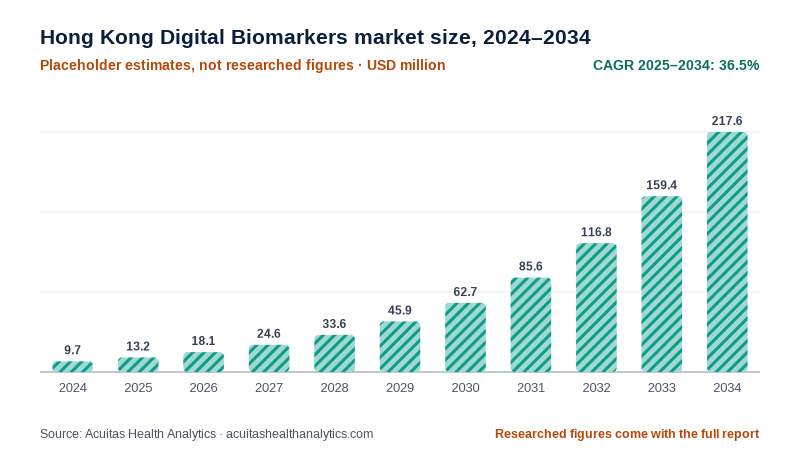
Estimate 2024$9.7 MnPlaceholder estimate
Estimate 2025$13.2 Mn0.2% of the global market
Projected 2034$217.6 Mn 1,545.1%Adds $204.4 Mn over 9 forecast years
CAGR 2025–203436.5%Faster than 95% of 103 Digital Health markets here
Hong Kong Digital Biomarkers Market Analysis at a glance
Market size, 2025
$13.2 Mn placeholder estimate
Forecast, 2034
$217.6 Mn placeholder estimate
Growth (CAGR), 2025–2034
36.5% placeholder estimate
Years
2024 historical · 2025 base year · 2026–2034 forecast
Segments
Type of product, purpose of solution, type of biomarker, therapeutic area and end user (see all)
Key players
AliveCor Inc., Altoida Inc., Amgen Inc., Fitbit Inc., Biogen Inc and 3 more (see all)
Active clinical trials
9 in Hong KongSource: ClinicalTrials.gov, Studies recruiting, active or not yet recruiting, in Hong Kong. Retrieved 9 Nov 2026.
Formats
PDF, PPTX, XLSX
Sizes and growth here are placeholder estimates, not researched figures. Researched figures come with the full report.
The Hong Kong Digital Biomarkers Market Executive Summary
A key pillar of healthcare’s journey towards precision medicine has been the proliferation and development of biomarkers to detect, monitor and manage disease. ‘Digital Biomarkers’ (DBx) have emerged as a promising paradigm in healthcare to aid the diagnosis, monitoring, and treatment of various health conditions. The opportunity has been enabled partly due to a rapid increase in the volume, velocity and variety of data collected (images, text, audio and video).
The digital biomarker market is rapidly growing, driven by advancements in wearable technology, AI, and the increasing need for personalized healthcare. These biomarkers, collected via digital devices, are pivotal in disease monitoring, clinical trials, and preventive care. The market is expected to expand significantly, with North America leading and Asia-Pacific seeing the fastest growth. Despite challenges like data privacy and regulatory hurdles, the market's future looks promising as digital health technologies become more integrated into healthcare, offering continuous monitoring and better management of chronic conditions.
Hong Kong Digital Biomarkers market size, 2024–2034. Placeholder estimates; researched figures come with the full report. Source: Acuitas Health Analytics.
Hong Kong Digital Biomarkers Market Dynamics
Market Growth Drivers
The increased global trends and burden of chronic illnesses like cardiovascular, neurological, and respiratory diseases have also urged for timely and individualized monitoring and care that digital biomarkers offer through remote care. Notably, organization such as the FDA are backing this expansion by embracing relaxed policies, and campaigns that foster innovation in digital health technologies. Also, the poor success rates and the costs of developing drug therapies for neurodegenerative diseases have highlighted the usefulness of digital biomarkers through improving research efficiency and cutting costs. Rising funding on innovative technologies like voice-based biomarkers and superior wearables advance the digital biomarkers market and jointly embed them as revolutionary tools in contemporary healthcare.
Opportunity
Trend towards precision medicine, which applies patient-specific information for treatment and overall health enhancement, primarily in chronic illness management. The growing focus on voice-based digital biomarkers provides more opportunities for tracking cognitive and emotional well-being; wearable technology allows for continuous, multifactor monitoring. Telemedicine and remote patient monitoring across different age segments point to the relevance of digital biomarkers for timely interventions. Furthermore, incorporation of digital biomarkers in decentralized clinical trials helps in increasing patient-centric clinical research and lowering the expenditure, which can provide a head start to the market.
Market Restraints
The integration of digital biomarkers presents several issues such as cost of the devices, which could be a hindrance since it may not be affordable by providers with fewer resources and or self-pay patients. The matter of data protection is another crucial aspect because the data involved is often of a rather sensitive nature, and there is always a risk of cybercriminal activity. Higher regulations in multiple regions, compatibility problems with existing healthcare systems, and the necessity of strict checks to prevent data bias are other factors challenging market expansion. Furthermore, reimbursement is not clearly defined in most cases making it an expensive affair to incorporate digital biomarkers in clinical practice.
Competitive Landscape for Digital Biomarkers Market in Hong Kong
March 2024, NeuraMetrix has identified a novel digital biomarker for neurological disorders: typing cadence, the distinctive rhythm individuals employ when typing on a keyboard. While initially envisioning keystroke patterns as an authentication tool, Neurametrix developers later discovered its potential as a diagnostic tool.
November 2025, Empatica, a digital health and AI company developing medical-grade wearables and digital biomarkers for health monitoring and diagnostics, today announced US Food and Drug Administration (FDA) 510(k) clearance for two new digital biomarkers for its Empatica Health Monitoring Platform: pulse and respiratory rate.
October 2022, Koneksa, a healthcare technology company developing evidence-based validated digital biomarkers, announced the launch of its clinical pipeline featuring biomarkers across neuroscience, oncology, respiratory, and other therapeutic areas. With 15 digital biomarker programs in development, the company will also be launching several upcoming clinical studies.
Mergers and Acquisitions
August 2024, Hitachi High-Tech Corporation ("Hitachi High-Tech") and Gencurix, Inc. ("Gencurix") have entered a strategic partnership (the Partnership) in the field of cancer molecular diagnostics. The Partnership aims to develop a testing service for the cancer molecular diagnostics by combining Hitachi High-Tech's core expertise in R&D and manufacturing of in vitro diagnostic products and digital technology, and Gencurix's technology and experience in biomarker. Discovery for cancer diagnosis and development of molecular testing service. As a part of the Partnership, both companies concluded a Feasibility Study (FS) agreement to examine the feasibility of the business and completed the checkpoints defined in this FS agreement in June 2024. As the next step, Hitachi High-Tech and Gencurix are planning commercialization of testing services in Japan.
May 2024, RCSI has partnered with Dublin-based Head Diagnostics on a clinical study to enhance the assessment and monitoring of multiple sclerosis (MS) through innovative technology. The study, launched to coincide with World MS Day, will explore the use of novel digital biomarkers to monitor disease, with the aim of providing greater objectivity in assessing the condition.
September 2021, Medidata, Labcorp Collaborate to Boost Digital Biomarker Discovery. The companies will leverage Medidata Sensor Cloud to process sensor data within clinical trials and enhance digital biomarker discovery for medical devices and therapeutic areas.
Healthcare Policies and Regulatory Landscape for Digital Biomarkers Market in Hong Kong
Digital Biomarkers in Hong Kong: payment and research
Public hospitals and clinics, run by the Hospital Authority, are heavily subsidised by the government.[1] ClinicalTrials.gov lists 9 studies on Digital Biomarkers that are recruiting, active or about to start in Hong Kong.[2]
[2]ClinicalTrials.gov, Studies recruiting, active or not yet recruiting, in Hong Kong. Retrieved 9 Nov 2026.
Policy changes and Reimbursement scenario
Fluctuating regional regulations and standards; Reimbursement challenges due to a lack of clear pathways; Data standardization and collection problems. While there are efforts by organizations like the FDA to lower entry barriers, the process has always been elaborate. Overcoming these hurdles is crucial to the advancement and adoption of digital biomarkers in the health management field.
7.8 Eli Lilly and Company Product & Services, Strategies & Financials
8 Healthcare Policies and Regulatory Landscape
8.1 Policy changes and Reimbursement scenario
8.2 Government Initiatives / Intervention programs
The digital biomarkers market is segmented into various categories based on different criteria, which helps in understanding the diverse applications and potential growth areas within the industry. Here are the key segmentation categories:
Other companies that free public records show in this market: trials they lead, US approvals and WHO prequalification. They are not part of our key players research. Each count opens its source.
Also active in this area, from free public records
Source: ClinicalTrials.gov, Active studies (recruiting, about to start or running) each company leads, found with this market's trial search, worldwide. Retrieved 13 Nov 2026.
Beyond the market numbers
Research, trials and patients
What doctors and scientists are doing in Digital Biomarkers right now, from free public sources.
Sources:PubMed (US National Library of Medicine),
ClinicalTrials.gov,
World Bank.
Fetched 12 Nov 2026. Papers and trials are found by search words, so the counts are a guide. Titles only; read each paper at its source.
Public data, with sources
Digital Biomarkers in context
Hong Kong compared
People aged 65 and over: 23.7% of people (2025). World: 10.4% of people (2025). 2nd highest of the 18 countries we cover in APAC.[1]
[1]World Bank Open Data, People aged 65 and over (% of people). Retrieved 24 Nov 2026.
How big is the Digital Biomarkers market in Hong Kong?
Placeholder estimate: about $13.2 Mn in 2025, rising to about $217.6 Mn by 2034. These are early estimates, not researched figures; the researched values come with the full report.
How fast is the Digital Biomarkers market in Hong Kong growing?
Placeholder estimate: about 36.5% a year (CAGR, 2025–2034). The researched growth rate comes with the full report.
What segments does the Digital Biomarkers market report cover?
The report splits the market by type of product (Wearables, Software/Applications, Sensors, Gaming Solutions), purpose of solution (Monitoring, Diagnosis, Early Detection, Predictive Insights), type of biomarker (Physiological Biomarkers, Cognitive Biomarkers, Idiosyncratic Biomarkers, Vocal Biomarkers and more) and therapeutic area (Neurological Disorders, Mental Health Disorders, Cardiovascular Disorders, Autoimmune Disorders, Respiratory Disorders, Substance Abuse Disorders).
Who are the key players in the Digital Biomarkers market?
Key players include AliveCor Inc., Altoida Inc., Amgen Inc., Fitbit Inc., Biogen Inc and Bayer AG, among 8 companies the report profiles.
What is driving the Digital Biomarkers market?
The increased global trends and burden of chronic illnesses like cardiovascular, neurological, and respiratory diseases have also urged for timely and individualized monitoring and care that digital biomarkers offer through remote care.
How is healthcare paid for in Hong Kong?
Public hospitals and clinics, run by the Hospital Authority, are heavily subsidised by the government. Source: Hospital Authority. Checked 14 Nov 2026.
How many clinical trials on Digital Biomarkers are running in Hong Kong?
9 studies are recruiting, active or about to start in Hong Kong, according to ClinicalTrials.gov. Source: ClinicalTrials.gov, Studies recruiting, active or not yet recruiting, in Hong Kong. Retrieved 9 Nov 2026.
How much research is published on Digital Biomarkers?
PubMed lists 1,175 papers on Digital Biomarkers added since January 2021, worldwide. Source: PubMed, Papers added since 1 January 2021 matching this market. Retrieved 12 Nov 2026.
 Hong Kong



 China
 India
 US
 Canada
 Japan
 Germany
 France
 UK
 Brazil
 Italy
 Ecuador
 Spain
 Saudi Arabia
 Mexico
 Australia
 South Africa
 UAE
 Egypt
 Philippines
 Malaysia
 Singapore
 Thailand
 Kenya
 Bayer AG
 GlaxoSmithKline Plc
 Eli Lilly and Company
 Novartis AG
 Roche