Animal Genetics
Europe · 3 shared keywords
Updated
 Reviewed by Chandani Patel
Europe Veterinary Artificial Insemination Market Industry Trends and Forecast to 2034: Segmented by (Animal, Product, Region) - Growth, Market Size, Future Prospects & Competitive Analysis, 2024-2034
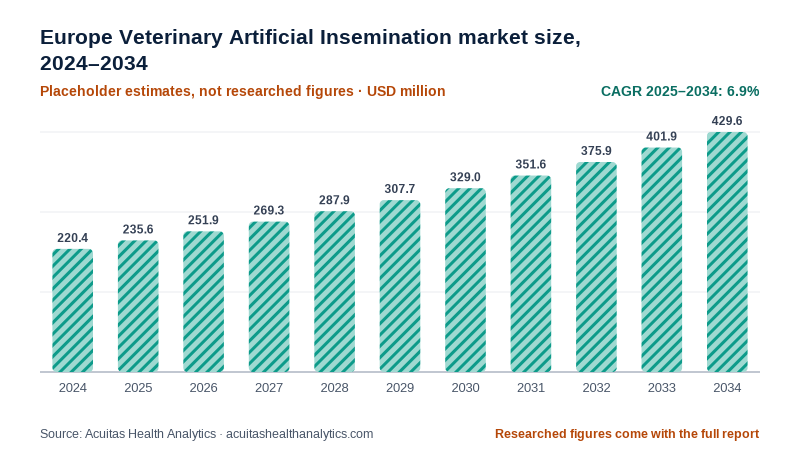
Values shown here are placeholder estimates, not researched figures. Researched 2024 historical, 2025 base-year and 2026–2034 forecast values are prepared with the full report.
Source: Acuitas Health Analytics. Full methods, sources and usage terms come with report purchase.
$193.9 Mn total, 2026–2034
| Year | Market size | Change that year | Since 2025 |
|---|---|---|---|
| 2024 (estimate) | $220.4 Mn | — | — |
| 2025 (base) | $235.6 Mn | +$15.2 Mn | — |
| 2026 (forecast) | $251.9 Mn | +$16.3 Mn | +6.9% |
| 2027 (forecast) | $269.3 Mn | +$17.4 Mn | +14.3% |
| 2028 (forecast) | $287.9 Mn | +$18.6 Mn | +22.2% |
| 2029 (forecast) | $307.7 Mn | +$19.9 Mn | +30.6% |
| 2030 (forecast) | $329.0 Mn | +$21.2 Mn | +39.6% |
| 2031 (forecast) | $351.6 Mn | +$22.7 Mn | +49.2% |
| 2032 (forecast) | $375.9 Mn | +$24.3 Mn | +59.5% |
| 2033 (forecast) | $401.9 Mn | +$25.9 Mn | +70.5% |
| 2034 (forecast) | $429.6 Mn | +$27.7 Mn | +82.3% |
Placeholder estimates. Each year is projected from our earlier market estimate and its CAGR. Researched values come with the full report.
 US
$441.7 Mn
 China
$91.9 Mn
 Canada
$87.0 Mn
 Japan
$75.7 Mn
 Germany
$39.4 Mn
 UK
$29.1 Mn
 France
$28.6 Mn
 Ecuador
$26.6 Mn
 Brazil
$26.4 Mn
 Italy
$25.6 Mn
 South Korea
$25.2 Mn
 Saudi Arabia
$20.7 Mn
 Spain
$19.1 Mn
 Netherlands
$18.1 Mn
 India
$19.4 Mn
 Mexico
$16.9 Mn
 Australia
$15.4 Mn
 Switzerland
$13.4 Mn
 Russia
$13.6 Mn
 New Zealand
$11.6 Mn
 Belgium
$10.9 Mn
 Argentina
$10.5 Mn
 Sweden
$9.5 Mn
 Poland
$9.1 Mn
 South Africa
$6.9 Mn
 Turkey
$6.6 Mn
 Indonesia
$6.1 Mn
 UAE
$6.1 Mn
 Chile
$5.3 Mn
 Israel
$5.1 Mn
 Denmark
$4.9 Mn
 Colombia
$4.7 Mn
 Egypt
$3.1 Mn
 Vietnam
$2.5 Mn
 Nigeria
$2.4 Mn
 Philippines
$2.3 Mn
 Malaysia
$2.0 Mn
 Hong Kong
$1.9 Mn
 Thailand
$1.6 Mn
 Singapore
$1.4 Mn
 Pakistan
$1.0 Mn
 Kenya
$0.9 Mn
 Qatar
$0.7 Mn
| Market size, 2025 | $235.6 Mn placeholder estimate |
|---|---|
| Forecast, 2034 | $429.6 Mn placeholder estimate |
| Growth (CAGR), 2025–2034 | 6.9% placeholder estimate |
| Years | 2024 historical · 2025 base year · 2026–2034 forecast |
| Segments | Animal and product (see all) |
| Key players | Genus, Inguran (STgenetics), CRV, Alta Genetics, Minitube and 1 more (see all) |
| Formats | PDF, PPTX, XLSX |
Sizes and growth here are placeholder estimates, not researched figures. Researched figures come with the full report.
Veterinary artificial insemination places collected semen into female animals by hand or with tools, to breed livestock and pets without natural mating.
Key segments of the veterinary artificial insemination market include animal (Cattle, Swine and Horses) and product (Semen, Insemination Kits and Semen Storage Equipment).
More pet ownership, demand for meat and milk, and a push for healthier and more productive herds are driving the veterinary artificial insemination market.
Genetic tools, connected devices and growing pet spending in emerging countries give the veterinary artificial insemination market room to grow.
Low pet-care spending in many countries, farm cost pressure and animal disease rules hold back the veterinary artificial insemination market.
The veterinary artificial insemination market is moderately concentrated. Leading companies compete on product innovation, clinical evidence, pricing and geographic reach, and use partnerships and acquisitions to expand their portfolios.
Each country runs its own health system and decides prices and reimbursement; since January 2025, EU countries also share joint clinical assessments of some new medicines.[1]
[1] European Commission, health technology assessment. Checked 14 Nov 2026.
Licensing, quality standards and payment models from public and private payers shape how veterinary artificial insemination services are delivered and paid for in Europe. Government health programs and insurance coverage are key to access.
From our blog
Europe · 3 shared keywords
Europe · 1 shared keyword
Europe
Europe
Europe
Europe
Pharmaceuticals · Europe
Pharmaceuticals · Europe
OTC & Nutraceuticals · Europe
Pharmaceuticals · Europe
Medical Devices · Europe
Pharmaceuticals · Europe