At-Home Diagnostic Tests
Europe · 1 shared keyword
Updated
 Reviewed by Chandani Patel
Europe At-Home Fertility Tests Market Industry Trends and Forecast to 2034: Segmented by (Test, Format, End User, Region) - Growth, Market Size, Future Prospects & Competitive Analysis, 2024-2034
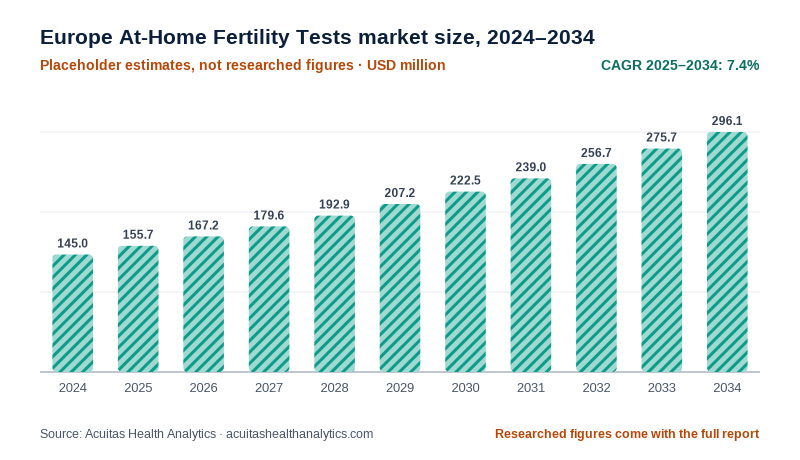
Values shown here are placeholder estimates, not researched figures. Researched 2024 historical, 2025 base-year and 2026–2034 forecast values are prepared with the full report.
Source: Acuitas Health Analytics. Full methods, sources and usage terms come with report purchase.
$140.3 Mn total, 2026–2034
| Year | Market size | Change that year | Since 2025 |
|---|---|---|---|
| 2024 (estimate) | $145.0 Mn | — | — |
| 2025 (base) | $155.7 Mn | +$10.7 Mn | — |
| 2026 (forecast) | $167.2 Mn | +$11.5 Mn | +7.4% |
| 2027 (forecast) | $179.6 Mn | +$12.4 Mn | +15.3% |
| 2028 (forecast) | $192.9 Mn | +$13.3 Mn | +23.9% |
| 2029 (forecast) | $207.2 Mn | +$14.3 Mn | +33.1% |
| 2030 (forecast) | $222.5 Mn | +$15.3 Mn | +42.9% |
| 2031 (forecast) | $239.0 Mn | +$16.5 Mn | +53.5% |
| 2032 (forecast) | $256.7 Mn | +$17.7 Mn | +64.8% |
| 2033 (forecast) | $275.7 Mn | +$19.0 Mn | +77% |
| 2034 (forecast) | $296.1 Mn | +$20.4 Mn | +90.1% |
Placeholder estimates. Each year is projected from our earlier market estimate and its CAGR. Researched values come with the full report.
 US
$336.1 Mn
 China
$83.1 Mn
 Canada
$77.5 Mn
 Japan
$53.4 Mn
 Germany
$35.1 Mn
 France
$28.3 Mn
 Italy
$24.1 Mn
 Brazil
$22.0 Mn
 UK
$20.6 Mn
 Ecuador
$20.7 Mn
 India
$19.0 Mn
 Spain
$17.6 Mn
 Mexico
$15.1 Mn
 Saudi Arabia
$14.7 Mn
 Australia
$13.1 Mn
 Russia
$9.0 Mn
 New Zealand
$8.6 Mn
 South Africa
$5.7 Mn
 UAE
$5.0 Mn
 Egypt
$2.6 Mn
 Philippines
$2.0 Mn
 Hong Kong
$1.4 Mn
 Malaysia
$1.3 Mn
 Singapore
$1.2 Mn
 Thailand
$1.2 Mn
 Kenya
$0.7 Mn
| Market size, 2025 | $155.7 Mn placeholder estimate |
|---|---|
| Forecast, 2034 | $296.1 Mn placeholder estimate |
| Growth (CAGR), 2025–2034 | 7.4% placeholder estimate |
| Years | 2024 historical · 2025 base year · 2026–2034 forecast |
| Segments | Test, format and end user (see all) |
| Key players | Clearblue (SPD), Modern Fertility (Ro), Proov, Mira, Legacy and 1 more (see all) |
| Regulator in Europe | EU MDRSource: European Commission, medical devices. Checked 14 Nov 2026. |
| Formats | PDF, PPTX, XLSX |
Sizes and growth here are placeholder estimates, not researched figures. Researched figures come with the full report.
At-home fertility tests check hormones such as AMH, LH and progesterone, or sperm quality, to help people understand their fertility.
Key segments of the at-Home Fertility Tests market include test (Ovulation Tests, Hormone Panels and Sperm Tests) and format (Urine Strips, Finger-Prick Blood Kits and Digital Readers).
Greater awareness of women's health needs, more funding for female-focused research, later pregnancies and an ageing female population are driving the at-Home Fertility Tests market. New products designed around women's biology and digital care are improving access.
Femtech, personalised care and new treatments for under-served conditions open strong growth for the at-Home Fertility Tests market, especially as employers and payers add women's health benefits.
Under-diagnosis, stigma around some conditions, limited insurance coverage and a long history of under-research in women's health hold back the at-Home Fertility Tests market.
The at-Home Fertility Tests market is moderately concentrated. Leading companies compete on product innovation, clinical evidence, pricing and geographic reach, and use partnerships and acquisitions to expand their portfolios.
In the EU, medical devices need CE marking under the Medical Device Regulation (MDR); for most devices, an independent notified body checks them first.[1] In the countries we cover here, medical devices are regulated by ANSM (France)[2], BfArM (Germany)[3], Ministry of Health (Italy)[4], Roszdravnadzor (Russia)[5], AEMPS (Spain)[6], MHRA (UK)[7], IGJ (Netherlands)[8], FAMHP (Belgium)[9], Swissmedic (Switzerland)[10], Läkemedelsverket (Sweden)[11], Danish Medicines Agency (Denmark)[12], URPL (Poland)[13] and TITCK (Turkey)[14]. Each country runs its own health system and decides prices and reimbursement; since January 2025, EU countries also share joint clinical assessments of some new medicines.[15]
[1] European Commission, medical devices. Checked 14 Nov 2026.
[2] ANSM, French medicines agency. Checked 14 Nov 2026.
[3] Federal Institute for Drugs and Medical Devices (BfArM). Checked 14 Nov 2026.
[4] Italian Ministry of Health. Checked 14 Nov 2026.
[5] Roszdravnadzor. Checked 14 Nov 2026.
[6] Spanish Agency of Medicines and Medical Devices (AEMPS). Checked 14 Nov 2026.
[7] Medicines and Healthcare products Regulatory Agency. Checked 14 Nov 2026.
[8] Health and Youth Care Inspectorate (IGJ). Checked 19 Nov 2026.
[9] Federal Agency for Medicines and Health Products (FAMHP). Checked 19 Nov 2026.
[10] Swissmedic. Checked 19 Nov 2026.
[11] Swedish Medical Products Agency (Läkemedelsverket). Checked 19 Nov 2026.
[12] Danish Medicines Agency. Checked 19 Nov 2026.
[13] Office for Registration of Medicinal Products, Medical Devices and Biocidal Products (URPL). Checked 19 Nov 2026.
[14] Turkish Medicines and Medical Devices Agency (TITCK). Checked 19 Nov 2026.
[15] European Commission, health technology assessment. Checked 14 Nov 2026.
Medical device rules, such as the US FDA 510(k) and PMA pathways and the EU Medical Device Regulation, govern how at-Home Fertility Tests products are approved and monitored. Reimbursement codes and hospital purchasing policies decide how widely they are used in Europe.
What doctors and scientists are doing in At-Home Fertility Tests right now, from free public sources.
Sources: PubMed (US National Library of Medicine), ClinicalTrials.gov. Fetched 12 Nov 2026. Papers and trials are found by search words, so the counts are a guide. Titles only; read each paper at its source.
From our blog
Europe · 1 shared keyword
Europe
Europe
Europe
Europe
Europe
Digital Health · Europe
Healthcare Services · Europe
Healthcare Services · Europe
Pharmaceuticals · Europe
Healthcare Services · Europe
Healthcare Services · Europe