APAC Arrhythmia Monitoring Devices Market Analysis Industry Trends and Forecast to 2034: Segmented by (By Type, By Application, By End User, By Region) - Growth, Market Size, Future Prospects & Competitive Analysis, 2024-2034
Overview
Market Dashboard
APAC · 2024–2034 · placeholder estimates
Values shown here are placeholder estimates, not researched figures. Researched 2024 historical, 2025 base-year and 2026–2034 forecast values are prepared with the
full report.
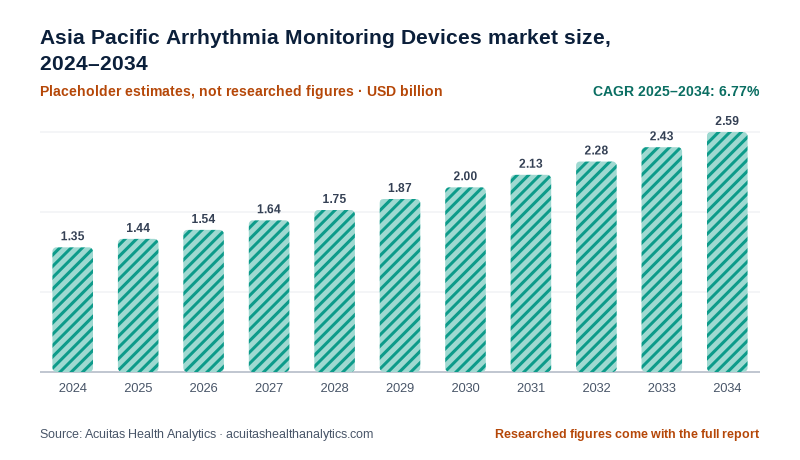
Estimate 2024$1.35 BnPlaceholder estimate
Estimate 2025$1.44 Bn21.5% of the global market
Projected 2034$2.59 Bn 80.3%Adds $1.16 Bn over 9 forecast years
CAGR 2025–20346.77%Faster than 8% of 205 Medical Devices markets here
Abbott Laboratories, Medtronic, GE Healthcare, Koninklijke Philips N.V., iRhythm Technologies, Inc. and 2 more (see all)
Active clinical trials
100 in Asia PacificSource: ClinicalTrials.gov, Studies recruiting, active or not yet recruiting, in Asia Pacific. Retrieved 9 Nov 2026.
Formats
PDF, PPTX, XLSX
Sizes and growth here are placeholder estimates, not researched figures. Researched figures come with the full report.
The APAC Arrhythmia Monitoring Devices Market Executive Summary
Arrhythmia Monitoring Devices serve as essential instruments for recording and analysing the rhythm and rate of the heart, thereby facilitating the identification and diagnosis of irregular heart rhythms, known as arrhythmias. These instruments encompass conventional alternatives such as 12-lead electrocardiograms (ECGs) and Holter monitors, in addition to modern portable devices, smartphones, and smartwatches that offer continuous heart activity monitoring.
The market for Arrhythmia Monitoring Devices is experiencing significant growth, propelled by the increasing incidence of cardiovascular diseases, advancements in technology, and a heightened focus on the early detection of arrhythmias. Prominent devices in this sector include ECG monitors, Holter monitors, event monitors, and implantable loop recorders. Leading companies in this field comprise Medtronic, Boston Scientific, and Abbott Laboratories. Emerging technological trends such as artificial intelligence, wearable technology, and telemedicine are influencing market dynamics, despite the ongoing challenges posed by high costs and regulatory barriers. There are substantial opportunities for growth in raising public awareness and expanding into developing markets.
Asia Pacific Arrhythmia Monitoring Devices market size, 2024–2034. Placeholder estimates; researched figures come with the full report. Source: Acuitas Health Analytics.
Cardiac conditions such as atrial fibrillation and ventricular arrhythmias that are attributed to the growth in the geriatric population, sedentary lifestyle, hypertension, and obesity. The trends like wireless connectivity, remote control, and use of artificial intelligence in data processing enhance and refine the use of such devices. Also, with the increased use of wearable devices, especially smartwatches, there is an opportunity for constant supervision.
Opportunity
The application of artificial intelligence and machine learning in cardiology is improving the detection and management of arrhythmia. Machines, wearables, and innovations in ICMs are improving patient reach and healthcare standards. Some of the factors that are favouring the market growth include: partnerships, regulatory approvals, and better reimbursement policies.
Market Restraints
Expensive devices mainly due to the hardware, making it hard for the technology to penetrate the emerging markets. Insufficient reimbursement also continues to hinder its utilization, as insurance only partly covers such devices. In the emerging region, poor adoptions of telemetry technology because of, for example, poor infrastructure, and low awareness of telemetry technology solutions also hinder market growth. Furthermore, a scarcity of skilled human resource in the healthcare sector hampers the utilization of monitoring devices, while extensive regulations slow down the approval of devices, stunting the pace of progress and expansion.
Competitive Landscape for Arrhythmia Monitoring Devices Market in APAC
August 2024, iRhythm Technologies Expanded Global Reach with the Launch of Zio® Cardiac Arrhythmia Monitoring Service in Austria, the Netherlands, Switzerland, and Spain.
May 2024, OMRON Healthcare India collaborated with AliveCor to launch portable ECG monitoring devices in India. With a deeper dive into cardiovascular health, the company has unearthed the crucial role of Afib as a significant contributor to stroke and cardiovascular disease risk.
May 2024, Vivalink introduced new solution for MCT and Holter monitoring. The new technology combines RPM technologies with advanced arrhythmia detection algorithms.
October 2025, Arab Health 2025 saw UltraLinQ Healthcare Solutions launch a new end-to-end patient monitoring concept for the way cardiac arrhythmias are diagnosed.
July 2022, Xplore Lifestyle collaborated with an Israeli company to launch CardiacSense, world’s first medical grade and wearable continuous monitoring device in form a watch that will. The watch can detect and read heart activity beat-by-beat. As a result, it can detect fatal Arrhythmia like AFib, and notify doctors and family members of patient instantly.
February 2021, RhythMedix Launched Next-Generation RhythmStar Wearable Cardiac Monitor With Built-In Cellular Connectivity. Technology designed to improve cardiac monitoring for faster arrhythmia detection.
Mergers and Acquisitions
May 2024, OMRON Healthcare India collaborated with AliveCor to launch portable ECG monitoring devices in India. With a deeper dive into cardiovascular health, the company unearthed the crucial role of Afib as a significant contributor to stroke and cardiovascular disease risk.
November 2025, Johnson & Johnson MedTech Acquired Laminar, Inc. Innovative investigational device designed for Left Atrial Appendage Elimination (LAAX) to reduce the risk of stroke in patients with non-valvular atrial fibrillation. Strengthens position in high-growth MedTech segments.
January 2021, Boston Scientific Announced Agreement To Acquire Preventice Solutions, Inc. Acquisition of external cardiac monitoring technologies and services provider to expand rhythm management diagnostics portfolio and capabilities.
Healthcare Policies and Regulatory Landscape for Arrhythmia Monitoring Devices Market in APAC
Arrhythmia Monitoring Devices in APAC: rules, payment and research
In some of the countries we cover here, medical devices are regulated by TGA (Australia)[1], NMPA (China)[2], MDACS (Hong Kong)[3], CDSCO (India)[4], PMDA (Japan)[5], MDA (Malaysia)[6], Medsafe (WAND) (New Zealand)[7], FDA Philippines (Philippines)[8], HSA (Singapore)[9], Thai FDA (Thailand)[10], Ministry of Health (Indonesia)[11], DRAP (Pakistan)[12], MFDS (South Korea)[13] and Ministry of Health (Vietnam)[14]. How care is paid for in some of these countries: Medicare and the PBS (Australia)[15], basic medical insurance (China)[16], the Hospital Authority (Hong Kong)[17], Ayushman Bharat PM-JAY (India)[18], public health insurance (Japan)[19], subsidised public care (Malaysia)[20], Pharmac (New Zealand)[21], PhilHealth (Philippines)[22], MediShield Life (Singapore)[23], the Universal Coverage Scheme (Thailand)[24], JKN (BPJS Kesehatan) (Indonesia)[25], out of pocket and Sehat Sahulat (Pakistan)[26], National Health Insurance (South Korea)[27] and social health insurance (Vietnam)[28]. ClinicalTrials.gov lists 100 studies on Arrhythmia Monitoring Devices that are recruiting, active or about to start in APAC.[29]
[29]ClinicalTrials.gov, Studies recruiting, active or not yet recruiting, in APAC. Retrieved 9 Nov 2026.
Policy changes and Reimbursement scenario
There is a change in reimbursement trends of Arrhythmia Monitoring Devices but there are still some hurdles. Limited insurance access, particularly for new technologies such as mobile cardiac telemetry and wearable technology, hinders adoption. Various policies are adjusted depending on the geographical location; the United States have added Medicare, however, there are still some gaps especially in remote areas. Technologies for implantable monitors are now under consideration for changes in the standard reimbursement methods. Favourable policy reforms include the focus on preventive care, enhancement of the regulatory environment to facilitate faster approval, and telehealth with favourable implications on reimbursement and market development of Arrhythmia Monitoring Devices.
7.5 iRhythm Technologies, Inc. Product & Services, Strategies & Financials
7.6 AliveCor, Inc. Product & Services, Strategies & Financials
7.7 BioTelemetry, Inc. Product & Services, Strategies & Financials
8 Healthcare Policies and Regulatory Landscape
8.1 Policy changes and Reimbursement scenario
8.2 Government Initiatives / Intervention programs
The Arrhythmia Monitoring Devices market is segmented based on various criteria, including device type, application, and end-user. This segmentation helps in understanding the market dynamics and identifying growth opportunities within specific categories.
Other companies that free public records show in this market: trials they lead, US approvals and WHO prequalification. They are not part of our key players research. Each count opens its source.
Also active in this area, from free public records
Source: ClinicalTrials.gov, Active studies (recruiting, about to start or running) each company leads, found with this market's trial search, worldwide. Retrieved 13 Nov 2026.
Source: FDA 510(k) and PMA databases, 510(k) clearances and PMA approvals since 2015 for devices whose name has this market's words. Retrieved 13 Nov 2026.
Beyond the market numbers
Research, trials and patients
What doctors and scientists are doing in Arrhythmia Monitoring Devices right now, from free public sources.
Clinical trials
100 active trials in China, India, Japan, South Korea, Australia, Hong Kong, Philippines, Singapore, Thailand, Vietnam, Malaysia, New Zealand, Bangladesh, Afghanistan, Indonesia, Myanmar, Nepal and Pakistan
Recruiting, about to start, or running now. Counted across the 18 countries we report on in APAC.
Sources:PubMed (US National Library of Medicine),
ClinicalTrials.gov.
Fetched 9 Nov 2026. Papers and trials are found by search words, so the counts are a guide. Titles only; read each paper at its source.
How big is the Arrhythmia Monitoring Devices market in Asia Pacific?
Placeholder estimate: about $1.44 Bn in 2025, rising to about $2.59 Bn by 2034. These are early estimates, not researched figures; the researched values come with the full report.
How fast is the Arrhythmia Monitoring Devices market in Asia Pacific growing?
Placeholder estimate: about 6.77% a year (CAGR, 2025–2034). The researched growth rate comes with the full report.
What segments does the Arrhythmia Monitoring Devices market report cover?
The report splits the market by type (ECG Monitors, Implantable Monitors, Holter Monitors, Mobile Cardiac Telemetry (MCT)), application (Bradycardia, Tachycardia, Atrial Fibrillation, Ventricular Fibrillation and more) and end-user (Hospitals and Diagnostic Centres, Ambulatory Centres, Others).
Who are the key players in the Arrhythmia Monitoring Devices market?
Key players include Abbott Laboratories, Medtronic, GE Healthcare, Koninklijke Philips N.V., iRhythm Technologies, Inc. and AliveCor Inc., among 7 companies the report profiles.
What is driving the Arrhythmia Monitoring Devices market?
Cardiac conditions such as atrial fibrillation and ventricular arrhythmias that are attributed to the growth in the geriatric population, sedentary lifestyle, hypertension, and obesity.
How many clinical trials on Arrhythmia Monitoring Devices are running in Asia Pacific?
100 studies are recruiting, active or about to start in Asia Pacific, counted across the 18 countries we report on there, according to ClinicalTrials.gov. Source: ClinicalTrials.gov, Studies recruiting, active or not yet recruiting, in Asia Pacific. Retrieved 9 Nov 2026.
How much research is published on Arrhythmia Monitoring Devices?
PubMed lists 7,869 papers on Arrhythmia Monitoring Devices added since January 2021, worldwide. Source: PubMed, Papers added since 1 January 2021 matching this market. Retrieved 9 Nov 2026.



 US
 China
 Canada
 Japan
 Germany
 France
 UK
 Brazil
 Italy
 Ecuador
 Spain
 India
 Saudi Arabia
 Mexico
 Australia
 South Africa
 UAE
 Egypt
 Philippines
 Malaysia
 Hong Kong
 Singapore
 Thailand
 Kenya
 AtriCure, Inc