APAC Dental Articulators Market Industry Trends and Forecast to 2034: Segmented by (Product Type, End-user, Region) - Growth, Market Size, Future Prospects & Competitive Analysis, 2024-2034
Overview
Market Dashboard
APAC · 2024–2034 · placeholder estimates
Values shown here are placeholder estimates, not researched figures. Researched 2024 historical, 2025 base-year and 2026–2034 forecast values are prepared with the
full report.
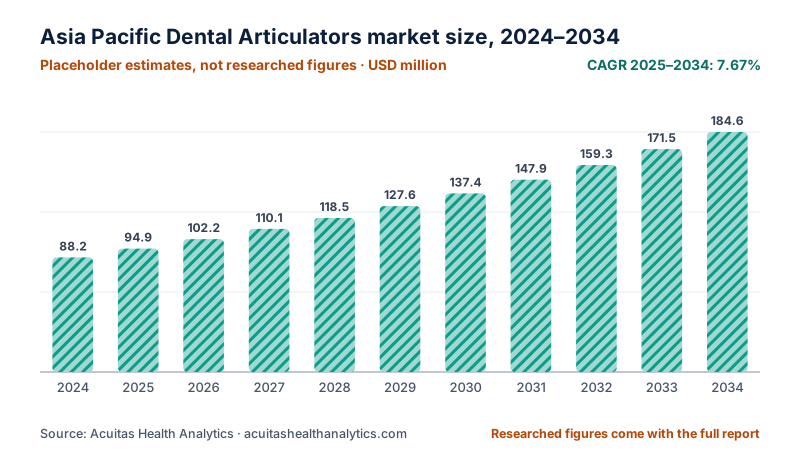
Estimate 2024$88.2 MnPlaceholder estimate
Estimate 2025$94.9 Mn21.5% of the global market
Projected 2034$184.6 Mn 94.5%Adds $89.7 Mn over 9 forecast years
CAGR 2025–20347.67%Faster than 21% of 173 Medical Devices markets here
Amann Girrbach, Zirkonzahn, Bio-Art, KaVo Dental, Dentatus and 5 more (see all)
Formats
PDF, PPTX, XLSX
Sizes and growth here are placeholder estimates, not researched figures. Researched figures come with the full report.
The APAC Dental Articulators Market Analysis Executive Summary
Dental articulators are mechanical devices that aid in the creation of dentures and fixed prosthodontic restorations. These devices are utilized by dental professionals to align the mandibular and maxillary (upper and lower) teeth. They replicate the temporomandibular joint (TMJ), allowing for the attachment of mandibular and maxillary casts to simulate jaw movements. By protecting sliding motions and maintaining the opposing casts in predetermined vertical and horizontal positions, dental articulators facilitate prosthetic work without the need for the patient to be present, enabling the arrangement of artificial teeth for removable partial dentures. One of the key factors driving the global dental articulators market is the reduction in chair time for patients, as these devices allow dental professionals to continue working even when the patient is not present, provided that the interocclusal records have been obtained.
Asia Pacific Dental Articulators market size, 2024–2034. Placeholder estimates; researched figures come with the full report. Source: Acuitas Health Analytics.
APAC Dental Articulators Market Dynamics
Market Growth Drivers
The dental articulators market is driven by the increasing demand for efficient and precise dental restorations. As dental professionals strive to enhance patient outcomes, the ability to accurately simulate jaw movements and relationships becomes essential. Dental articulators facilitate this process by allowing practitioners to work on prosthetic devices in the absence of the patient, significantly reducing chair time and improving workflow efficiency. This capability not only enhances the productivity of dental practices but also contributes to better patient experiences, as fewer appointments are required for complex procedures. The growing emphasis on high-quality dental care and the rising prevalence of dental conditions that necessitate prosthetic interventions further fuel the demand for advanced dental articulators.
Additionally, the integration of digital technologies into dental practices is a significant driver of the dental articulators market. The adoption of Computer-Aided Design (CAD) and 3D printing technologies has revolutionized the way dental restorations are designed and fabricated, leading to a higher demand for articulators that can seamlessly integrate with these digital workflows. As dental laboratories and clinics increasingly adopt digital solutions for enhanced precision and customization, the need for articulators that can accommodate these advancements becomes paramount. Furthermore, the rise of dental tourism, where patients seek high-quality dental care abroad, has prompted dental practices to invest in state-of-the-art equipment, including articulators, to attract and retain patients. Collectively, these drivers are contributing to the robust growth of the dental articulators market.
Market Restraints
The dental articulators market faces several restraints that could impede its growth. One significant challenge is the availability of alternative dental solutions. Various options, such as reusable plastic and metal articulators, provide cost-effective alternatives that may deter dental professionals from investing in more advanced articulators. This abundance of alternatives can negatively impact the market for dental articulators, particularly for those that are fully adjustable or disposable.
Additionally, the high cost of fully adjustable dental articulators can be a barrier for many dental practices, especially smaller clinics that may have budget constraints. These costs can discourage dental professionals from adopting these advanced devices, limiting their market penetration and growth potential. Furthermore, the lack of well-equipped healthcare facilities in emerging economies can hinder the expansion of the dental articulators market in those regions, as access to advanced dental technologies remains limited. Collectively, these factors pose challenges that the market must navigate to achieve sustained growth.
Competitive Landscape for Dental Articulators Market in APAC
January 2024: Zirkonzahn launched a new line of fully adjustable dental articulators that incorporate advanced materials and digital technology, aimed at meeting the growing demand for precision in dental restorations.
March 2024: Dentsply Sirona acquired a small dental technology firm specializing in CAD/CAM systems, enhancing its product portfolio and capabilities in the dental articulators market.
Mergers and Acquisitions
April 2024: A partnership was announced between Amann Girrbach and a leading dental software developer to enhance the integration of software solutions with dental articulators, aiming to improve functionality and user experience in digital workflows.
February 2024: Bio-Art announced a strategic collaboration with a prominent dental university to conduct research on the effectiveness of digital articulators in clinical settings, focusing on improving patient outcomes and treatment efficiency.
December 2025: A partnership was formed between KaVo Dental and a technology firm to develop a new digital articulator that integrates seamlessly with existing dental imaging systems, enhancing the workflow for dental professionals.
Healthcare Policies and Regulatory Landscape for Dental Articulators Market in APAC
Dental Articulators in APAC: rules and payment
In some of the countries we cover here, medical devices are regulated by TGA (Australia)[1], NMPA (China)[2], MDACS (Hong Kong)[3], CDSCO (India)[4], PMDA (Japan)[5], MDA (Malaysia)[6], Medsafe (WAND) (New Zealand)[7], FDA Philippines (Philippines)[8], HSA (Singapore)[9] and Thai FDA (Thailand)[10]. How care is paid for in some of these countries: Medicare and the PBS (Australia)[11], basic medical insurance (China)[12], the Hospital Authority (Hong Kong)[13], Ayushman Bharat PM-JAY (India)[14], public health insurance (Japan)[15], subsidised public care (Malaysia)[16], Pharmac (New Zealand)[17], PhilHealth (Philippines)[18], MediShield Life (Singapore)[19] and the Universal Coverage Scheme (Thailand)[20].
The healthcare policies and regulatory landscape for the dental articulators market is influenced by several key factors that ensure the safety, efficacy, and accessibility of these essential dental devices. Regulatory bodies such as the U.S. Food and Drug Administration (FDA) and the European Medicines Agency (EMA) have established stringent guidelines that manufacturers must adhere to in order to bring dental articulators to market. These regulations require comprehensive testing and clinical evaluations to demonstrate that the devices meet safety and quality standards. Compliance with these regulations is critical for manufacturers, as it not only facilitates market entry but also builds trust among dental professionals and patients regarding the reliability of the products.
Additionally, healthcare policies that promote dental health and access to care significantly impact the dental articulators market. Increasing awareness of oral health, along with the rising demand for cosmetic and restorative dental procedures, has led to a greater emphasis on the use of advanced dental technologies, including articulators. Governments and health organizations are also focusing on improving dental care infrastructure, particularly in emerging markets, which presents opportunities for growth in the dental articulators sector. Furthermore, the growing trend of dental tourism is driving demand for high-quality dental equipment, as clinics seek to attract international patients by offering state-of-the-art solutions. Overall, the evolving regulatory landscape and supportive healthcare policies are fostering an environment conducive to the growth and innovation of dental articulators in the market.
What doctors and scientists are doing in Dental Articulators right now, from free public sources.
Clinical trials
1,627 active trials in China, India, Japan, Australia, Hong Kong, Philippines, Singapore, Thailand, Malaysia, New Zealand, Bangladesh, Afghanistan, Indonesia, Myanmar, Nepal and Pakistan
Recruiting, about to start, or running now. Counted across the 16 countries we report on in APAC.
Sources:PubMed (US National Library of Medicine),
ClinicalTrials.gov.
Fetched 9 Nov 2026. Papers and trials are found by search words, so the counts are a guide. Titles only; read each paper at its source.
How big is the Dental Articulators market in Asia Pacific?
Placeholder estimate: about $94.9 Mn in 2025, rising to about $184.6 Mn by 2034. These are early estimates, not researched figures; the researched values come with the full report.
How fast is the Dental Articulators market in Asia Pacific growing?
Placeholder estimate: about 7.67% a year (CAGR, 2025–2034). The researched growth rate comes with the full report.
What segments does the Dental Articulators market report cover?
The report splits the market by product type (Ordinary Articulators, Semi-Adjustable Articulators, Fully Adjustable Articulators, Ceramic Articulators) and end user (Hospitals, Dental Clinics, Dental Laboratories, Others).
Who are the key players in the Dental Articulators market?
Key players include Amann Girrbach, Zirkonzahn, Bio-Art, KaVo Dental, Dentatus and Aseptico, among 10 companies the report profiles.
What is driving the Dental Articulators market?
The dental articulators market is driven by the increasing demand for efficient and precise dental restorations. As dental professionals strive to enhance patient outcomes, the ability to accurately simulate jaw movements and relationships becomes essential.



 US
 China
 Canada
 Japan
 Germany
 France
 UK
 Brazil
 Italy
 Ecuador
 Spain
 India
 Saudi Arabia
 Mexico
 Australia
 South Africa
 UAE
 Egypt
 Philippines
 Hong Kong
 Malaysia
 Singapore
 Thailand
 Kenya