APAC Sports Medicine Devices Market Industry Trends and Forecast to 2034: Segmented by (Product, Application, End User, Region) - Growth, Market Size, Future Prospects & Competitive Analysis, 2024-2034
Overview
Market Dashboard
APAC · 2024–2034 · placeholder estimates
Values shown here are placeholder estimates, not researched figures. Researched 2024 historical, 2025 base-year and 2026–2034 forecast values are prepared with the
full report.
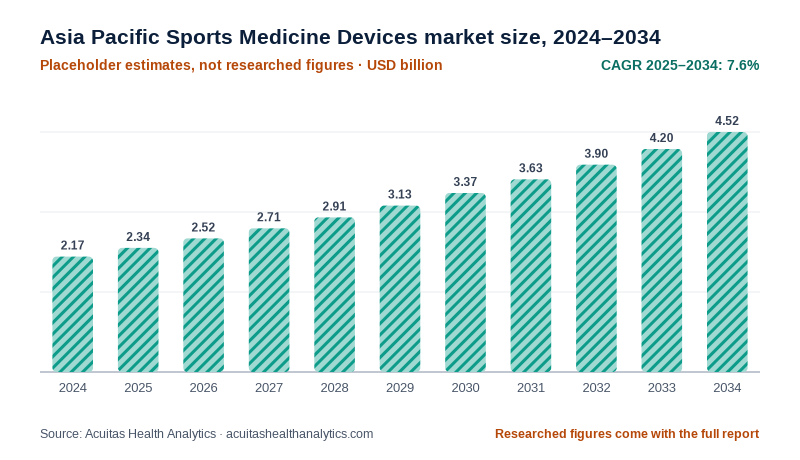
Estimate 2024$2.17 BnPlaceholder estimate
Estimate 2025$2.34 Bn24.3% of the global market
Projected 2034$4.52 Bn 93.3%Adds $2.18 Bn over 9 forecast years
CAGR 2025–20347.6%Faster than 21% of 193 Medical Devices markets here
Key players5
APAC is 24.25% of the global market.
Among regions, the largest is North America at $4.12 Bn.
Arthrex, Inc., Smith & Nephew, Stryker, CONMED Corporation, Zimmer Biomet Holdings, Inc. (see all)
Formats
PDF, PPTX, XLSX
Sizes and growth here are placeholder estimates, not researched figures. Researched figures come with the full report.
The APAC Sports Medicine Devices Market Analysis Executive Summary
Sports medicine devices repair ligaments, tendons and cartilage and support recovery from sports injuries.
Key segments of the sports Medicine Devices market include product (Arthroscopy Devices, Implants and Anchors and Braces and Supports) and application (Knee, Shoulder and Hip).
Asia Pacific Sports Medicine Devices market size, 2024–2034. Placeholder estimates; researched figures come with the full report. Source: Acuitas Health Analytics.
APAC Sports Medicine Devices Market Dynamics
Market Growth Drivers
An ageing and more active population, more sports injuries, rising obesity and better implants and procedures are driving the sports Medicine Devices market.
Opportunity
Same-day joint surgery, robotics, smart implants and biologic treatments give the sports Medicine Devices market room to grow.
Market Restraints
High procedure costs, pricing pressure from hospitals, recalls and long recovery times hold back the sports Medicine Devices market.
Competitive Landscape for Sports Medicine Devices Market in APAC
The sports Medicine Devices market is moderately concentrated. Leading companies compete on product innovation, clinical evidence, pricing and geographic reach, and use partnerships and acquisitions to expand their portfolios.
Healthcare Policies and Regulatory Landscape for Sports Medicine Devices Market in APAC
Sports Medicine Devices in APAC: rules and payment
In some of the countries we cover here, medical devices are regulated by TGA (Australia)[1], NMPA (China)[2], MDACS (Hong Kong)[3], CDSCO (India)[4], PMDA (Japan)[5], MDA (Malaysia)[6], Medsafe (WAND) (New Zealand)[7], FDA Philippines (Philippines)[8], HSA (Singapore)[9], Thai FDA (Thailand)[10], Ministry of Health (Indonesia)[11], DRAP (Pakistan)[12], MFDS (South Korea)[13] and Ministry of Health (Vietnam)[14]. How care is paid for in some of these countries: Medicare and the PBS (Australia)[15], basic medical insurance (China)[16], the Hospital Authority (Hong Kong)[17], Ayushman Bharat PM-JAY (India)[18], public health insurance (Japan)[19], subsidised public care (Malaysia)[20], Pharmac (New Zealand)[21], PhilHealth (Philippines)[22], MediShield Life (Singapore)[23], the Universal Coverage Scheme (Thailand)[24], JKN (BPJS Kesehatan) (Indonesia)[25], out of pocket and Sehat Sahulat (Pakistan)[26], National Health Insurance (South Korea)[27] and social health insurance (Vietnam)[28].
Medical device rules, such as the US FDA 510(k) and PMA pathways and the EU Medical Device Regulation, govern how sports Medicine Devices products are approved and monitored. Reimbursement codes and hospital purchasing policies decide how widely they are used in APAC.
2.2 Market Size, Growth Prospects and Key findings
3 Market Dynamics
3.1 Market Growth Drivers Analysis
3.2 Market Restraints Analysis
4 Market Segmentation
4.1 By Product
4.2 By Application
4.3 By End User
5 By Market Share
5.1 Market Analysis, Insights and Forecast – By Revenue
6 Competitive Landscape
6.1 Major Top Market Players Products in Pipeline
6.2 R&D Initiatives
6.3 Notable recent Deals
6.3.1 Strategic Divestments
6.3.2 Mergers & Acquisitions
6.3.3 Partnerships
6.3.4 Joint Ventures
7 Key Company Profiles
7.1 Arthrex
7.2 Smith & Nephew
7.3 Stryker
7.4 CONMED
7.5 Zimmer Biomet
8 Healthcare Policies and Regulatory Landscape
8.1 Policy changes and Reimbursement scenario
8.2 Government Initiatives / Intervention programs
The sports Medicine Devices market can be segmented based on various criteria, including product, application and end user. Here's a breakdown of the market segmentation
Sources:PubMed (US National Library of Medicine),
ClinicalTrials.gov,
World Bank.
Fetched 23 Nov 2026. Papers and trials are found by search words, so the counts are a guide. Titles only; read each paper at its source.
How big is the Sports Medicine Devices market in Asia Pacific?
Placeholder estimate: about $2.34 Bn in 2025, rising to about $4.52 Bn by 2034. These are early estimates, not researched figures; the researched values come with the full report.
How fast is the Sports Medicine Devices market in Asia Pacific growing?
Placeholder estimate: about 7.6% a year (CAGR, 2025–2034). The researched growth rate comes with the full report.
What segments does the Sports Medicine Devices market report cover?
The report splits the market by product (Arthroscopy Devices, Implants and Anchors, Braces and Supports, Recovery Devices), application (Knee, Shoulder, Hip, Foot and Ankle) and end user (Hospitals, Ambulatory Surgical Centers, Diagnostic Centers, Home Care Settings).
Who are the key players in the Sports Medicine Devices market?
Key players include Arthrex, Inc., Smith & Nephew, Stryker, CONMED Corporation and Zimmer Biomet Holdings, Inc..
What is driving the Sports Medicine Devices market?
An ageing and more active population, more sports injuries, rising obesity and better implants and procedures are driving the sports Medicine Devices market.
How much research is published on Sports Medicine Devices?
PubMed lists 296 papers on Sports Medicine Devices added since January 2021, worldwide. Source: PubMed, Papers added since 1 January 2021 matching this market. Retrieved 12 Nov 2026.



 US
 Canada
 China
 Japan
 Germany
 Brazil
 France
 Italy
 UK
 Ecuador
 India
 Spain
 Saudi Arabia
 Mexico
 Australia
 Russia
 New Zealand
 South Africa
 UAE
 Egypt
 Philippines
 Hong Kong
 Malaysia
 Singapore
 Thailand
 Kenya