Australia Mammography Market Industry Trends and Forecast to 2034: Segmented by (Product, Setting, Region) - Growth, Market Size, Future Prospects & Competitive Analysis, 2024-2034
Overview
Market Dashboard
Australia · 2024–2034 · placeholder estimates
Values shown here are placeholder estimates, not researched figures. Researched 2024 historical, 2025 base-year and 2026–2034 forecast values are prepared with the
full report.
Estimate 2024$32.7 MnPlaceholder estimate
Estimate 2025$35.8 Mn1.4% of the global market
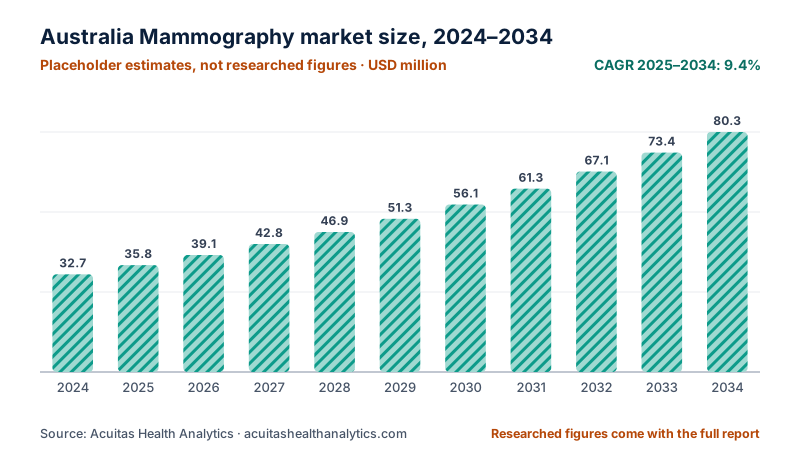
Projected 2034$80.3 Mn 124.5%Adds $44.5 Mn over 9 forecast years
CAGR 2025–20349.4%Faster than 43% of 180 Medical Devices markets here
197 in AustraliaSource: ClinicalTrials.gov, Studies recruiting, active or not yet recruiting, in Australia. Retrieved 20 Nov 2026.
Formats
PDF, PPTX, XLSX
Sizes and growth here are placeholder estimates, not researched figures. Researched figures come with the full report.
The Australia Mammography Market Analysis Executive Summary
Mammography systems take low-dose X-ray images of the breast to find cancer early.
Key segments of the mammography market include product (2D Digital Mammography, 3D Tomosynthesis and Contrast-Enhanced Mammography) and setting (Hospitals, Breast Care Centers and Diagnostic Centers).
Australia Mammography market size, 2024–2034. Placeholder estimates; researched figures come with the full report. Source: Acuitas Health Analytics.
Australia Mammography Market Dynamics
Market Growth Drivers
More imaging for cancer and heart disease, older populations and sharper, faster scanners are driving the mammography market. Clinicians also use imaging earlier in care.
Opportunity
AI-assisted reading, compact systems for clinics and the replacement of old scanners give the mammography market room to grow.
Market Restraints
High equipment prices, a shortage of trained staff and long replacement cycles in public hospitals hold back the mammography market.
Competitive Landscape for Mammography Market in Australia
The mammography market is moderately concentrated. Leading companies compete on product innovation, clinical evidence, pricing and geographic reach, and use partnerships and acquisitions to expand their portfolios.
Healthcare Policies and Regulatory Landscape for Mammography Market in Australia
Mammography in Australia: rules, payment and research
Medical devices must be included in the Australian Register of Therapeutic Goods (ARTG), run by the Therapeutic Goods Administration (TGA), before they can be supplied.[1] Medicare pays for public hospital care and many doctor visits, and the Pharmaceutical Benefits Scheme (PBS) subsidises listed medicines.[2] ClinicalTrials.gov lists 197 studies on Mammography that are recruiting, active or about to start in Australia.[3]
[3]ClinicalTrials.gov, Studies recruiting, active or not yet recruiting, in Australia. Retrieved 20 Nov 2026.
Policy changes and Reimbursement scenario
Medical device rules, such as the US FDA 510(k) and PMA pathways and the EU Medical Device Regulation, govern how mammography products are approved and monitored. Reimbursement codes and hospital purchasing policies decide how widely they are used in Australia.
Sources:PubMed (US National Library of Medicine),
ClinicalTrials.gov,
World Bank.
Fetched 20 Nov 2026. Papers and trials are found by search words, so the counts are a guide. Titles only; read each paper at its source.
Public data, with sources
Mammography in context
Australia compared
Health spending per person: 6,980 US$ per person (2023). World: 1,317 US$ per person (2023). Highest of the 17 countries we cover in APAC.[1]
Doctors: 4.09 per 1,000 people (2022). World: 1.86 per 1,000 people (2022). Highest of the 17 countries we cover in APAC.[2]
People aged 65 and over: 18.1% of people (2025). World: 10.4% of people (2025). 4th highest of the 18 countries we cover in APAC.[3]
[1]World Bank Open Data, Health spending per person (US$ per person). Retrieved 19 Nov 2026.
Placeholder estimate: about $35.8 Mn in 2025, rising to about $80.3 Mn by 2034. These are early estimates, not researched figures; the researched values come with the full report.
How fast is the Mammography market in Australia growing?
Placeholder estimate: about 9.4% a year (CAGR, 2025–2034). The researched growth rate comes with the full report.
What segments does the Mammography market report cover?
The report splits the market by product (2D Digital Mammography, 3D Tomosynthesis, Contrast-Enhanced Mammography) and setting (Hospitals, Breast Care Centers, Diagnostic Centers).
Who are the key players in the Mammography market?
Key players include Hologic, Inc., GE Healthcare, Siemens Healthineers, FUJIFILM Holdings Corporation and Planmed.
What is driving the Mammography market?
More imaging for cancer and heart disease, older populations and sharper, faster scanners are driving the mammography market. Clinicians also use imaging earlier in care.
Who regulates Mammography in Australia?
Medical devices must be included in the Australian Register of Therapeutic Goods (ARTG), run by the Therapeutic Goods Administration (TGA), before they can be supplied. Source: Therapeutic Goods Administration. Checked 14 Nov 2026.
How is healthcare paid for in Australia?
Medicare pays for public hospital care and many doctor visits, and the Pharmaceutical Benefits Scheme (PBS) subsidises listed medicines. Source: Pharmaceutical Benefits Scheme. Checked 14 Nov 2026.
How many clinical trials on Mammography are running in Australia?
197 studies are recruiting, active or about to start in Australia, according to ClinicalTrials.gov. Source: ClinicalTrials.gov, Studies recruiting, active or not yet recruiting, in Australia. Retrieved 20 Nov 2026.
How much research is published on Mammography?
PubMed lists 7,524 papers on Mammography added since January 2021, worldwide. Source: PubMed, Papers added since 1 January 2021 matching this market. Retrieved 20 Nov 2026.
 Australia



 China
 India
 US
 Canada
 Japan
 Germany
 Italy
 France
 Brazil
 UK
 Ecuador
 Spain
 South Korea
 Netherlands
 Saudi Arabia
 Mexico
 Switzerland
 Russia
 Belgium
 New Zealand
 Sweden
 Poland
 Argentina
 South Africa
 Turkey
 Israel
 UAE
 Denmark
 Chile
 Indonesia
 Colombia
 Egypt
 Vietnam
 Philippines
 Nigeria
 Hong Kong
 Malaysia
 Thailand
 Singapore
 Pakistan
 Kenya
 Qatar