Canada Continuous Glucose Monitoring (CGM) Market Industry Trends and Forecast to 2034: Segmented by (Component, Use, End User, Region) - Growth, Market Size, Future Prospects & Competitive Analysis, 2024-2034
Overview
Market Dashboard
Canada · 2024–2034 · placeholder estimates
Values shown here are placeholder estimates, not researched figures. Researched 2024 historical, 2025 base-year and 2026–2034 forecast values are prepared with the
full report.
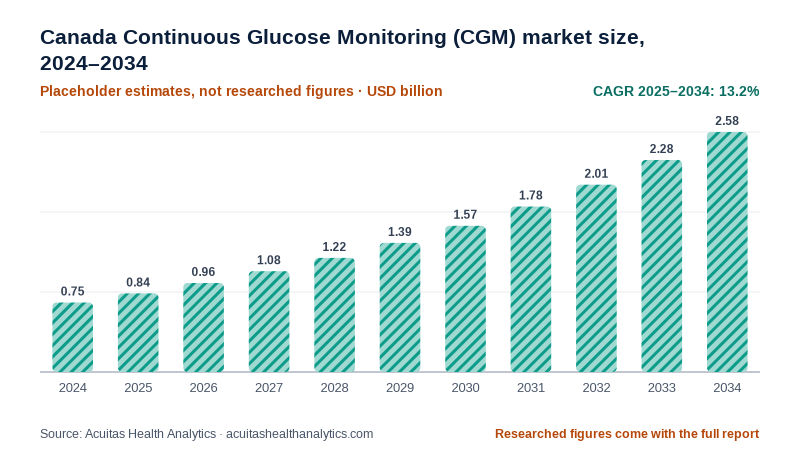
Estimate 2024$745.9 MnPlaceholder estimate
Estimate 2025$844.3 Mn7.3% of the global market
Projected 2034$2.58 Bn 205.2%Adds $1.73 Bn over 9 forecast years
CAGR 2025–203413.2%Faster than 87% of 201 Medical Devices markets here
Abbott Laboratories, Dexcom, Inc., Medtronic, Senseonics, Roche and 1 more (see all)
Regulator in Canada
Health CanadaSource: Health Canada. Checked 14 Nov 2026.
Active clinical trials
206 in CanadaSource: ClinicalTrials.gov, Studies recruiting, active or not yet recruiting, in Canada. Retrieved 21 Nov 2026.
Formats
PDF, PPTX, XLSX
Sizes and growth here are placeholder estimates, not researched figures. Researched figures come with the full report.
The Canada Continuous Glucose Monitoring (CGM) Market Analysis Executive Summary
Continuous glucose monitors are body-worn sensors that read glucose levels all day and send them to a phone or pump.
Key segments of the continuous glucose monitoring (CGM) market include component (Sensors, Transmitters and Receivers and Apps) and use (Type 1 Diabetes, Type 2 Diabetes and Gestational Diabetes).
Canada Continuous Glucose Monitoring (CGM) market size, 2024–2034. Placeholder estimates; researched figures come with the full report. Source: Acuitas Health Analytics.
Rising numbers of people with diabetes, a shift to tools that track and deliver treatment automatically, and more insurance cover are driving the continuous glucose monitoring (CGM) market.
Opportunity
Connected devices, lower-priced sensors and new insulins and pills give the continuous glucose monitoring (CGM) market room to grow.
Market Restraints
High costs for people without cover, price competition and uneven access to care in low-income countries hold back the continuous glucose monitoring (CGM) market.
Competitive Landscape for Continuous Glucose Monitoring (CGM) Market in Canada
The continuous glucose monitoring (CGM) market is moderately concentrated. Leading companies compete on product innovation, clinical evidence, pricing and geographic reach, and use partnerships and acquisitions to expand their portfolios.
Healthcare Policies and Regulatory Landscape for Continuous Glucose Monitoring (CGM) Market in Canada
Continuous Glucose Monitoring (CGM) in Canada: rules, payment and research
Health Canada licenses Class II, III and IV medical devices; Class I devices are sold by companies that hold an establishment licence.[1] Each province and territory runs public health insurance under the Canada Health Act, which covers medically necessary hospital and doctor services.[2] ClinicalTrials.gov lists 206 studies on Continuous Glucose Monitoring (CGM) that are recruiting, active or about to start in Canada.[3] Diabetes (ages 20–79): 7.7% of people 20–79 in 2024, the latest World Bank figure for Canada.[4]
[3]ClinicalTrials.gov, Studies recruiting, active or not yet recruiting, in Canada. Retrieved 21 Nov 2026.
[4]World Bank Open Data, Diabetes (ages 20–79) (% of people 20–79). Retrieved 23 Nov 2026.
Policy changes and Reimbursement scenario
Medical device rules, such as the US FDA 510(k) and PMA pathways and the EU Medical Device Regulation, govern how continuous glucose monitoring (CGM) products are approved and monitored. Reimbursement codes and hospital purchasing policies decide how widely they are used in Canada.
2.2 Market Size, Growth Prospects and Key findings
3 Market Dynamics
3.1 Market Growth Drivers Analysis
3.2 Market Restraints Analysis
4 Market Segmentation
4.1 By Component
4.2 By Use
4.3 By End User
5 By Market Share
5.1 Market Analysis, Insights and Forecast – By Revenue
6 Competitive Landscape
6.1 Major Top Market Players Products in Pipeline
6.2 R&D Initiatives
6.3 Notable recent Deals
6.3.1 Strategic Divestments
6.3.2 Mergers & Acquisitions
6.3.3 Partnerships
6.3.4 Joint Ventures
7 Key Company Profiles
7.1 Abbott
7.2 Dexcom
7.3 Medtronic
7.4 Senseonics
7.5 Roche
7.6 Sinocare
8 Healthcare Policies and Regulatory Landscape
8.1 Policy changes and Reimbursement scenario
8.2 Government Initiatives / Intervention programs
The continuous glucose monitoring (CGM) market can be segmented based on various criteria, including component, use and end user. Here's a breakdown of the market segmentation
Sources:PubMed (US National Library of Medicine),
ClinicalTrials.gov,
World Bank.
Fetched 23 Nov 2026. Papers and trials are found by search words, so the counts are a guide. Titles only; read each paper at its source.
Public data, with sources
Continuous Glucose Monitoring (CGM) in context
Canada compared
Diabetes (ages 20–79): 7.7% of people 20–79 (2024). World: 10.8% of people 20–79 (2024).[1]
Health spending per person: 6,378 US$ per person (2024). World: 1,317 US$ per person (2023).[2]
Doctors: 2.82 per 1,000 people (2023). World: 1.86 per 1,000 people (2022).[3]
[1]World Bank Open Data, Diabetes (ages 20–79) (% of people 20–79). Retrieved 23 Nov 2026.
[2]World Bank Open Data, Health spending per person (US$ per person). Retrieved 24 Nov 2026.
How big is the Continuous Glucose Monitoring (CGM) market in Canada?
Placeholder estimate: about $844.3 Mn in 2025, rising to about $2.58 Bn by 2034. These are early estimates, not researched figures; the researched values come with the full report.
How fast is the Continuous Glucose Monitoring (CGM) market in Canada growing?
Placeholder estimate: about 13.2% a year (CAGR, 2025–2034). The researched growth rate comes with the full report.
What segments does the Continuous Glucose Monitoring (CGM) market report cover?
The report splits the market by component (Sensors, Transmitters, Receivers and Apps), use (Type 1 Diabetes, Type 2 Diabetes, Gestational Diabetes) and end user (Hospitals, Ambulatory Surgical Centers, Diagnostic Centers, Home Care Settings).
Who are the key players in the Continuous Glucose Monitoring (CGM) market?
Key players include Abbott Laboratories, Dexcom, Inc., Medtronic, Senseonics, Roche and Sinocare.
What is driving the Continuous Glucose Monitoring (CGM) market?
Rising numbers of people with diabetes, a shift to tools that track and deliver treatment automatically, and more insurance cover are driving the continuous glucose monitoring (CGM) market.
Who regulates Continuous Glucose Monitoring (CGM) in Canada?
Health Canada licenses Class II, III and IV medical devices; Class I devices are sold by companies that hold an establishment licence. Source: Health Canada. Checked 14 Nov 2026.
How is healthcare paid for in Canada?
Each province and territory runs public health insurance under the Canada Health Act, which covers medically necessary hospital and doctor services. Source: Health Canada. Checked 14 Nov 2026.
How many clinical trials on Continuous Glucose Monitoring (CGM) are running in Canada?
206 studies are recruiting, active or about to start in Canada, according to ClinicalTrials.gov. Source: ClinicalTrials.gov, Studies recruiting, active or not yet recruiting, in Canada. Retrieved 21 Nov 2026.
What does World Bank report for Canada?
Diabetes (ages 20–79): 7.7% of people 20–79 in 2024, the latest World Bank figure. Source: World Bank Open Data, Diabetes (ages 20–79) (% of people 20–79). Retrieved 23 Nov 2026.
How many people in Canada are 65 or older?
20.3% of people were 65 or older in 2025. Source: World Bank Open Data, Population ages 65 and above (% of total population), from UN population estimates. Retrieved 24 Nov 2026.
 Canada



 US
 China
 Japan
 Germany
 UK
 France
 Italy
 Brazil
 South Korea
 Ecuador
 India
 Spain
 Saudi Arabia
 Netherlands
 Mexico
 Switzerland
 Australia
 New Zealand
 Belgium
 Russia
 Argentina
 Poland
 Sweden
 South Africa
 Turkey
 Denmark
 Chile
 UAE
 Colombia
 Israel
 Indonesia
 Egypt
 Vietnam
 Philippines
 Nigeria
 Hong Kong
 Malaysia
 Thailand
 Singapore
 Pakistan
 Kenya
 Qatar