Europe Acute Care Needleless Connectors Market Analysis Industry Trends and Forecast to 2034: Segmented by (By Mechanism, By Connector Type, By End User, By Region) - Growth, Market Size, Future Prospects & Competitive Analysis, 2024-2034
Overview
Market Dashboard
Europe · 2024–2034 · placeholder estimates
Values shown here are placeholder estimates, not researched figures. Researched 2024 historical, 2025 base-year and 2026–2034 forecast values are prepared with the
full report.
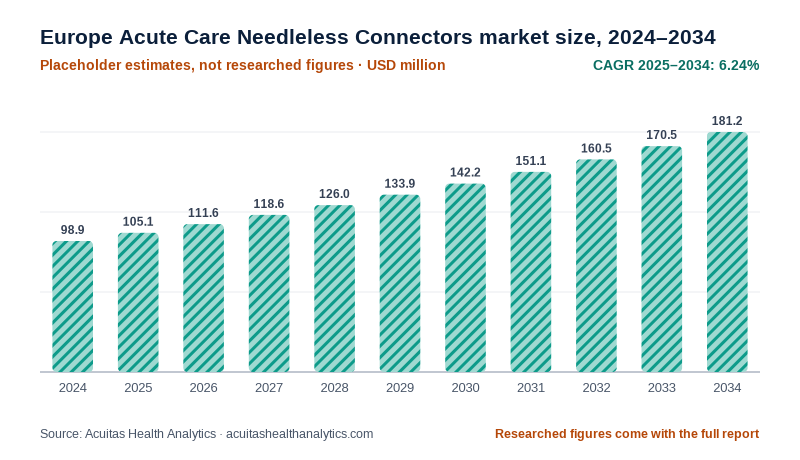
Estimate 2024$98.9 MnPlaceholder estimate
Estimate 2025$105.1 Mn18.6% of the global market
Projected 2034$181.2 Mn 72.4%Adds $76.1 Mn over 9 forecast years
CAGR 2025–20346.24%Faster than 40% of 205 Medical Devices markets here
1 in EuropeSource: ClinicalTrials.gov, Studies recruiting, active or not yet recruiting, in Europe. Retrieved 9 Nov 2026.
Formats
PDF, PPTX, XLSX
Sizes and growth here are placeholder estimates, not researched figures. Researched figures come with the full report.
The Europe Acute Care Needleless Connectors Market Executive Summary
Acute Care Needleless Connectors are medical devices that are used to establish access points to tips of vascular catheters for introducing fluids as well as drawing out material without necessarily using needles. These connectors are important, particularly in the acute care, to reduce patient risk and protect staff from needle stick injuries.
The acute care needleless connectors market has grown because there is a need to minimize Healthcare-Associated Infections and conform to the regulatory requirements. These devices are used to avoid complications such as needle-stick injuries, especially in acute-care situations including hospitals and emergency departments. North America dominates the market, while the Asia-Pacific region is the fastest-growing, attributed to increasing healthcare expenditures. Integration of new technologies, increased concern for the safety of patients and allowing market competition has its advantages while such factors as high price and specificity of use may cause obstacles to creating a successful market in some areas. Some of the market leaders are ICU Medical, BD, and B. Braun.
Europe Acute Care Needleless Connectors market size, 2024–2034. Placeholder estimates; researched figures come with the full report. Source: Acuitas Health Analytics.
Europe Acute Care Needleless Connectors Market Dynamics
Market Growth Drivers
New needleless connector designs are also improving performance and reducing risk of infection, including the issue of efficient fluid displacement. The key factors that are propelling the demand for these devices are the increasing expenditure on healthcare across the globe and the governments having strict policies related to cases of diseases. There is an increasing awareness of the value and application of these technologies among the healthcare professionals, due to their ability to prevent situations like needle stick injuries or cases of catheter related bloodstream infections (CRBSI). These connectors are getting popular in intravenous administration of medicines and blood sampling.
Opportunity
There are future prospects for applications of the needleless connectors to increase its usage in hospitals, clinics, and homecare as they opt for enhanced patient safety. Technological developments in the connector designs and the materials used, especially for better displacement of fluid and infection control, are imperative for the future growth of the market. Furthermore, the increase in global healthcare spending, especially in the developed nations, and the expansion in demand in the emergent nations with a quickly progressing healthcare sector are additional opportunities within the market.
Market Restraints
Lack of adequate training on the use of these devices may lead to wrong application and increased problems like infection transmission and catheter-related bloodstream infections (CRBSI). The designs of some connectors can in fact be intricate and this can also discourage their use because small intricate connectors are hard to use especially during emergencies such as in emergency department. However, some factors that still restrain the market rise include the fact that sophisticated systems are expensive, and due to these costs, some institutions especially in the developing world may opt for the low-end varieties.
Competitive Landscape for Acute Care Needleless Connectors Market in Europe
March 2024, Medtronic Neurosurgery Recalled Duet External Drainage and Monitoring System Catheter Tubing due to a Potential for the Catheter Disconnection from the Patient Line Stopcock Connectors.
December 2025, B. Braun Medical Inc., a leader in smart infusion therapy and pain management, announced the launch of its new CARESITE MicroTM Luer Access Device, designed to reduce exposure to harmful chemicals and decrease infection risk, making IV access for patients and healthcare providers.
October 2025, The PIVO™ Pro Needle-free Blood Collection Device is designed to achieve the first and only compatibility with integrated and long peripheral IV catheters, including the new Nexiva™ Closed IV Catheter System with NearPort™ IV Access in addition to traditional short IV catheters.
August 2021, PuraCath Medical, a venture-backed startup company focusing on the development of technologies to reduce infections in patients with intravascular catheters, announced that it has received 510(k) clearance for its FireFly Needleless Connector from the USFDA. The Firefly Needleless Connector is a sterile single patient use connector for needleless access to the IV line and IV catheter during IV therapy and can be used for direct injection, intermittent infusion, continuous infusion or aspiration.
Healthcare Policies and Regulatory Landscape for Acute Care Needleless Connectors Market in Europe
Acute Care Needleless Connectors in Europe: rules, payment and research
In the EU, medical devices need CE marking under the Medical Device Regulation (MDR); for most devices, an independent notified body checks them first.[1] In the countries we cover here, medical devices are regulated by ANSM (France)[2], BfArM (Germany)[3], Ministry of Health (Italy)[4], Roszdravnadzor (Russia)[5], AEMPS (Spain)[6], MHRA (UK)[7], IGJ (Netherlands)[8], FAMHP (Belgium)[9], Swissmedic (Switzerland)[10], Läkemedelsverket (Sweden)[11], Danish Medicines Agency (Denmark)[12], URPL (Poland)[13] and TITCK (Turkey)[14]. Each country runs its own health system and decides prices and reimbursement; since January 2025, EU countries also share joint clinical assessments of some new medicines.[15] ClinicalTrials.gov lists 1 study on Acute Care Needleless Connectors that is recruiting, active or about to start in Europe.[16]
[16]ClinicalTrials.gov, Studies recruiting, active or not yet recruiting, in Europe. Retrieved 9 Nov 2026.
Policy changes and Reimbursement scenario
Needleless connectors are being prescribed in institutions by virtue of Policy/Regulation modification from OSHA among others which recommend the use of needleless connectors in a bid to reduce needlestick injuries and improve patient outcomes. Other measures related to infection control by governments and health organizations also contribute to the need for safer medical devices, propelling the demand for needleless connectors. Furthermore, funding programs in some parts of the globe help healthcare centres to purchase such sophisticated instruments. With regards to reimbursement, changes in insurance policies and transitions to value-based care systems are encouraging the use of needleless connectors by eliminating or decreasing costs. Research on the cost-saving impact that averaged decreased infections and improved patient experiences could widen insurance acceptance and coverage.
8.2 Government Initiatives / Intervention programs
The Acute Care Needleless Connectors Market is segmented into several key categories that provide insights into its structure and potential growth areas. The main segments include:
Other companies that free public records show in this market: trials they lead, US approvals and WHO prequalification. They are not part of our key players research. Each count opens its source.
Also active in this area, from free public records
Source: FDA 510(k) and PMA databases, 510(k) clearances and PMA approvals since 2015 for devices whose name has this market's words. Retrieved 13 Nov 2026.
Beyond the market numbers
Research, trials and patients
What doctors and scientists are doing in Acute Care Needleless Connectors right now, from free public sources.
Clinical trials
1 active trial in UK, Germany, France, Italy, Spain, Netherlands, Belgium, Switzerland, Sweden, Denmark, Poland, Turkey and Russia
Recruiting, about to start, or running now. Counted across the 13 countries we report on in Europe.
Sources:PubMed (US National Library of Medicine),
ClinicalTrials.gov.
Fetched 9 Nov 2026. Papers and trials are found by search words, so the counts are a guide. Titles only; read each paper at its source.
How big is the Acute Care Needleless Connectors market in Europe?
Placeholder estimate: about $105.1 Mn in 2025, rising to about $181.2 Mn by 2034. These are early estimates, not researched figures; the researched values come with the full report.
How fast is the Acute Care Needleless Connectors market in Europe growing?
Placeholder estimate: about 6.24% a year (CAGR, 2025–2034). The researched growth rate comes with the full report.
What segments does the Acute Care Needleless Connectors market report cover?
The report splits the market by mechanism (Positive Fluid Displacement, Negative Fluid Displacement, Neutral Fluid Displacement), connector type (Simple Needleless Connectors, Complex Needleless Connectors) and end user (Hospitals, Clinics and Ambulatory Settings, Others).
Who are the key players in the Acute Care Needleless Connectors market?
Key players include B. Braun Melsungen AG, Baxter International, BD (Becton, Dickinson), Cardinal Health, CareFusion Corporation and ICU Medical, among 7 companies the report profiles.
What is driving the Acute Care Needleless Connectors market?
New needleless connector designs are also improving performance and reducing risk of infection, including the issue of efficient fluid displacement.
Who regulates Acute Care Needleless Connectors in Europe?
In the EU, medical devices need CE marking under the Medical Device Regulation (MDR); for most devices, an independent notified body checks them first. Source: European Commission, medical devices. Checked 14 Nov 2026.
How is healthcare paid for in Europe?
Each country runs its own health system and decides prices and reimbursement; since January 2025, EU countries also share joint clinical assessments of some new medicines. Source: European Commission, health technology assessment. Checked 14 Nov 2026.
How many clinical trials on Acute Care Needleless Connectors are running in Europe?
1 study is recruiting, active or about to start in Europe, counted across the 13 countries we report on there, according to ClinicalTrials.gov. Source: ClinicalTrials.gov, Studies recruiting, active or not yet recruiting, in Europe. Retrieved 9 Nov 2026.
How much research is published on Acute Care Needleless Connectors?
PubMed lists 67 papers on Acute Care Needleless Connectors added since January 2021, worldwide. Source: PubMed, Papers added since 1 January 2021 matching this market. Retrieved 9 Nov 2026.



 US
 China
 Canada
 Japan
 Germany
 France
 UK
 Brazil
 Italy
 Ecuador
 Spain
 India
 Saudi Arabia
 Mexico
 Australia
 South Africa
 UAE
 Egypt
 Philippines
 Hong Kong
 Malaysia
 Singapore
 Thailand
 Kenya