Europe Diabetes Care Devices Market Industry Trends and Forecast to 2034: Segmented by (Product type, Device Type, Delivery Type, Distribution Channel, Region) - Growth, Market Size, Future Prospects & Competitive Analysis, 2024-2034
Overview
Market Dashboard
Europe · 2024–2034 · placeholder estimates
Values shown here are placeholder estimates, not researched figures. Researched 2024 historical, 2025 base-year and 2026–2034 forecast values are prepared with the
full report.
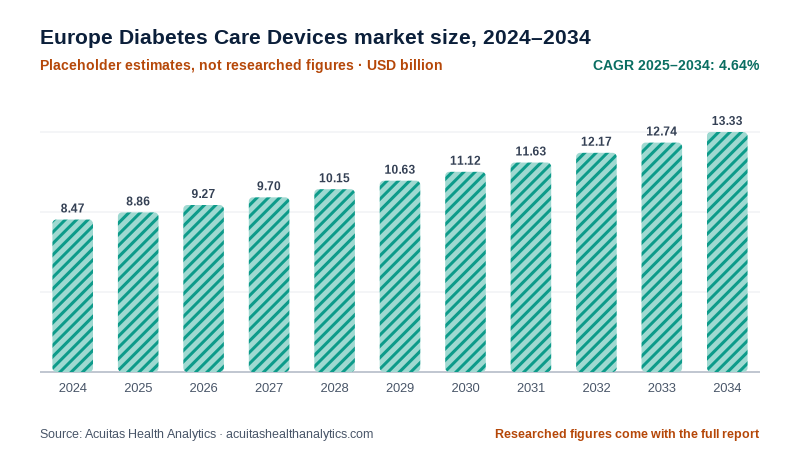
Estimate 2024$8.47 BnPlaceholder estimate
Estimate 2025$8.86 Bn18.6% of the global market
Projected 2034$13.33 Bn 50.4%Adds $4.47 Bn over 9 forecast years
CAGR 2025–20344.64%Faster than 13% of 193 Medical Devices markets here
133 in EuropeSource: ClinicalTrials.gov, Studies recruiting, active or not yet recruiting, in Europe. Retrieved 9 Nov 2026.
Formats
PDF, PPTX, XLSX
Sizes and growth here are placeholder estimates, not researched figures. Researched figures come with the full report.
The Europe Diabetes Care Devices Market Analysis Executive Summary
The Diabetes Care Devices Market encompasses a range of medical devices specifically designed to assist individuals in managing their diabetes effectively. This includes devices for monitoring blood glucose levels, administering insulin, and overall diabetes management. The market is crucial for helping patients avoid complications associated with diabetes, such as kidney failure, heart disease, and vision loss. The increasing prevalence of diabetes globally, driven by factors such as rising obesity rates and sedentary lifestyles, is propelling the demand for these devices.
Key segments within the diabetes care devices market include blood glucose monitoring devices, such as self-monitoring blood glucose meters and continuous glucose monitors, as well as insulin delivery devices like insulin pens and pumps. The integration of smart technology into these devices is transforming diabetes management, making it more convenient and effective for patients. Additionally, the market is characterized by a competitive landscape with major players like Abbott Laboratories, Medtronic, and Becton, Dickinson and Company, continuously innovating to enhance their product offerings and improve patient outcomes.
Europe Diabetes Care Devices market size, 2024–2034. Placeholder estimates; researched figures come with the full report. Source: Acuitas Health Analytics.
Europe Diabetes Care Devices Market Dynamics
Market Growth Drivers
Driving factors in the diabetes care devices market are primarily linked to the escalating prevalence of diabetes worldwide. This increase is largely attributed to rising obesity rates, unhealthy dietary habits, and sedentary lifestyles, which contribute to a higher incidence of diabetes, particularly type 2. According to the National Center for Biotechnology Information (NCBI), if current trends continue, a significant portion of the global population will be overweight or obese by 2035, leading to a surge in diabetes cases. As the demand for effective diabetes management solutions grows, so does the need for advanced diabetes care devices, such as continuous glucose monitoring systems, insulin pumps, and smart insulin pens, which enhance patient outcomes and improve the quality of life for individuals living with diabetes.
Technological advancements are also a crucial driver of market growth. Innovations in diabetes care devices have led to the development of more accurate, convenient, and efficient tools for monitoring blood glucose levels and administering insulin. The integration of smart technology into insulin delivery devices has transformed diabetes management, making it easier for patients to track their health and adhere to treatment plans. Additionally, the increasing adoption of telemedicine and remote monitoring technologies allows healthcare providers to offer more personalized care, further driving the demand for diabetes care devices.
Market Restraints
Despite the positive outlook, the market faces challenges such as limited access to healthcare in rural areas and high costs associated with diabetes care devices. These factors can hinder the adoption of necessary technologies, particularly in underdeveloped regions. However, the overall growth potential remains strong, driven by rising awareness of diabetes management, government initiatives to promote healthy lifestyles, and the continuous innovation of diabetes care devices. As the market evolves, it is expected to witness significant advancements that will enhance the management of diabetes and improve patient outcomes.
Competitive Landscape for Diabetes Care Devices Market in Europe
In 2022, Dexcom launched the Dexcom G7 continuous glucose monitoring (CGM) system in the US and several European countries. The G7 is 60% smaller than the previous G6 model and features a 30-minute warm-up period.
In 2022,Insulet received FDA clearance for its Omnipod 5 automated insulin delivery system, the first tubeless, wearable system integrated with a smartphone app and compatible with multiple blood glucose devices.
In 2022,Tandem Diabetes Care launched the t:slim X2 insulin pump with Control-IQ technology in several international markets, offering automated insulin delivery based on Dexcom CGM readings.
In 2025, Abbott received CE Mark for its FreeStyle Libre 3 CGM system in Europe, providing real-time glucose readings every minute with improved accuracy compared to fingerstick measurements.
Medtronic launched the MiniMed 780G insulin pump system with advanced hybrid closed-loop technology in several countries, automatically adjusting insulin delivery based on Medtronic CGM data.
In 2025, Eli Lilly and Dexcom announced a strategic collaboration to integrate Dexcom CGM data into Lilly's connected insulin pen solutions, aiming to provide a more comprehensive diabetes management platform
Healthcare Policies and Regulatory Landscape for Diabetes Care Devices Market in Europe
Diabetes Care Devices in Europe: rules, payment and research
In the EU, medical devices need CE marking under the Medical Device Regulation (MDR); for most devices, an independent notified body checks them first.[1] In the countries we cover here, medical devices are regulated by ANSM (France)[2], BfArM (Germany)[3], Ministry of Health (Italy)[4], Roszdravnadzor (Russia)[5], AEMPS (Spain)[6], MHRA (UK)[7], IGJ (Netherlands)[8], FAMHP (Belgium)[9], Swissmedic (Switzerland)[10], Läkemedelsverket (Sweden)[11], Danish Medicines Agency (Denmark)[12], URPL (Poland)[13] and TITCK (Turkey)[14]. Each country runs its own health system and decides prices and reimbursement; since January 2025, EU countries also share joint clinical assessments of some new medicines.[15] ClinicalTrials.gov lists 133 studies on Diabetes Care Devices that are recruiting, active or about to start in Europe.[16]
[16]ClinicalTrials.gov, Studies recruiting, active or not yet recruiting, in Europe. Retrieved 9 Nov 2026.
The healthcare policies and regulatory landscape for the diabetes care devices market is characterized by a framework designed to ensure the safety, efficacy, and accessibility of these essential medical devices. Regulatory bodies such as the U.S. Food and Drug Administration (FDA) and the European Medicines Agency (EMA) set stringent guidelines for the approval and monitoring of diabetes care devices. Manufacturers must demonstrate the safety and effectiveness of their products through comprehensive clinical trials and testing before they can enter the market. This regulatory oversight is crucial for maintaining consumer trust and ensuring that patients have access to reliable and effective diabetes management tools.
In addition to regulatory requirements, reimbursement policies significantly influence the adoption of diabetes care devices. In many regions, including those with universal healthcare systems, government support for diabetes management technologies can enhance patient access to necessary devices. Conversely, limited reimbursement for advanced diabetes technologies can hinder their uptake in certain markets. Advocacy from patient groups and healthcare organizations is vital in pushing for broader coverage and reimbursement policies that recognize the value of diabetes care devices in improving patient outcomes.
Furthermore, global initiatives aimed at increasing awareness of diabetes and promoting healthy lifestyles are also impacting the regulatory landscape. Organizations such as the World Health Organization (WHO) and the International Diabetes Federation (IDF) work to raise awareness about diabetes management and the importance of using advanced technologies. These initiatives help to educate healthcare providers and patients, fostering an environment that encourages the adoption of diabetes care devices. Overall, the regulatory landscape is evolving to support the integration of innovative technologies into diabetes management, ultimately aiming to improve patient care and outcomes on a global scale.
8.2 Government Initiatives / Intervention programs
The diabetes care devices market can be segmented based on various criteria, including product type, device type, delivery type, and distribution channel. Here's a breakdown of the market segmentation:
Other companies that free public records show in this market: trials they lead, US approvals and WHO prequalification. They are not part of our key players research. Each count opens its source.
Also active in this area, from free public records
Source: ClinicalTrials.gov, Active studies (recruiting, about to start or running) each company leads, found with this market's trial search, worldwide. Retrieved 13 Nov 2026.
Source: FDA 510(k) and PMA databases, 510(k) clearances and PMA approvals since 2015 for devices whose name has this market's words. Retrieved 13 Nov 2026.
Beyond the market numbers
Research, trials and patients
What doctors and scientists are doing in Diabetes Care Devices right now, from free public sources.
Clinical trials
133 active trials in UK, Germany, France, Italy, Spain, Netherlands, Belgium, Switzerland, Sweden, Denmark, Poland, Turkey and Russia
Recruiting, about to start, or running now. Counted across the 13 countries we report on in Europe.
Sources:PubMed (US National Library of Medicine),
ClinicalTrials.gov,
WHO Global Health Observatory.
Fetched 22 Nov 2026. Papers and trials are found by search words, so the counts are a guide. Titles only; read each paper at its source.
How big is the Diabetes Care Devices market in Europe?
Placeholder estimate: about $8.86 Bn in 2025, rising to about $13.33 Bn by 2034. These are early estimates, not researched figures; the researched values come with the full report.
How fast is the Diabetes Care Devices market in Europe growing?
Placeholder estimate: about 4.64% a year (CAGR, 2025–2034). The researched growth rate comes with the full report.
What segments does the Diabetes Care Devices market report cover?
The report splits the market by product type (Blood Glucose Monitoring Devices, Insulin Delivery Devices), device type (Self-monitoring, Diagnostic), delivery type (Pumps, Pen, Syringes, Injectors and more) and distribution channel (Institutional Sales, Retail Sales).
Who are the key players in the Diabetes Care Devices market?
Key players include Medtronic, Abbott Laboratories, Dexcom, Inc., Roche Diabetes Care, Novo Nordisk A/S and Ascensia Diabetes Care, among 10 companies the report profiles.
What is driving the Diabetes Care Devices market?
Driving factors in the diabetes care devices market are primarily linked to the escalating prevalence of diabetes worldwide. This increase is largely attributed to rising obesity rates, unhealthy dietary habits, and sedentary lifestyles, which contribute to a higher incidence of diabetes, particularly type 2.
Who regulates Diabetes Care Devices in Europe?
In the EU, medical devices need CE marking under the Medical Device Regulation (MDR); for most devices, an independent notified body checks them first. Source: European Commission, medical devices. Checked 14 Nov 2026.
How is healthcare paid for in Europe?
Each country runs its own health system and decides prices and reimbursement; since January 2025, EU countries also share joint clinical assessments of some new medicines. Source: European Commission, health technology assessment. Checked 14 Nov 2026.
How many clinical trials on Diabetes Care Devices are running in Europe?
133 studies are recruiting, active or about to start in Europe, counted across the 13 countries we report on there, according to ClinicalTrials.gov. Source: ClinicalTrials.gov, Studies recruiting, active or not yet recruiting, in Europe. Retrieved 9 Nov 2026.
How much research is published on Diabetes Care Devices?
PubMed lists 8,417 papers on Diabetes Care Devices added since January 2021, worldwide. Source: PubMed, Papers added since 1 January 2021 matching this market. Retrieved 9 Nov 2026.



 US
 China
 Canada
 Japan
 Germany
 France
 UK
 Brazil
 Italy
 Ecuador
 Spain
 India
 Saudi Arabia
 Mexico
 Australia
 South Africa
 UAE
 Egypt
 Philippines
 Malaysia
 Hong Kong
 Singapore
 Thailand
 Kenya
 LifeScan, Inc.
 AgaMatrix Holdings LLC
 Sanofi
 Senseonics
 AstraZeneca