Global Anti-Snoring Devices Market Analysis Industry Trends and Forecast to 2034: Segmented by (By Device Type, By End User, By Region) - Growth, Market Size, Future Prospects & Competitive Analysis, 2024-2034F
Overview
Market Dashboard
Global · 2024–2034 · placeholder estimates
Values shown here are placeholder estimates, not researched figures. Researched 2024 historical, 2025 base-year and 2026–2034 forecast values are prepared with the
full report.
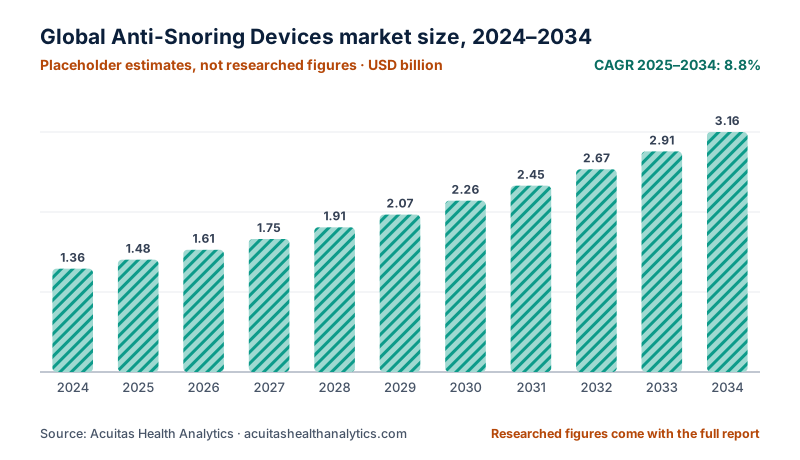
Estimate 2024$1.36 BnPlaceholder estimate
Estimate 2025$1.48 BnPlaceholder estimate
Projected 2034$3.16 Bn 113.6%Adds $1.68 Bn over 9 forecast years
CAGR 2025–20348.8%Faster than 49% of 173 Medical Devices markets here
262 worldwideSource: ClinicalTrials.gov, Studies recruiting, active or not yet recruiting, worldwide. Retrieved 9 Nov 2026.
Formats
PDF, PPTX, XLSX
Sizes and growth here are placeholder estimates, not researched figures. Researched figures come with the full report.
The Global Anti-Snoring Devices Market Executive Summary
Approximately 25% to 50% of adults snore regularly, with about 90 Mn Americans reporting snoring at some point in their lives, and 37 Mn stating they snore regularly. It stems from the inflammation of tissues in the upper airway and causes life-threatening risks such as cardiovascular disease and diabetes. Positional devices, oral appliances, positional aids, and continuous positive airway pressure (CPAP) treatments provide relief by enhancing airflow and avoiding blockage of airways during sleeping.
The market for the anti-snoring device has been growing because of growing awareness of sleep disorders, increasing obesity rates, and the growing elderly population. There is a growing popularity in both invasive and non-invasive treatment options, which include nasal devices, mandibular advancement devices, CPAP machines, and smart wearables. North America is the largest market for injectable drugs followed by Europe and Asia-Pacific, primarily due to increasing accessibility and understanding of healthcare requirements in emerging nations like China and India. Market growth is supported by technology development and new product development.
Global Anti-Snoring Devices market size, 2024–2034. Placeholder estimates; researched figures come with the full report. Source: Acuitas Health Analytics.
Global Anti-Snoring Devices Market Dynamics
Market Growth Drivers
The market of anti-snoring devices is advancing because of increase in the incidence of snoring problems like obstructive sleep apnea due to obesity and increased life span. Awareness of the relative risks to health and greater comfort and convenience offered by technological advancements in devices are other factors that are driving the demand. On the same note, a rising elderly and overweight population, coupled with rising healthcare expenditure and promotional campaigns on health, is leading to the continued growth of the market.
Opportunity
The markets with future development opportunities in the anti-snoring devices market are the Asia-Pacific and Latin American markets, which are experiencing enhancements in healthcare systems and a rise in awareness of this condition. Smart features like smart sensors, wireless solutions, and tailored functions will improve device desirability and performance.
Market Restraints
Some of the challenges affecting the anti-snoring devices market are discomfort among the users, high prices especially where the devices have to be custom made, and questions of inefficiency and lack of adequate scientific evidence. Lack of acceptance related to snoring and competition from related products such as CPAP machines and surgeries also pose as constraints to market growth. Moreover, in areas that are not very exposed to health promotion and awareness campaigns, gaps in knowledge deter demand.
Competitive Landscape for Anti-Snoring Devices Market in Global
December 2025, For the first time, the FDA cleared oral devices that treat severe obstructive sleep apnea (OSA). These devices offer an alternative to more common sleep apnea treatments, like continuous positive airway pressure (CPAP) therapy and surgery.
November 2022, Prosomnus announced Nov. 2, 2022, that it received FDA 510(k) clearance for its ProSomnus EVO [PH] sleep and snore device, a precision oral appliance therapy (OAT) device.
February 2021, The FDA authorized marketing of a new prescription device, eXciteOSA, to reduce snoring and mild obstructive sleep apnea. It is the first device used while awake that is intended to improve tongue muscle function, which in time can help prevent the tongue from collapsing backwards and obstructing the airway during sleep.
Mergers and Acquisitions
July 2024, EnsoData announces the acquisition of sleep testing diagnostic technology from Resonea aimed at reducing the cost of systematically addressing sleep apnea across large patient populations. With this acquisition, EnsoData adds acoustic flow and microphone data channels to enable an exciting new way to pre-screen patients for sleep apnea with an FDA-cleared mobile application and extend the diagnostic capabilities of home sleep testing.
Healthcare Policies and Regulatory Landscape for Anti-Snoring Devices Market in Global
Anti-Snoring Devices worldwide: rules, payment and research
There is no single global regulator; the International Medical Device Regulators Forum (IMDRF) helps national regulators align their device rules.[1] WHO reports that 4.5 billion people were not fully covered by essential health services in 2021.[2] ClinicalTrials.gov lists 262 studies on Anti-Snoring Devices that are recruiting, active or about to start worldwide.[3]
[3]ClinicalTrials.gov, Studies recruiting, active or not yet recruiting, worldwide. Retrieved 9 Nov 2026.
Policy changes and Reimbursement scenario
Regulatory shifts and favourable healthcare campaigns are fostering the use of anti-snoring devices because sleep disorders, including snoring, and OSA are significant concerns. The deregulation of the approval systems and emphasis placed on minimally invasive procedures are positively influencing the development of new products and market participation. The role of reimbursement scenarios is prominent in the context to insurance coverage in regions involving North America that escalates the adoption. An emerging market is present as existing potential markets can progress over time, and this is also applicable to healthcare systems that can improve the access and reimbursement of anti-snoring treatments.
8.2 Government Initiatives / Intervention programs
The anti-snoring devices market can be segmented based on several criteria, including device type, surgical procedure, end user, and geography. Here's a detailed overview of the segmentation:
Other companies that free public records show in this market: trials they lead, US approvals and WHO prequalification. They are not part of our key players research. Each count opens its source.
Also active in this area, from free public records
Source: ClinicalTrials.gov, Active studies (recruiting, about to start or running) each company leads, found with this market's trial search, worldwide. Retrieved 13 Nov 2026.
Source: FDA 510(k) and PMA databases, 510(k) clearances and PMA approvals since 2015 for devices whose name has this market's words. Retrieved 13 Nov 2026.
Beyond the market numbers
Research, trials and patients
What doctors and scientists are doing in Anti-Snoring Devices right now, from free public sources.
Sources:PubMed (US National Library of Medicine),
ClinicalTrials.gov,
World Bank.
Fetched 9 Nov 2026. Papers and trials are found by search words, so the counts are a guide. Titles only; read each paper at its source.
How big is the Anti-Snoring Devices market worldwide?
Placeholder estimate: about $1.48 Bn in 2025, rising to about $3.16 Bn by 2034. These are early estimates, not researched figures; the researched values come with the full report.
How fast is the Anti-Snoring Devices market worldwide growing?
Placeholder estimate: about 8.8% a year (CAGR, 2025–2034). The researched growth rate comes with the full report.
What segments does the Anti-Snoring Devices market report cover?
The report splits the market by device type (Oral Appliances/Mouthpieces, Nasal Devices, Position Control Devices, Chin Straps and more) and end user (Hospitals, Ambulatory Surgical Centres (ASCs), Specialty Clinics, Home Care Settings).
Who are the key players in the Anti-Snoring Devices market?
Key players include ResMed Inc., Koninklijke Philips N.V., SomnoMed, Fisher & Paykel, Apnea Sciences and Tomed.
What is driving the Anti-Snoring Devices market?
The market of anti-snoring devices is advancing because of increase in the incidence of snoring problems like obstructive sleep apnea due to obesity and increased life span.
Who regulates Anti-Snoring Devices worldwide?
There is no single global regulator; the International Medical Device Regulators Forum (IMDRF) helps national regulators align their device rules. Source: International Medical Device Regulators Forum. Checked 14 Nov 2026.
How many clinical trials on Anti-Snoring Devices are running worldwide?
262 studies are recruiting, active or about to start worldwide, according to ClinicalTrials.gov. Source: ClinicalTrials.gov, Studies recruiting, active or not yet recruiting, worldwide. Retrieved 9 Nov 2026.
How much research is published on Anti-Snoring Devices?
PubMed lists 2,051 papers on Anti-Snoring Devices added since January 2021, worldwide. Source: PubMed, Papers added since 1 January 2021 matching this market. Retrieved 9 Nov 2026.



 US
 India
 China
 Canada
 Japan
 Germany
 France
 UK
 Brazil
 Italy
 Ecuador
 Spain
 Saudi Arabia
 Mexico
 Australia
 South Africa
 UAE
 Egypt
 Philippines
 Hong Kong
 Malaysia
 Singapore
 Thailand
 Kenya