Kenya at a glance
- Population
- 57.5 million 2025
- Life expectancy at birth
- 63.8 years, 2024
- People aged 65 and over
- 3.0 % of people, 2025
- Health spending per person
- 85 US$ per person, 2023
- Doctors
- 0.29 per 1,000 people, 2023
 Kenya
Updated
 Reviewed by Vidhi Upadhyay
Kenya Rehabilitation Equipment Market Analysis Trends and Forecast to 2034: Segmented by (By Product Type, By Application, By End User, By Region) - Growth, Market Size, Future Prospects & Competitive Analysis, 2024-2034
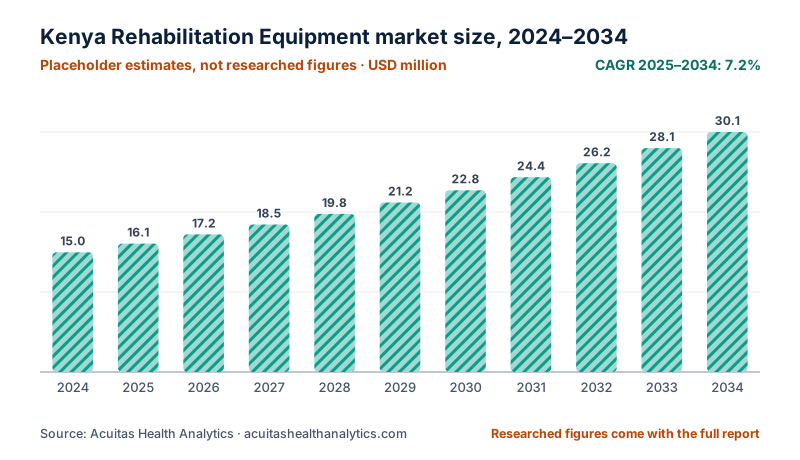
Kenya · 2024–2034 · placeholder estimates
Values shown here are placeholder estimates, not researched figures. Researched 2024 historical, 2025 base-year and 2026–2034 forecast values are prepared with the full report.
 South Africa at $149.9 Mn.
 Egypt at 7.6% a year.
Source: Acuitas Health Analytics. Full methods, sources and usage terms come with report purchase.
$14.0 Mn total, 2026–2034
| Year | Market size | Change that year | Since 2025 |
|---|---|---|---|
| 2024 (estimate) | $15.0 Mn | — | — |
| 2025 (base) | $16.1 Mn | +$1.1 Mn | — |
| 2026 (forecast) | $17.2 Mn | +$1.2 Mn | +7.2% |
| 2027 (forecast) | $18.5 Mn | +$1.2 Mn | +14.9% |
| 2028 (forecast) | $19.8 Mn | +$1.3 Mn | +23.2% |
| 2029 (forecast) | $21.2 Mn | +$1.4 Mn | +32.1% |
| 2030 (forecast) | $22.8 Mn | +$1.5 Mn | +41.6% |
| 2031 (forecast) | $24.4 Mn | +$1.6 Mn | +51.8% |
| 2032 (forecast) | $26.2 Mn | +$1.8 Mn | +62.7% |
| 2033 (forecast) | $28.1 Mn | +$1.9 Mn | +74.4% |
| 2034 (forecast) | $30.1 Mn | +$2.0 Mn | +87% |
Placeholder estimates. Each year is projected from our earlier market estimate and its CAGR. Researched values come with the full report.
 US
$9.11 Bn
 China
$1.86 Bn
 Canada
$1.80 Bn
 Japan
$1.41 Bn
 Germany
$796.7 Mn
 France
$607.9 Mn
 UK
$563.8 Mn
 Brazil
$573.9 Mn
 Italy
$535.5 Mn
 Ecuador
$455.8 Mn
 Spain
$426.6 Mn
 India
$433.1 Mn
 Saudi Arabia
$393.9 Mn
 Mexico
$339.5 Mn
 Australia
$278.0 Mn
South Africa
$149.9 Mn
 UAE
$114.8 Mn
Egypt
$64.8 Mn
 Philippines
$50.0 Mn
 Malaysia
$36.4 Mn
 Hong Kong
$36.8 Mn
 Singapore
$27.3 Mn
 Thailand
$27.2 Mn
Kenya (this report)
$16.1 Mn
| Market size, 2025 | $16.1 Mn placeholder estimate |
|---|---|
| Forecast, 2034 | $30.1 Mn placeholder estimate |
| Growth (CAGR), 2025–2034 | 7.2% placeholder estimate |
| Years | 2024 historical · 2025 base year · 2026–2034 forecast |
| Segments | Product type, application and end-user (see all) |
| Key players | Medline Industries, Inc., Invacare Corporation, Caremax Rehabilitation Equipment Co. Ltd., Drive DeVilbiss Healthcare, Carex Health Brands and 3 more (see all) |
| Regulator in Kenya | PPBSource: Pharmacy and Poisons Board. Checked 14 Nov 2026. |
| Formats | PDF, PPTX, XLSX |
Sizes and growth here are placeholder estimates, not researched figures. Researched figures come with the full report.
Rehabilitation equipment is a unique instrument that assists patients to gain strength, flexibility, and motion after an accident or an illness. This can be applied in different scenarios, where the potential may endure a physical affliction, such as a hospital or rehabilitation centre.
The market for rehabilitation equipment is also growing at a very high rate because of factors such as the growing elderly people, high incidences of ailment and better technology on rehabilitation equipment. Products sold within this market consist of mobility products, daily living aids, fitness and exercise equipment, body support systems, therapeutic products, and cognitive aids for use in hospitals, rehabilitation clinics, home care, and elderly care markets. They are available at higher costs, relatively undeveloped infrastructure in the emerging geographic locations, and varying insurance density. North America has the largest share of the CDMO market due to its highly developed healthcare system and spending, while the Asia-Pacific region has the highest growth rate due to the increased healthcare investment. It is assumed that the market will go on its growth with the help of technological advancements and increased attention to the home-based rehabilitation.
The rehabilitation equipment market is expected to gain remarkable growth due to increase in diseases like arthritis, stroke, and cardiovascular diseases which demand lifelong physical therapy for improving the locomotor disability. These devices are also being demanded by the aging population across the globe who are more prone to these chronic illnesses. Advancements in technology such as the use of robots in therapy, tele-rehabilitation, and apps are enhancing ways of delivering the treatment and patient satisfaction.
There are vast future opportunities in the rehabilitation equipment market with new technologies like AI and robots for individual targeting therapy, tele-rehabilitation in case of limited mobility, and better wearable devices in case of patient compliance. The increasing number of elders and patients with chronic diseases require home care, which has led to the emergence of mobile and inexpensive rehabilitation equipment.
Higher prices allow only few patients to afford highly innovative devices, particularly in developing countries; the reimbursement in countries like Medicare also remain limited. Ignorance of rehabilitation options especially in the developing world reduces the uptake and regulatory issues also slow the release of new products to the market. Also, the scarcity of skilled personnel hinders the utilization of sophisticated tools and technology; fluctuation of the economic times also affects the funding on rehabilitation services. Overcoming these barriers is critical in achieving the optimum market potential.
 Medline Industries, Inc.
 Invacare Corporation
 Caremax Rehabilitation Equipment Co. Ltd.
 Dynatronics Corporation
August 2024, GreenPioneer Mobility launches retail store for rehabilitation and mobility solutions.
May 2024, Dash Rehab launches two three-in-one power rollators for users with limited mobility.
April 2024, Ghent University spin-off OnTracx launches innovative tool for prevention and rehabilitation of running injuries.
March 2024, Trilife Hospital Launches Advanced Neuro Rehabilitation and Sports Medicine Center.
January 2024, Vortex Companies proudly announces UNITED FELTS, the result of the acquisition of Applied Felts Inc., FerraTex Solutions and MaxLiner. UNITED FELTS is the continuation of the premier supplier of Cured-In-Place Pipe (CIPP) in the Americas, signalling a new era in trenchless infrastructure solutions.
September 2025, RehabWeek sees launch of latest Fourier robot.
November 2025, Syrebo Launches New Revolutionary Rehabilitation Robots At MEDICA 2025.
October 2022, DIH Technology, Inc announces acquisition of SafeGait™ Rehabilitation Devices.
The Pharmacy and Poisons Board (PPB) registers medical devices as well as medicines.[1] The Social Health Authority (SHA) replaced the National Health Insurance Fund (NHIF) in October 2024.[2]
[1] Pharmacy and Poisons Board. Checked 14 Nov 2026.
[2] Social Health Authority. Checked 14 Nov 2026.
Reimbursement policies are an issue in the rehabilitation equipment market as industry, Medicare and Medicaid only partially cover such equipment as wheelchairs and hospital beds. Additional barriers are the elaborate process of enrolment and prescription needs to meet specific conditions. Nonetheless, potential growth factors include desirable government policies and investments in the healthcare sector as well as WHO programs such as the GATE and APL to promote the availability of affordable yet superior rehabilitation equipment. Regulations, as helpful as they are in maintaining safety, are also time-consuming and increase costs of production.
What doctors and scientists are doing in Rehabilitation Equipment right now, from free public sources.
Sources: PubMed (US National Library of Medicine), ClinicalTrials.gov, World Bank. Fetched 9 Nov 2026. Papers and trials are found by search words, so the counts are a guide. Titles only; read each paper at its source.
[1] World Bank Open Data, Health spending per person (US$ per person). Retrieved 19 Nov 2026.
[2] World Bank Open Data, Doctors (per 1,000 people). Retrieved 20 Nov 2026.
[3] World Bank Open Data, People aged 65 and over (% of people). Retrieved 19 Nov 2026.
From our blog
Kenya · 2 shared keywords
Kenya · 1 shared keyword
Kenya · 1 shared keyword
Kenya · 1 shared keyword
Kenya · 1 shared keyword
Kenya · 1 shared keyword
Digital Health · Kenya
Healthcare Services · Kenya
Digital Health · Kenya
Pharmaceuticals · Kenya
Pharmaceuticals · Kenya
Pharmaceuticals · Kenya