Patients
| Country | Value | Year |
|---|---|---|
| Argentina | 14.5 | 2023 |
| Brazil | 14.6 | 2023 |
| Chile | 10.0 | 2023 |
| Colombia | 9.8 | 2023 |
| Ecuador | 10.5 | 2023 |
| Haiti | 30.7 | 2023 |
| Mexico | 15.4 | 2023 |
Updated
 Reviewed by Vidhi Upadhyay
Latin America Peripheral Artery Disease Devices Market Industry Trends and Forecast to 2034: Segmented by (Product, Procedure, End User, Region) - Growth, Market Size, Future Prospects & Competitive Analysis, 2024-2034
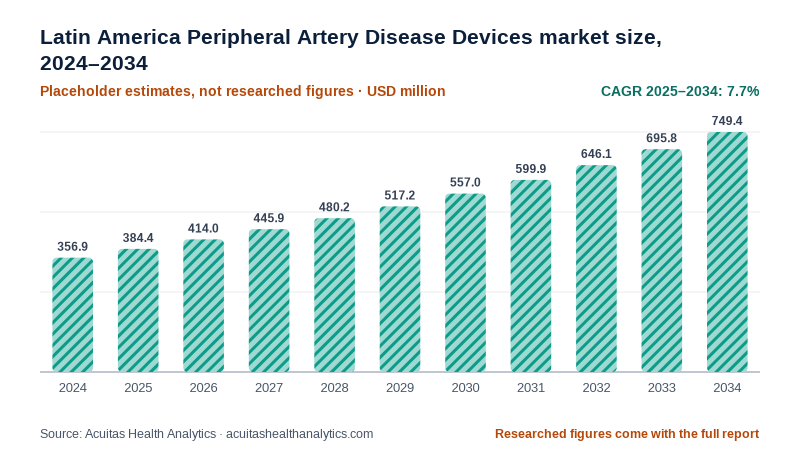
Values shown here are placeholder estimates, not researched figures. Researched 2024 historical, 2025 base-year and 2026–2034 forecast values are prepared with the full report.


Source: Acuitas Health Analytics. Full methods, sources and usage terms come with report purchase.
$365.0 Mn total, 2026–2034
| Year | Market size | Change that year | Since 2025 |
|---|---|---|---|
| 2024 (estimate) | $356.9 Mn | — | — |
| 2025 (base) | $384.4 Mn | +$27.5 Mn | — |
| 2026 (forecast) | $414.0 Mn | +$29.6 Mn | +7.7% |
| 2027 (forecast) | $445.9 Mn | +$31.9 Mn | +16% |
| 2028 (forecast) | $480.2 Mn | +$34.3 Mn | +24.9% |
| 2029 (forecast) | $517.2 Mn | +$37.0 Mn | +34.5% |
| 2030 (forecast) | $557.0 Mn | +$39.8 Mn | +44.9% |
| 2031 (forecast) | $599.9 Mn | +$42.9 Mn | +56.1% |
| 2032 (forecast) | $646.1 Mn | +$46.2 Mn | +68.1% |
| 2033 (forecast) | $695.8 Mn | +$49.7 Mn | +81% |
| 2034 (forecast) | $749.4 Mn | +$53.6 Mn | +95% |
Placeholder estimates. Each year is projected from our earlier market estimate and its CAGR. Researched values come with the full report.
 US
$2.71 Bn
 China
$692.4 Mn
 Canada
$598.1 Mn
 Japan
$469.5 Mn
 Germany
$278.0 Mn
 France
$229.6 Mn
 UK
$209.3 Mn
 Brazil
$212.2 Mn
 Italy
$175.5 Mn
 Saudi Arabia
$138.1 Mn
 Ecuador
$137.4 Mn
 Spain
$128.6 Mn
 Mexico
$121.1 Mn
 India
$122.7 Mn
 Australia
$101.4 Mn
 New Zealand
$83.1 Mn
 Russia
$73.1 Mn
 South Africa
$55.0 Mn
 UAE
$37.2 Mn
 Egypt
$23.9 Mn
 Philippines
$17.2 Mn
 Malaysia
$12.5 Mn
 Hong Kong
$12.3 Mn
 Singapore
$9.4 Mn
 Thailand
$7.8 Mn
 Kenya
$5.1 Mn
| Market size, 2025 | $384.4 Mn placeholder estimate |
|---|---|
| Forecast, 2034 | $749.4 Mn placeholder estimate |
| Growth (CAGR), 2025–2034 | 7.7% placeholder estimate |
| Years | 2024 historical · 2025 base year · 2026–2034 forecast |
| Segments | Product, procedure and end user (see all) |
| Key players | Medtronic, Boston Scientific Corporation, Abbott Laboratories, BD (Becton, Dickinson), Cook Medical (see all) |
| Formats | PDF, PPTX, XLSX |
Sizes and growth here are placeholder estimates, not researched figures. Researched figures come with the full report.
Peripheral artery disease devices open blocked arteries in the legs using balloons, stents and atherectomy tools.
Key segments of the peripheral Artery Disease Devices market include product (Stents, Balloons and Atherectomy Devices) and procedure (Angioplasty, Atherectomy and Bypass).
Heart disease remains the leading cause of death worldwide. An ageing population, more minimally invasive procedures and strong clinical evidence for newer devices are driving the peripheral Artery Disease Devices market.
Less invasive procedures, remote monitoring of implanted devices and rising access to cardiac care in emerging markets give the peripheral Artery Disease Devices market room to grow.
High device prices, the need for trained specialists, reimbursement pressure and product recalls hold back the peripheral Artery Disease Devices market.
The peripheral Artery Disease Devices market is moderately concentrated. Leading companies compete on product innovation, clinical evidence, pricing and geographic reach, and use partnerships and acquisitions to expand their portfolios.
In some of the countries we cover here, medical devices are regulated by ANVISA (Brazil)[1], ARCSA (Ecuador)[2], COFEPRIS (Mexico)[3], ANMAT (Argentina)[4], INVIMA (Colombia)[5] and ISP (Chile)[6]. How care is paid for in some of these countries: the SUS (Brazil)[7]; public care and IESS (Ecuador)[8]; IMSS, ISSSTE and IMSS-Bienestar (Mexico)[9]; public care, obras sociales and prepaid plans (Argentina)[10]; social health insurance (EPS) (Colombia)[11]; and FONASA and ISAPREs (Chile)[12].
[1] ANVISA. Checked 14 Nov 2026.
[2] ARCSA. Checked 14 Nov 2026.
[3] COFEPRIS. Checked 14 Nov 2026.
[4] ANMAT. Checked 19 Nov 2026.
[5] INVIMA. Checked 19 Nov 2026.
[6] Institute of Public Health of Chile (ISP). Checked 19 Nov 2026.
[7] CONITEC. Checked 14 Nov 2026.
[8] Ministry of Public Health of Ecuador. Checked 14 Nov 2026.
[9] Mexican Social Security Institute (IMSS). Checked 14 Nov 2026.
[10] Superintendence of Health Services (SSSalud). Checked 19 Nov 2026.
[11] Ministry of Health and Social Protection. Checked 19 Nov 2026.
[12] FONASA. Checked 19 Nov 2026.
Medical device rules, such as the US FDA 510(k) and PMA pathways and the EU Medical Device Regulation, govern how peripheral Artery Disease Devices products are approved and monitored. Reimbursement codes and hospital purchasing policies decide how widely they are used in Latin America.
What doctors and scientists are doing in Peripheral Artery Disease Devices right now, from free public sources.
| Country | Value | Year |
|---|---|---|
| Argentina | 14.5 | 2023 |
| Brazil | 14.6 | 2023 |
| Chile | 10.0 | 2023 |
| Colombia | 9.8 | 2023 |
| Ecuador | 10.5 | 2023 |
| Haiti | 30.7 | 2023 |
| Mexico | 15.4 | 2023 |
Sources: PubMed (US National Library of Medicine), ClinicalTrials.gov, WHO Global Health Observatory. Fetched 23 Nov 2026. Papers and trials are found by search words, so the counts are a guide. Titles only; read each paper at its source.
From our blog
Latin America · 2 shared keywords
Latin America · 1 shared keyword
Latin America · 1 shared keyword
Latin America · 1 shared keyword
Latin America
Latin America
Digital Health · Latin America
Pharmaceuticals · Latin America
Pharmaceuticals · Latin America
Pharmaceuticals · Latin America
Pharmaceuticals · Latin America
Healthcare Services · Latin America