Microfluidics
Middle East
Updated
 Reviewed by Chandani Patel
Middle East Pet Wearables Market Industry Trends and Forecast to 2034: Segmented by (Product, Application, Region) - Growth, Market Size, Future Prospects & Competitive Analysis, 2024-2034
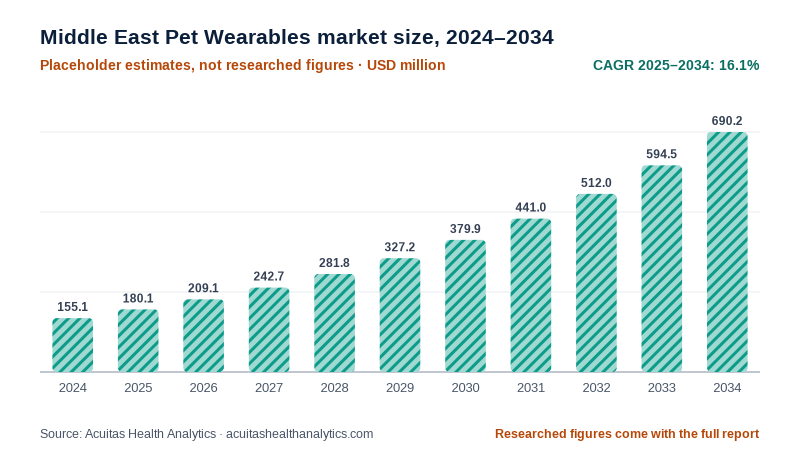
Values shown here are placeholder estimates, not researched figures. Researched 2024 historical, 2025 base-year and 2026–2034 forecast values are prepared with the full report.

Source: Acuitas Health Analytics. Full methods, sources and usage terms come with report purchase.
$510.1 Mn total, 2026–2034
| Year | Market size | Change that year | Since 2025 |
|---|---|---|---|
| 2024 (estimate) | $155.1 Mn | — | — |
| 2025 (base) | $180.1 Mn | +$25.0 Mn | — |
| 2026 (forecast) | $209.1 Mn | +$29.0 Mn | +16.1% |
| 2027 (forecast) | $242.7 Mn | +$33.7 Mn | +34.8% |
| 2028 (forecast) | $281.8 Mn | +$39.1 Mn | +56.5% |
| 2029 (forecast) | $327.2 Mn | +$45.4 Mn | +81.7% |
| 2030 (forecast) | $379.9 Mn | +$52.7 Mn | +110.9% |
| 2031 (forecast) | $441.0 Mn | +$61.2 Mn | +144.9% |
| 2032 (forecast) | $512.0 Mn | +$71.0 Mn | +184.3% |
| 2033 (forecast) | $594.5 Mn | +$82.4 Mn | +230.1% |
| 2034 (forecast) | $690.2 Mn | +$95.7 Mn | +283.3% |
Placeholder estimates. Each year is projected from our earlier market estimate and its CAGR. Researched values come with the full report.
 US
$1.86 Bn
 China
$410.3 Mn
 Canada
$361.3 Mn
 Japan
$258.4 Mn
 Germany
$169.2 Mn
 Brazil
$115.0 Mn
 France
$106.1 Mn
 UK
$98.5 Mn
 Italy
$99.2 Mn
 South Korea
$99.0 Mn
 India
$87.0 Mn
 Spain
$81.0 Mn
 Ecuador
$76.6 Mn
 Mexico
$69.8 Mn
 Saudi Arabia
$68.3 Mn
 Netherlands
$65.5 Mn
 Switzerland
$63.4 Mn
 Australia
$48.9 Mn
 Russia
$43.3 Mn
 New Zealand
$41.7 Mn
 Belgium
$40.3 Mn
 Argentina
$39.9 Mn
 Sweden
$37.7 Mn
 Poland
$30.6 Mn
 Turkey
$27.1 Mn
 South Africa
$26.8 Mn
 UAE
$22.3 Mn
 Chile
$20.1 Mn
 Denmark
$19.3 Mn
 Indonesia
$19.9 Mn
 Israel
$19.4 Mn
 Colombia
$18.7 Mn
 Vietnam
$12.0 Mn
 Egypt
$11.7 Mn
 Philippines
$10.5 Mn
 Nigeria
$9.5 Mn
 Hong Kong
$8.0 Mn
 Malaysia
$7.4 Mn
 Thailand
$6.1 Mn
 Singapore
$4.9 Mn
 Pakistan
$4.6 Mn
 Kenya
$3.3 Mn
 Qatar
$2.7 Mn
| Market size, 2025 | $180.1 Mn placeholder estimate |
|---|---|
| Forecast, 2034 | $690.2 Mn placeholder estimate |
| Growth (CAGR), 2025–2034 | 16.1% placeholder estimate |
| Years | 2024 historical · 2025 base year · 2026–2034 forecast |
| Segments | Product and application (see all) |
| Key players | Garmin, Fi, PetPace, Tractive, Halo Collar (see all) |
| Formats | PDF, PPTX, XLSX |
Sizes and growth here are placeholder estimates, not researched figures. Researched figures come with the full report.
Pet wearables are collars and tags with sensors that track a pet's location, activity, sleep and health signs.
Key segments of the pet wearables market include product (Collars, Tags and Harnesses) and application (Location Tracking, Health Monitoring and Behavior Monitoring).
More pet ownership, demand for meat and milk, and a push for healthier and more productive herds are driving the pet wearables market.
Genetic tools, connected devices and growing pet spending in emerging countries give the pet wearables market room to grow.
Low pet-care spending in many countries, farm cost pressure and animal disease rules hold back the pet wearables market.
The pet wearables market is moderately concentrated. Leading companies compete on product innovation, clinical evidence, pricing and geographic reach, and use partnerships and acquisitions to expand their portfolios.
In some of the countries we cover here, medical devices are regulated by SFDA (Saudi Arabia)[1], EDE (UAE)[2], Ministry of Public Health (Qatar)[3] and AMAR (Israel)[4]. How care is paid for in some of these countries: free public care and CHI-regulated insurance (Saudi Arabia)[5], mandatory health insurance (UAE)[6], public care and compulsory insurance (Qatar)[3] and four health funds (Israel)[4].
[1] Saudi Food and Drug Authority. Checked 14 Nov 2026.
[2] Emirates Drug Establishment. Checked 14 Nov 2026.
[3] Ministry of Public Health, Qatar. Checked 19 Nov 2026.
[4] Israel Ministry of Health. Checked 19 Nov 2026.
[5] Council of Health Insurance. Checked 14 Nov 2026.
[6] Ministry of Human Resources and Emiratisation. Checked 14 Nov 2026.
Medical device rules, such as the US FDA 510(k) and PMA pathways and the EU Medical Device Regulation, govern how pet wearables products are approved and monitored. Reimbursement codes and hospital purchasing policies decide how widely they are used in Middle East.
From our blog
Middle East
Middle East
Middle East
Middle East
Middle East
Middle East
Digital Health · Middle East
Pharmaceuticals · Middle East
OTC & Nutraceuticals · Middle East
Pharmaceuticals · Middle East
Digital Health · Middle East
Public Health · Middle East