


Patients
13.7 % of people 20–79
Diabetes (ages 20–79), US, 2024 (World Bank).
Compare every country on the Public Health DashboardUS Insulin Pens Market Industry Trends and Forecast to 2034: Segmented by (Type, Needle, Region) - Growth, Market Size, Future Prospects & Competitive Analysis, 2024-2034
 US · 2024–2034 · placeholder estimates
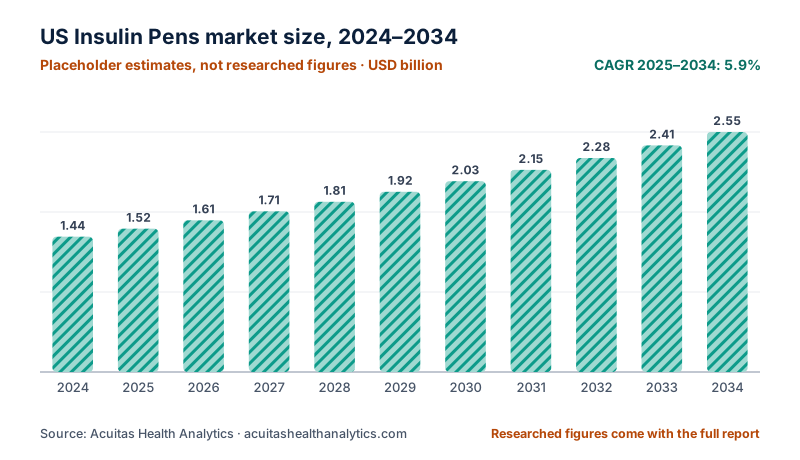
Values shown here are placeholder estimates, not researched figures. Researched 2024 historical, 2025 base-year and 2026–2034 forecast values are prepared with the full report.
US (this report) at $1.52 Bn. Canada at 7.7% a year.
Source: Acuitas Health Analytics. Full methods, sources and usage terms come with report purchase.
$1.03 Bn total, 2026–2034
| Year | Market size | Change that year | Since 2025 |
|---|---|---|---|
| 2024 (estimate) | $1.44 Bn | — | — |
| 2025 (base) | $1.52 Bn | +$84.9 Mn | — |
| 2026 (forecast) | $1.61 Bn | +$89.9 Mn | +5.9% |
| 2027 (forecast) | $1.71 Bn | +$95.2 Mn | +12.1% |
| 2028 (forecast) | $1.81 Bn | +$100.8 Mn | +18.8% |
| 2029 (forecast) | $1.92 Bn | +$106.7 Mn | +25.8% |
| 2030 (forecast) | $2.03 Bn | +$113.0 Mn | +33.2% |
| 2031 (forecast) | $2.15 Bn | +$119.7 Mn | +41.1% |
| 2032 (forecast) | $2.28 Bn | +$126.8 Mn | +49.4% |
| 2033 (forecast) | $2.41 Bn | +$134.2 Mn | +58.2% |
| 2034 (forecast) | $2.55 Bn | +$142.2 Mn | +67.5% |
Placeholder estimates. Each year is projected from our earlier market estimate and its CAGR. Researched values come with the full report.
US (this report)
$1.52 Bn
Canada
$263.7 Mn
 China
$264.7 Mn
 Japan
$238.5 Mn
 Germany
$126.3 Mn
 France
$103.8 Mn
 Brazil
$94.9 Mn
 UK
$82.8 Mn
 Italy
$77.5 Mn
 Ecuador
$78.1 Mn
 Spain
$70.4 Mn
 South Korea
$70.6 Mn
 India
$64.8 Mn
 Saudi Arabia
$59.0 Mn
 Netherlands
$50.4 Mn
 Mexico
$49.4 Mn
 Australia
$39.0 Mn
 Switzerland
$36.8 Mn
 New Zealand
$35.2 Mn
 Russia
$32.7 Mn
 Sweden
$26.9 Mn
 Argentina
$27.3 Mn
 Belgium
$26.5 Mn
 Poland
$26.5 Mn
 Turkey
$19.1 Mn
 South Africa
$19.4 Mn
 UAE
$18.9 Mn
 Indonesia
$15.8 Mn
 Denmark
$14.7 Mn
 Chile
$15.3 Mn
 Israel
$14.3 Mn
 Colombia
$13.6 Mn
 Vietnam
$9.2 Mn
 Egypt
$8.5 Mn
 Philippines
$7.4 Mn
 Nigeria
$6.8 Mn
 Hong Kong
$5.8 Mn
 Malaysia
$5.3 Mn
 Singapore
$4.3 Mn
 Thailand
$3.7 Mn
 Pakistan
$3.6 Mn
 Kenya
$2.2 Mn
 Qatar
$1.8 Mn
| Market size, 2025 | $1.52 Bn placeholder estimate |
|---|---|
| Forecast, 2034 | $2.55 Bn placeholder estimate |
| Growth (CAGR), 2025–2034 | 5.9% placeholder estimate |
| Years | 2024 historical · 2025 base year · 2026–2034 forecast |
| Segments | Type and needle (see all) |
| Key players | Novo Nordisk A/S, Eli Lilly and Company, Sanofi, Ypsomed, Owen Mumford and 1 more (see all) |
| Regulator in the US | FDASource: US Food and Drug Administration. Checked 14 Nov 2026. |
| Formats | PDF, PPTX, XLSX |
Sizes and growth here are placeholder estimates, not researched figures. Researched figures come with the full report.
Insulin pens are handheld injectors that give set doses of insulin, as a simpler option than vials and syringes.
Key segments of the insulin pens market include type (Prefilled Pens, Reusable Pens and Connected Pens) and needle (Standard Needles and Safety Needles).
Rising numbers of people with diabetes, a shift to tools that track and deliver treatment automatically, and more insurance cover are driving the insulin pens market.
Connected devices, lower-priced sensors and new insulins and pills give the insulin pens market room to grow.
High costs for people without cover, price competition and uneven access to care in low-income countries hold back the insulin pens market.
The insulin pens market is moderately concentrated. Leading companies compete on product innovation, clinical evidence, pricing and geographic reach, and use partnerships and acquisitions to expand their portfolios.
The FDA clears or approves medical devices by risk class, through 510(k) clearance, De Novo classification or premarket approval (PMA).[1] Medicare covers people aged 65 and over and some younger people with disabilities, and Medicaid covers many people on low incomes; both are run with the Centers for Medicare & Medicaid Services (CMS).[2] Diabetes (ages 20–79): 13.7% of people 20–79 in 2024, the latest World Bank figure for the US.[3]
[1] US Food and Drug Administration. Checked 14 Nov 2026.
[2] Centers for Medicare & Medicaid Services. Checked 14 Nov 2026.
[3] World Bank Open Data, Diabetes (ages 20–79) (% of people 20–79). Retrieved 21 Nov 2026.
Medical device rules, such as the US FDA 510(k) and PMA pathways and the EU Medical Device Regulation, govern how insulin pens products are approved and monitored. Reimbursement codes and hospital purchasing policies decide how widely they are used in the US.
What doctors and scientists are doing in Insulin Pens right now, from free public sources.
13.7 % of people 20–79
Diabetes (ages 20–79), US, 2024 (World Bank).
Compare every country on the Public Health DashboardSources: PubMed (US National Library of Medicine), ClinicalTrials.gov, World Bank. Fetched 21 Nov 2026. Papers and trials are found by search words, so the counts are a guide. Titles only; read each paper at its source.
[1] World Bank Open Data, Diabetes (ages 20–79) (% of people 20–79). Retrieved 21 Nov 2026.
[2] World Bank Open Data, Health spending per person (US$ per person). Retrieved 22 Nov 2026.
[3] World Bank Open Data, Doctors (per 1,000 people). Retrieved 21 Nov 2026.
From our blog
Pharmaceuticals · US
Healthcare Services · US
Digital Health · US
Pharmaceuticals · US
Pharmaceuticals · US
Pharmaceuticals · US