Africa Treatment-Resistant Depression Drugs Market Industry Trends and Forecast to 2034: Segmented by (Drug Class, Route, End User, Region) - Growth, Market Size, Future Prospects & Competitive Analysis, 2024-2034
Overview
Market Dashboard
Africa · 2024–2034 · placeholder estimates
Values shown here are placeholder estimates, not researched figures. Researched 2024 historical, 2025 base-year and 2026–2034 forecast values are prepared with the
full report.
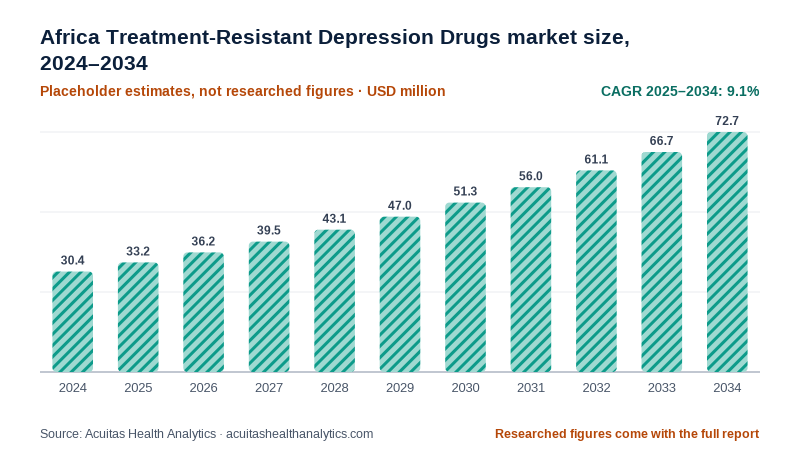
Estimate 2024$30.4 MnPlaceholder estimate
Estimate 2025$33.2 Mn1.4% of the global market
Projected 2034$72.7 Mn 119%Adds $39.5 Mn over 9 forecast years
CAGR 2025–20349.1%Faster than 46% of 187 Pharmaceuticals markets here
Key players5
Africa is 1.42% of the global market.
Among regions, the largest is North America at $1.17 Bn.
1 in AfricaSource: ClinicalTrials.gov, Studies recruiting, active or not yet recruiting, in Africa. Retrieved 12 Nov 2026.
Formats
PDF, PPTX, XLSX
Sizes and growth here are placeholder estimates, not researched figures. Researched figures come with the full report.
The Africa Treatment-Resistant Depression Drugs Market Analysis Executive Summary
Treatment-resistant depression drugs help people whose depression has not improved with at least two standard antidepressants.
Key segments of the treatment-Resistant Depression Drugs market include drug class (NMDA Antagonists, Atypical Antipsychotic Add-Ons and Psychedelics) and route (Oral, Intranasal and Intravenous).
Africa Treatment-Resistant Depression Drugs market size, 2024–2034. Placeholder estimates; researched figures come with the full report. Source: Acuitas Health Analytics.
Africa Treatment-Resistant Depression Drugs Market Dynamics
Market Growth Drivers
More people seeking help for mental health, less stigma, better screening and new treatments with faster effects are driving the treatment-Resistant Depression Drugs market. Governments and employers are investing more in mental health care.
Opportunity
Digital tools, new drug classes and care built into primary care and workplaces give the treatment-Resistant Depression Drugs market strong room to grow worldwide.
Market Restraints
Shortages of mental health professionals, limited insurance coverage, side effects and the need for long-term treatment hold back the treatment-Resistant Depression Drugs market.
Competitive Landscape for Treatment-Resistant Depression Drugs Market in Africa
The treatment-Resistant Depression Drugs market is moderately concentrated. Leading companies compete on product innovation, clinical evidence, pricing and geographic reach, and use partnerships and acquisitions to expand their portfolios.
Healthcare Policies and Regulatory Landscape for Treatment-Resistant Depression Drugs Market in Africa
Treatment-Resistant Depression Drugs in Africa: rules, payment and research
The African Medicines Agency (AMA), set up by an African Union treaty in force since November 2021, aims to bring the work of national regulators together.[1] In some of the countries we cover here, medicines are approved by EDA (Egypt)[2], PPB (Kenya)[3], SAHPRA (South Africa)[4] and NAFDAC (Nigeria)[5]. How care is paid for in some of these countries: universal health insurance (Egypt)[6], the SHA (Kenya)[7], planned National Health Insurance (South Africa)[8] and out of pocket and the NHIA (Nigeria)[9]. ClinicalTrials.gov lists 1 study on Treatment-Resistant Depression Drugs that is recruiting, active or about to start in Africa.[10]
[10]ClinicalTrials.gov, Studies recruiting, active or not yet recruiting, in Africa. Retrieved 12 Nov 2026.
Policy changes and Reimbursement scenario
Regulators such as the US FDA, the European Medicines Agency and national drug authorities set approval, pricing and safety rules for treatment-Resistant Depression Drugs. Reimbursement decisions by public payers and insurers shape how fast new therapies reach patients in Africa.
2.2 Market Size, Growth Prospects and Key findings
3 Market Dynamics
3.1 Market Growth Drivers Analysis
3.2 Market Restraints Analysis
4 Market Segmentation
4.1 By Drug Class
4.2 By Route
4.3 By End User
5 By Market Share
5.1 Market Analysis, Insights and Forecast – By Revenue
6 Competitive Landscape
6.1 Major Top Market Players Products in Pipeline
6.2 R&D Initiatives
6.3 Notable recent Deals
6.3.1 Strategic Divestments
6.3.2 Mergers & Acquisitions
6.3.3 Partnerships
6.3.4 Joint Ventures
7 Key Company Profiles
7.1 Johnson & Johnson (Janssen)
7.2 AbbVie
7.3 Otsuka Pharmaceutical
7.4 Axsome Therapeutics
7.5 Compass Pathways
8 Healthcare Policies and Regulatory Landscape
8.1 Policy changes and Reimbursement scenario
8.2 Government Initiatives / Intervention programs
The treatment-Resistant Depression Drugs market can be segmented based on various criteria, including drug class, route and end user. Here's a breakdown of the market segmentation
Other companies that free public records show in this market: trials they lead, US approvals and WHO prequalification. They are not part of our key players research. Each count opens its source.
Also active in this area, from free public records
Source: ClinicalTrials.gov, Active studies (recruiting, about to start or running) each company leads, found with this market's trial search, worldwide. Retrieved 13 Nov 2026.
Source: Drugs@FDA, US approvals each company holds for medicines on the market whose FDA label lists this use. Retrieved 13 Nov 2026.
Beyond the market numbers
Research, trials and patients
What doctors and scientists are doing in Treatment-Resistant Depression Drugs right now, from free public sources.
Clinical trials
1 active trial in Egypt, South Africa, Kenya, Nigeria, Ethiopia, DR Congo, Uganda, Tanzania, Niger, Mozambique, Sudan, Malawi, Zambia, Mali, Burkina Faso, Ghana and Morocco
Recruiting, about to start, or running now. Counted across the 17 countries we report on in Africa.
Sources:PubMed (US National Library of Medicine),
ClinicalTrials.gov,
WHO Global Health Observatory.
Fetched 24 Nov 2026. Papers and trials are found by search words, so the counts are a guide. Titles only; read each paper at its source.
How big is the Treatment-Resistant Depression Drugs market in Africa?
Placeholder estimate: about $33.2 Mn in 2025, rising to about $72.7 Mn by 2034. These are early estimates, not researched figures; the researched values come with the full report.
How fast is the Treatment-Resistant Depression Drugs market in Africa growing?
Placeholder estimate: about 9.1% a year (CAGR, 2025–2034). The researched growth rate comes with the full report.
What segments does the Treatment-Resistant Depression Drugs market report cover?
The report splits the market by drug class (NMDA Antagonists, Atypical Antipsychotic Add-Ons, Psychedelics, Others), route (Oral, Intranasal, Intravenous) and end user (Hospitals, Specialty Clinics, Retail Pharmacies, Online Pharmacies).
Who are the key players in the Treatment-Resistant Depression Drugs market?
Key players include Johnson & Johnson, AbbVie Inc., Otsuka Pharmaceutical Co., Ltd., Axsome Therapeutics and Compass Pathways.
What is driving the Treatment-Resistant Depression Drugs market?
More people seeking help for mental health, less stigma, better screening and new treatments with faster effects are driving the treatment-Resistant Depression Drugs market. Governments and employers are investing more in mental health care.
Who regulates Treatment-Resistant Depression Drugs in Africa?
The African Medicines Agency (AMA), set up by an African Union treaty in force since November 2021, aims to bring the work of national regulators together. Source: African Union, African Medicines Agency treaty. Checked 14 Nov 2026.
How many clinical trials on Treatment-Resistant Depression Drugs are running in Africa?
1 study is recruiting, active or about to start in Africa, counted across the 17 countries we report on there, according to ClinicalTrials.gov. Source: ClinicalTrials.gov, Studies recruiting, active or not yet recruiting, in Africa. Retrieved 12 Nov 2026.
How much research is published on Treatment-Resistant Depression Drugs?
PubMed lists 3,145 papers on Treatment-Resistant Depression Drugs added since January 2021, worldwide. Source: PubMed, Papers added since 1 January 2021 matching this market. Retrieved 12 Nov 2026.



 US
 China
 Canada
 Japan
 Germany
 UK
 France
 Brazil
 Ecuador
 Italy
 Spain
 Saudi Arabia
 India
 Mexico
 Australia
 Russia
 New Zealand
 South Africa
 UAE
 Egypt
 Philippines
 Malaysia
 Hong Kong
 Singapore
 Thailand
 Kenya
 Aurobindo Pharma
 LivaNova PLC
 Teva Pharmaceutical
 Dr Reddy’s Laboratories
 Apotex Inc