


Animal Health
APAC · 1 shared keyword
Updated
 Reviewed by Vidhi Upadhyay
APAC Women's Health Market Industry Trends and Forecast to 2034: Segmented by (Therapy Area, Product, End User, Region) - Growth, Market Size, Future Prospects & Competitive Analysis, 2024-2034
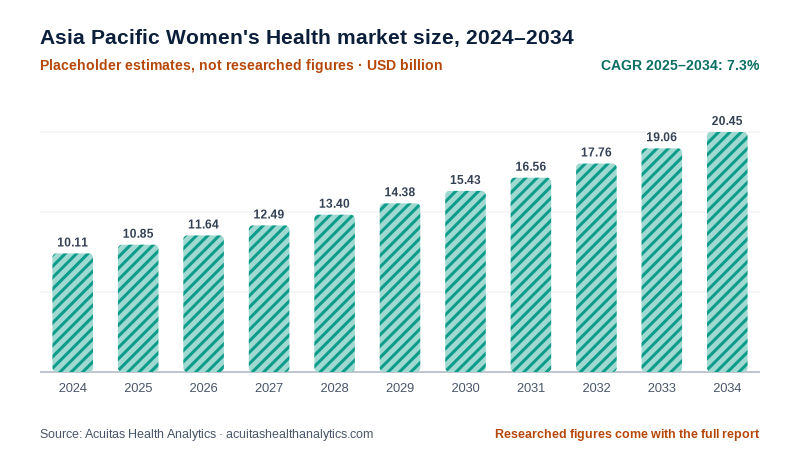
Values shown here are placeholder estimates, not researched figures. Researched 2024 historical, 2025 base-year and 2026–2034 forecast values are prepared with the full report.
Source: Acuitas Health Analytics. Full methods, sources and usage terms come with report purchase.
$9.60 Bn total, 2026–2034
| Year | Market size | Change that year | Since 2025 |
|---|---|---|---|
| 2024 (estimate) | $10.11 Bn | — | — |
| 2025 (base) | $10.85 Bn | +$738.0 Mn | — |
| 2026 (forecast) | $11.64 Bn | +$791.9 Mn | +7.3% |
| 2027 (forecast) | $12.49 Bn | +$849.7 Mn | +15.1% |
| 2028 (forecast) | $13.40 Bn | +$911.8 Mn | +23.5% |
| 2029 (forecast) | $14.38 Bn | +$978.3 Mn | +32.6% |
| 2030 (forecast) | $15.43 Bn | +$1.05 Bn | +42.2% |
| 2031 (forecast) | $16.56 Bn | +$1.13 Bn | +52.6% |
| 2032 (forecast) | $17.76 Bn | +$1.21 Bn | +63.8% |
| 2033 (forecast) | $19.06 Bn | +$1.30 Bn | +75.7% |
| 2034 (forecast) | $20.45 Bn | +$1.39 Bn | +88.5% |
Placeholder estimates. Each year is projected from our earlier market estimate and its CAGR. Researched values come with the full report.
 US
$17.76 Bn
 China
$4.36 Bn
 Canada
$3.97 Bn
 Japan
$3.24 Bn
 Germany
$1.96 Bn
 France
$1.40 Bn
 UK
$1.21 Bn
 Brazil
$1.14 Bn
 Italy
$1.07 Bn
 Spain
$1.05 Bn
 India
$1.11 Bn
 Ecuador
$933.8 Mn
 Saudi Arabia
$950.7 Mn
 South Korea
$880.7 Mn
 Switzerland
$744.0 Mn
 Netherlands
$723.4 Mn
 Mexico
$681.9 Mn
 Australia
$568.8 Mn
 Russia
$550.9 Mn
 New Zealand
$452.9 Mn
 Belgium
$390.5 Mn
 Argentina
$411.8 Mn
 Sweden
$352.4 Mn
 Poland
$326.9 Mn
 South Africa
$298.1 Mn
 UAE
$289.6 Mn
 Turkey
$267.5 Mn
 Indonesia
$273.0 Mn
 Israel
$269.5 Mn
 Denmark
$245.5 Mn
 Chile
$188.4 Mn
 Colombia
$183.7 Mn
 Vietnam
$140.2 Mn
 Philippines
$128.8 Mn
 Egypt
$126.8 Mn
 Nigeria
$110.9 Mn
 Hong Kong
$82.2 Mn
 Malaysia
$70.7 Mn
 Thailand
$65.5 Mn
 Singapore
$61.6 Mn
 Pakistan
$55.4 Mn
 Kenya
$34.4 Mn
 Qatar
$28.6 Mn
| Market size, 2025 | $10.85 Bn placeholder estimate |
|---|---|
| Forecast, 2034 | $20.45 Bn placeholder estimate |
| Growth (CAGR), 2025–2034 | 7.3% placeholder estimate |
| Years | 2024 historical · 2025 base year · 2026–2034 forecast |
| Segments | Therapy area, product and end user (see all) |
| Key players | Bayer AG, Pfizer Inc., Organon, Novo Nordisk A/S, Johnson & Johnson and 1 more (see all) |
| Formats | PDF, PPTX, XLSX |
Sizes and growth here are placeholder estimates, not researched figures. Researched figures come with the full report.
Women's health covers the medicines, devices and care for conditions that affect women, from contraception and pregnancy to menopause.
Key segments of the women's health market include therapy area (Contraception, Menopause and Infertility) and product (Drugs, Devices and Diagnostics).
Ageing populations, more chronic disease, wider access to medicines and pressure on health budgets are driving the women's health market.
Local manufacturing, newer production methods and growing demand in emerging countries give the women's health market room to grow.
Price controls, strict quality rules, drug shortages and thin margins on older products hold back the women's health market.
The women's health market is moderately concentrated. Leading companies compete on product innovation, clinical evidence, pricing and geographic reach, and use partnerships and acquisitions to expand their portfolios.
In some of the countries we cover here, medicines are approved by TGA (Australia)[1], NMPA (China)[2], Drug Office (Hong Kong)[3], CDSCO (India)[4], PMDA (Japan)[5], NPRA (Malaysia)[6], Medsafe (New Zealand)[7], FDA Philippines (Philippines)[8], HSA (Singapore)[9], Thai FDA (Thailand)[10], BPOM (Indonesia)[11], DRAP (Pakistan)[12], MFDS (South Korea)[13] and Drug Administration of Vietnam (Vietnam)[14]. How care is paid for in some of these countries: Medicare and the PBS (Australia)[15], basic medical insurance (China)[16], the Hospital Authority (Hong Kong)[17], Ayushman Bharat PM-JAY (India)[18], public health insurance (Japan)[19], subsidised public care (Malaysia)[20], Pharmac (New Zealand)[21], PhilHealth (Philippines)[22], MediShield Life (Singapore)[23], the Universal Coverage Scheme (Thailand)[24], JKN (BPJS Kesehatan) (Indonesia)[25], out of pocket and Sehat Sahulat (Pakistan)[26], National Health Insurance (South Korea)[27] and social health insurance (Vietnam)[28].
[1] Therapeutic Goods Administration. Checked 14 Nov 2026.
[2] National Medical Products Administration. Checked 14 Nov 2026.
[3] Drug Office, Department of Health. Checked 14 Nov 2026.
[4] Central Drugs Standard Control Organisation. Checked 14 Nov 2026.
[5] Pharmaceuticals and Medical Devices Agency. Checked 14 Nov 2026.
[6] National Pharmaceutical Regulatory Agency. Checked 14 Nov 2026.
[7] Medsafe. Checked 14 Nov 2026.
[8] Food and Drug Administration Philippines. Checked 14 Nov 2026.
[9] Health Sciences Authority. Checked 14 Nov 2026.
[10] Thai Food and Drug Administration. Checked 14 Nov 2026.
[11] National Agency of Drug and Food Control (BPOM). Checked 19 Nov 2026.
[12] Drug Regulatory Authority of Pakistan (DRAP). Checked 19 Nov 2026.
[13] Ministry of Food and Drug Safety. Checked 19 Nov 2026.
[14] Drug Administration of Vietnam. Checked 19 Nov 2026.
[15] Pharmaceutical Benefits Scheme. Checked 14 Nov 2026.
[16] National Healthcare Security Administration. Checked 14 Nov 2026.
[17] Hospital Authority. Checked 14 Nov 2026.
[18] National Health Authority (PM-JAY). Checked 14 Nov 2026.
[19] Ministry of Health, Labour and Welfare. Checked 14 Nov 2026.
[20] Ministry of Health Malaysia. Checked 14 Nov 2026.
[21] Pharmac. Checked 14 Nov 2026.
[22] PhilHealth. Checked 14 Nov 2026.
[23] CPF Board, MediShield Life. Checked 14 Nov 2026.
[24] National Health Security Office. Checked 14 Nov 2026.
[25] BPJS Kesehatan. Checked 19 Nov 2026.
[26] Ministry of National Health Services, Regulations and Coordination. Checked 19 Nov 2026.
[27] Health Insurance Review and Assessment Service (HIRA). Checked 19 Nov 2026.
[28] Vietnam Social Security. Checked 19 Nov 2026.
Regulators such as the US FDA, the European Medicines Agency and national drug authorities set approval, pricing and safety rules for women's health. Reimbursement decisions by public payers and insurers shape how fast new therapies reach patients in APAC.
From our blog
APAC · 1 shared keyword
APAC · 1 shared keyword
APAC · 1 shared keyword
APAC · 1 shared keyword
APAC · 1 shared keyword
APAC · 1 shared keyword
Healthcare Services · APAC
Medical Devices · APAC
Medical Devices · APAC
Healthcare Services · APAC
Digital Health · APAC
Healthcare Services · APAC