Brazil at a glance
- Population
- 212.8 million 2025
- Life expectancy at birth
- 76.0 years, 2024
- People aged 65 and over
- 11.5 % of people, 2025
- Health spending per person
- 1,010 US$ per person, 2023
- Doctors
- 2.36 per 1,000 people, 2023
 Brazil
Updated
 Reviewed by Chandani Patel
Brazil Uterine Fibroids Treatment Market Industry Trends and Forecast to 2034: Segmented by (Treatment, Approach, End User, Region) - Growth, Market Size, Future Prospects & Competitive Analysis, 2024-2034
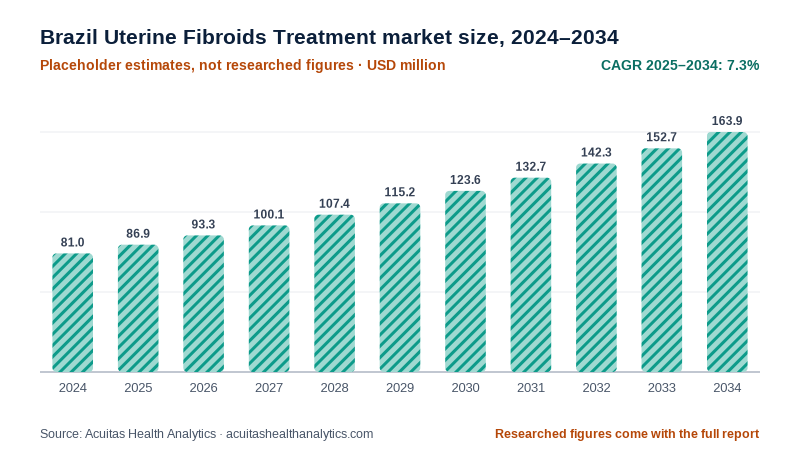
Brazil · 2024–2034 · placeholder estimates
Values shown here are placeholder estimates, not researched figures. Researched 2024 historical, 2025 base-year and 2026–2034 forecast values are prepared with the full report.


 Brazil (this report) at $86.9 Mn. Brazil (this report) at 7.3% a year.
Source: Acuitas Health Analytics. Full methods, sources and usage terms come with report purchase.
$77.0 Mn total, 2026–2034
| Year | Market size | Change that year | Since 2025 |
|---|---|---|---|
| 2024 (estimate) | $81.0 Mn | — | — |
| 2025 (base) | $86.9 Mn | +$5.9 Mn | — |
| 2026 (forecast) | $93.3 Mn | +$6.3 Mn | +7.3% |
| 2027 (forecast) | $100.1 Mn | +$6.8 Mn | +15.1% |
| 2028 (forecast) | $107.4 Mn | +$7.3 Mn | +23.5% |
| 2029 (forecast) | $115.2 Mn | +$7.8 Mn | +32.6% |
| 2030 (forecast) | $123.6 Mn | +$8.4 Mn | +42.2% |
| 2031 (forecast) | $132.7 Mn | +$9.0 Mn | +52.6% |
| 2032 (forecast) | $142.3 Mn | +$9.7 Mn | +63.8% |
| 2033 (forecast) | $152.7 Mn | +$10.4 Mn | +75.7% |
| 2034 (forecast) | $163.9 Mn | +$11.1 Mn | +88.5% |
Placeholder estimates. Each year is projected from our earlier market estimate and its CAGR. Researched values come with the full report.
 US
$1.67 Bn
 Canada
$333.7 Mn
 China
$337.6 Mn
 Japan
$252.3 Mn
 Germany
$148.9 Mn
 UK
$95.6 Mn
 France
$89.5 Mn
 Italy
$90.6 Mn
Brazil (this report)
$86.9 Mn
 Ecuador
$85.3 Mn
 Spain
$74.1 Mn
 India
$78.7 Mn
 Mexico
$63.0 Mn
 Saudi Arabia
$57.5 Mn
 Australia
$49.7 Mn
 New Zealand
$37.9 Mn
 Russia
$34.7 Mn
 South Africa
$22.9 Mn
 UAE
$18.5 Mn
 Egypt
$10.5 Mn
 Philippines
$8.1 Mn
 Malaysia
$6.2 Mn
 Hong Kong
$6.2 Mn
 Singapore
$4.9 Mn
 Thailand
$4.1 Mn
 Kenya
$2.9 Mn
| Market size, 2025 | $86.9 Mn placeholder estimate |
|---|---|
| Forecast, 2034 | $163.9 Mn placeholder estimate |
| Growth (CAGR), 2025–2034 | 7.3% placeholder estimate |
| Years | 2024 historical · 2025 base year · 2026–2034 forecast |
| Segments | Treatment, approach and end user (see all) |
| Key players | AbbVie Inc., Pfizer Inc., Hologic, Inc., Bayer AG, Merit Medical (see all) |
| Regulator in Brazil | ANVISASource: ANVISA. Checked 14 Nov 2026. |
| Formats | PDF, PPTX, XLSX |
Sizes and growth here are placeholder estimates, not researched figures. Researched figures come with the full report.
Uterine fibroid treatment relieves heavy bleeding and pain caused by non-cancer growths in the womb, using medicines or procedures.
Key segments of the uterine Fibroids Treatment market include treatment (GnRH Antagonists, Hormonal Therapy and Uterine Artery Embolization) and approach (Medication, Minimally Invasive Procedures and Surgery).
Greater awareness of women's health needs, more funding for female-focused research, later pregnancies and an ageing female population are driving the uterine Fibroids Treatment market. New products designed around women's biology and digital care are improving access.
Femtech, personalised care and new treatments for under-served conditions open strong growth for the uterine Fibroids Treatment market, especially as employers and payers add women's health benefits.
Under-diagnosis, stigma around some conditions, limited insurance coverage and a long history of under-research in women's health hold back the uterine Fibroids Treatment market.
The uterine Fibroids Treatment market is moderately concentrated. Leading companies compete on product innovation, clinical evidence, pricing and geographic reach, and use partnerships and acquisitions to expand their portfolios.
Medicines need registration with ANVISA, the National Health Surveillance Agency, before sale.[1] The Unified Health System (SUS) gives free public care to everyone, and CONITEC advises which medicines and technologies it adds.[2]
Regulators such as the US FDA, the European Medicines Agency and national drug authorities set approval, pricing and safety rules for uterine Fibroids Treatment. Reimbursement decisions by public payers and insurers shape how fast new therapies reach patients in Brazil.
What doctors and scientists are doing in Uterine Fibroids Treatment right now, from free public sources.
Sources: PubMed (US National Library of Medicine), ClinicalTrials.gov, World Bank. Fetched 12 Nov 2026. Papers and trials are found by search words, so the counts are a guide. Titles only; read each paper at its source.
[1] World Bank Open Data, Health spending per person (US$ per person). Retrieved 23 Nov 2026.
[2] World Bank Open Data, Doctors (per 1,000 people). Retrieved 22 Nov 2026.
[3] World Bank Open Data, People aged 65 and over (% of people). Retrieved 22 Nov 2026.
From our blog
Brazil · 3 shared keywords
Brazil · 2 shared keywords
Brazil · 1 shared keyword
Brazil · 1 shared keyword
Brazil · 1 shared keyword
Brazil · 1 shared keyword
Healthcare Services · Brazil
Medical Devices · Brazil
Healthcare Services · Brazil
Digital Health · Brazil
Healthcare Services · Brazil
Healthcare Services · Brazil