 Aurobindo Pharma
 Novo Nordisk A/S
 Glenmark Pharmaceuticals
Hong Kong at a glance
- Population
- 7.5 million 2025
- Life expectancy at birth
- 85.4 years, 2024
- People aged 65 and over
- 23.7 % of people, 2025
 Hong Kong
Updated
 Reviewed by Chandani Patel
Hong Kong Contraceptives Drugs Market Analysis Industry Trends and Forecast to 2034: Segmented by (By Product Type, By Devices, By Demographics, Behavioural Segmentation, By Gender, By Region) - Growth, Market Size, Future Prospects & Competitive Analysis, 2024-2034
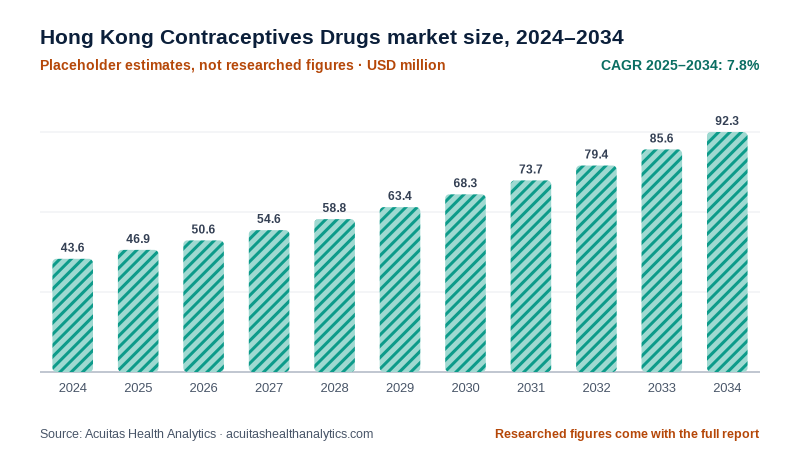
Hong Kong · 2024–2034 · placeholder estimates
Values shown here are placeholder estimates, not researched figures. Researched 2024 historical, 2025 base-year and 2026–2034 forecast values are prepared with the full report.
 China at $2.38 Bn.
 India at 9.8% a year.
Source: Acuitas Health Analytics. Full methods, sources and usage terms come with report purchase.
$45.3 Mn total, 2026–2034
| Year | Market size | Change that year | Since 2025 |
|---|---|---|---|
| 2024 (estimate) | $43.6 Mn | — | — |
| 2025 (base) | $46.9 Mn | +$3.4 Mn | — |
| 2026 (forecast) | $50.6 Mn | +$3.7 Mn | +7.8% |
| 2027 (forecast) | $54.6 Mn | +$3.9 Mn | +16.2% |
| 2028 (forecast) | $58.8 Mn | +$4.3 Mn | +25.3% |
| 2029 (forecast) | $63.4 Mn | +$4.6 Mn | +35% |
| 2030 (forecast) | $68.3 Mn | +$4.9 Mn | +45.6% |
| 2031 (forecast) | $73.7 Mn | +$5.3 Mn | +56.9% |
| 2032 (forecast) | $79.4 Mn | +$5.7 Mn | +69.2% |
| 2033 (forecast) | $85.6 Mn | +$6.2 Mn | +82.4% |
| 2034 (forecast) | $92.3 Mn | +$6.7 Mn | +96.6% |
Placeholder estimates. Each year is projected from our earlier market estimate and its CAGR. Researched values come with the full report.
 US
$11.62 Bn
China
$2.38 Bn
 Canada
$2.30 Bn
 Japan
$1.80 Bn
 Germany
$1.02 Bn
 France
$775.7 Mn
 UK
$719.6 Mn
 Brazil
$732.1 Mn
 Italy
$683.4 Mn
 Ecuador
$581.6 Mn
 Spain
$544.5 Mn
India
$552.5 Mn
 Saudi Arabia
$502.5 Mn
 Mexico
$433.2 Mn
 Australia
$354.7 Mn
 South Africa
$191.2 Mn
 UAE
$146.4 Mn
 Egypt
$82.8 Mn
 Philippines
$63.8 Mn
 Malaysia
$46.4 Mn
Hong Kong (this report)
$46.9 Mn
 Singapore
$34.8 Mn
 Thailand
$34.7 Mn
 Kenya
$20.5 Mn
| Market size, 2025 | $46.9 Mn placeholder estimate |
|---|---|
| Forecast, 2034 | $92.3 Mn placeholder estimate |
| Growth (CAGR), 2025–2034 | 7.8% placeholder estimate |
| Years | 2024 historical · 2025 base year · 2026–2034 forecast |
| Segments | Product type, devices, demographics and gender (see all) |
| Key players | AbbVie Inc., Pfizer Inc., Merck & Co., Inc., Johnson & Johnson, Afaxys, Inc. and 3 more (see all) |
| Regulator in Hong Kong | Drug OfficeSource: Drug Office, Department of Health. Checked 14 Nov 2026. |
| Formats | PDF, PPTX, XLSX |
Sizes and growth here are placeholder estimates, not researched figures. Researched figures come with the full report.
Family planning involves the ability to control the number and the interval of children through the use of contraceptives and fertility management. Contraceptive access is vital for health and human rights; it averts unintended pregnancies, improves maternal health, reduces the demand for unsafe abortio n, and prevents mother-to-child transmission of HIV. Also, family planning helps girl education and women’s employment in the society. Yet, 214 million women in developing countries had unmet needs for contraception in 2017 for reasons such as restricted physical availability, perceived risks, cultural beliefs, lack of quality services, and gender constraints. The most common contraceptives currently in use include the combined estrogen-progesterone preparations, progesterone only preparations, and the continuous or extended use preparations. Contraceptive pills are very reliable, with a failure rate of less than 1% when used correctly with correct usage of the pill taken every day.
The birth control market is a rapidly expanding and highly specialized segment of the pharmaceuticals sector, which provides various methods and means for protecting against pregnancy and some types of STIs. Alternative methods include the pills and injections, barrier methods like the condoms and the more recent ones like the pills with no hormones and the LARCS. It is important for these products to be regulated by the FDA to guarantee that they are safe and efficient before reaching the communities. However, some of the regulatory processes such as those involved in barrier methods have been criticized for being slow and therefore slow to make new products available. Recent changes have now forced OTC vaginal contraceptives to go through intensive clinical trials and get NDAs, which might lead to a decrease in the options especially from firms that are not so big. In sum, the contraceptive market is continuously developing and faces challenges with safety and accessibility as well as challenges to its regulations.
Contraceptive demand worldwide especially among women of child bearing age is on the rise and is currently above 1.1 billion women requiring access to family planning, based on the WHO and UNFP estimate. Market is growing because many women are searching for suitable methods to avoid unplanned pregnancies. This is due to reduced ignorance on birth control methods in low-and middle-income countries as well as health information campaigns by non-governmental organizations as well as health facility organizations. These include the shifting away from traditional contraceptive measures such as IUDs to more effective forms such as injectable and pills, which are less likely to fail and protect against STDs. Other factors that have propelled the need for contraceptive products include fear of getting an STD and teenage unintended pregnancies. Industry players are investing in new products, mergers, and acquisitions to consolidate their positions in the market, as well as driving innovation and product development.
Advanced contraceptive methods, including injectables, oral tablets, and LARCs, are gaining popularity. The integration of technology, such as voice assistants for tracking, is enhancing user experience and adherence. Emerging markets like Asia-Pacific and Africa offer significant growth opportunities due to rising disposable incomes and increased government initiatives. There is also a growing interest in male contraception as social norms shift, presenting opportunities for innovation in this area. E-commerce and virtual pharmacies are creating new distribution channels, expanding access to contraceptive products, especially among younger consumers. The competitive landscape is driving companies to pursue strategic alliances, acquisitions, and R&D investments, with regulatory approvals from bodies like the FDA providing a competitive edge.
There are several threats that may affect the growth of the contraceptive market. Some side effects related to the use of contraceptives include blood clotting and cardiovascular complications may reduce the likelihood of use among women with certain underlying conditions. Some of the studies carried out indicate that there is resistance to contraception due to cultural and religious factors. Lack of information on contraceptives methods or receiving wrong information can even go further in discouraging the potential users. Cost restraints, lack of funding or grants, and other financial issues may lead to difficulties in providing contraceptives and making them easily accessible, especially in low-income communities. Moreover, new types of family planning, such as natural family planning and fertility awareness, minimize the consumption of conventional birth control methods.
 AbbVie, Inc.
 Pfizer Inc.
 Merck & Co., Inc.
 Johnson & Johnson
 Viatris
July 2025, U.S. FDA approved Opill (norgestrel) tablet for nonprescription use to prevent pregnancy- the first daily oral contraceptive approved for use in the U.S. without a prescription
October 2025, Two new contraceptives launched in Karnataka: Subdermal Single Rod contraceptive Implants and SC- MPA Injectable contraceptive
December 2025, The UK has begun the first trial of YCT-529, a hormone-free male contraceptive pill from YourChoice Therapeutics. This pill blocks access to vitamin A, essential for sperm production. The trial, involving 16 participants, will assess its effectiveness and safety, with results expected by June 2024. YCT-529 is 99% effective and fully reversible, representing a significant advance in male contraception.
March 2025, Reckitt Benckiser Group sold its contraception division, including popular brands like Durex, to Mankind Pharma for USD 13 million. This acquisition highlights the ongoing market consolidation as companies aim to strengthen their product portfolios and expand their market presence.
October 2025, Insud Pharma successfully closes acquisition deal for Women’s Healthcare business from Viatris
December 2025, Evofem, marketer of contraceptive gel Phexxi, sells itself to Aditxt in $100M deal
Pharmaceutical products must be registered with the Pharmacy and Poisons Board before sale, through the Drug Office of the Department of Health.[1] Public hospitals and clinics, run by the Hospital Authority, are heavily subsidised by the government.[2]
[1] Drug Office, Department of Health. Checked 14 Nov 2026.
[2] Hospital Authority. Checked 14 Nov 2026.
Some recent regulatory dynamics that have occurred in contraceptive market are as follows: FDA has shortened and then completely removed the long-term toxicology testing requirements for contraceptive drugs that are in line with other drugs. However, the restrictive policy of the FDA still hinders their efficiency in permitting the products in the market and is evident in the 6.5-year approval process for the female condom. Likewise, new regulations for over-the-counter (OTC) contraceptives gives it clinical trials and New Drug Applications (NDA) which has adverse effects on the availability of OTC contraceptives particularly to the smaller manufacturers. In developed countries, good reimbursement policies ensure that contraceptive measures get proper reimbursement hence increasing demand.
What doctors and scientists are doing in Contraceptives Drugs right now, from free public sources.
Sources: PubMed (US National Library of Medicine), ClinicalTrials.gov, World Bank. Fetched 12 Nov 2026. Papers and trials are found by search words, so the counts are a guide. Titles only; read each paper at its source.
[1] World Bank Open Data, People aged 65 and over (% of people). Retrieved 23 Nov 2026.
From our blog
Hong Kong · 2 shared keywords
Hong Kong · 2 shared keywords
Hong Kong · 1 shared keyword
Hong Kong · 1 shared keyword
Hong Kong · 1 shared keyword
Hong Kong · 1 shared keyword
Healthcare Services · Hong Kong
Medical Devices · Hong Kong
Healthcare Services · Hong Kong
Digital Health · Hong Kong
Healthcare Services · Hong Kong
Healthcare Services · Hong Kong