Hong Kong Gastrointestinal Drugs Market Analysis Industry Trends and Forecast to 2034: Segmented by (By Drug Class, By Application, By Route of Administration, By Distribution Channel, By Region) - Growth, Market Size, Future Prospects & Competitive Analysis, 2024-2034
Overview
Market Dashboard
Hong Kong · 2024–2034 · placeholder estimates
Values shown here are placeholder estimates, not researched figures. Researched 2024 historical, 2025 base-year and 2026–2034 forecast values are prepared with the
full report.
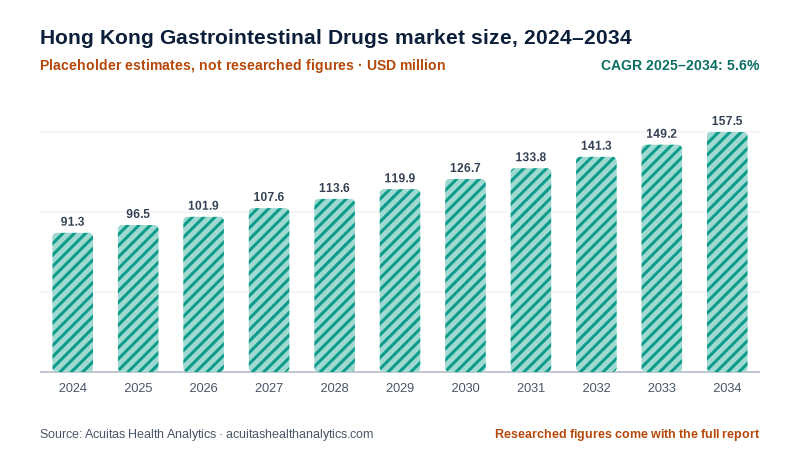
Estimate 2024$91.3 MnPlaceholder estimate
Estimate 2025$96.5 Mn0.2% of the global market
Projected 2034$157.5 Mn 63.3%Adds $61.1 Mn over 9 forecast years
CAGR 2025–20345.6%Faster than 12% of 186 Pharmaceuticals markets here
Sizes and growth here are placeholder estimates, not researched figures. Researched figures come with the full report.
The Hong Kong Gastrointestinal Drugs Market Analysis Executive Summary
Gastrointestinal medications encompass prescription and non-prescription drugs, conventional and non-conventional, small molecules, macromolecules and large recombinant protein molecules. These medications can be classified based on their use: antiemetics and prokinetic agents, laxatives and antidiarrheal agents, drugs for acid peptic disease, drugs for irritable bowel syndrome, inflammatory bowel disease, and miscellaneous categories. Globally, in 2019, there were 88.99 million DALYs due to digestive diseases (3.51% of global DALYs). Digestive diseases were the 13th leading cause of DALYs globally in 2019. Famotidine, sold as Pepcid, was one of the top prescribed medications for gastrointestinal (GI) disorders in 2022, ranking as the third-most prescribed GI medication with 5.8% of all GI prescriptions. Other common medications include Proton Pump Inhibitors such as Nexium, Prevacid, and Prilosec that are used for constant heartburn, stomach acid, or ulcers.
The global gastrointestinal (GI) market has steady growth due to the rising incidence of GI diseases, increased awareness, and new product development. This is due to higher demand for managing Chronic conditions such as GERD and IBD and an aging population that is more liable to these disorders. Current drivers include new biologics and targeted therapies as well as an increasing emphasis on personalized medicine. Reimbursement policies and regulatory approval significantly contribute to drug access and market conditions. Cost factors and insurance fluctuations influence pricing and patients’ availability; reimbursement and regulatory barriers and cost issues arise. It is believed that the said market will grow further with improvements in the kinds of treatment and health policies.
Hong Kong Gastrointestinal Drugs market size, 2024–2034. Placeholder estimates; researched figures come with the full report. Source: Acuitas Health Analytics.
Hong Kong Gastrointestinal Drugs Market Dynamics
Market Growth Drivers
Several factors contributed to the development of the market for GI drugs in the historic period, such as a rise in incidence of GI disorders resulting from changes in lifestyle continued economic revolution in emerging markets, and accelerated research and development costs by pharmaceutical companies. Other factors that prompted the increase in demand of GI drugs were increased insurance coverage and spending on healthcare, as well as an aging population. In the future, the growth of the market is anticipated to remain on an ascending slope due to the growing rates of GI diseases and continuing innovations in the development of drugs and their delivery systems. Furthermore, the continually increasing health care costs and the growth of the geriatric population will continue to drive demand for efficacious remedies and thus contribute to steady growth in the gastrointestinal drugs market.
Opportunity
The market for gastrointestinal drugs is predicted to increase tremendously in the near future because of advancement in biologic medicines and the new trend towards personalized treatment methods which are more precise than the usual medication. Market potential can be seen as the FDA continuously approves biologic drugs like Remicade and Entyvio. Targeted therapy according to genetic and molecular characteristics is increasingly applied, as such approach is more effective and less toxic. Wearables, telemedicine etc improve patient’s experience and results with possible disruptions from startup and pharmaceuticals cooperation. Also, the Asia-Pacific and Latin American regions remain largely unexplored markets where the increase in rates of gastrointestinal diseases and expenditure on healthcare can be capitalized on through local production and partnership. Diversifying drug interactions and fine-tuning therapeutic approaches to GID could be a promising avenue of research to enhance patient care.
Market Restraints
Rising competition due to generic products resulting from expiring patents resulting in cheap prices for gastrointestinal drugs and less market share for the big pharmaceutical firms undermining their revenues growth. Side effects such as nausea vomiting and diarrhea that may accompany the use of some GI medications reduce the level of patient compliance and confidence. Economic downturn might also affect healthcare expenditure and reduce customers’ ability to afford costly treatments, thereby hampering market expansion. Furthermore, disruption of supply chain, can result into scarcities of strategic raw materials for production and distribution.
Competitive Landscape for Gastrointestinal Drugs Market in Hong Kong
June 2024, Sun Pharma inks pact with Takeda to introduce gastrointestinal drug in India. Vonoprazan is a novel, orally active potassium competitive acid blocker (PCAB), used to treat reflux esophagitis and other acid peptic disorders.
May 2025, Upadacitinib, an oral, reversible Janus kinase (JAK) inhibitor, recently received its seventh FDA approval and first for for Crohn’s disease, making this the first oral therapy approved for moderate to severe disease.
Mergers and Acquisitions
June 2024, AbbVie has entered into a $150 million deal with China's FutureGen Biopharmaceutical to secure global rights to FG-M701, an antibody drug targeting TL1A, a molecule associated with inflammatory bowel disease (IBD).
April 2024, ONO Enters into a Definitive Agreement to Acquire Deciphera Pharmaceuticals. Deciphera Pharmaceuticals is known for its expertise in kinase biology and its development of cancer drugs, such as QINLOCK® (for gastrointestinal stromal tumor, GIST) and vimseltinib (for tenosynovial giant cell tumor, TGCT).
Healthcare Policies and Regulatory Landscape for Gastrointestinal Drugs Market in Hong Kong
Gastrointestinal Drugs in Hong Kong: rules and payment
Pharmaceutical products must be registered with the Pharmacy and Poisons Board before sale, through the Drug Office of the Department of Health.[1] Public hospitals and clinics, run by the Hospital Authority, are heavily subsidised by the government.[2]
The nature and trends of the GI medication market are influenced by changes in payment and reimbursement policies. For instance, policy changes that reduced access to metoclopramide resulted in greater use of cisapride. Governments and healthcare systems are also acting to enhance patient access to GI drugs, including for long-term diseases, by promoting rational pricing and efficient registration procedures. Availability and extent of insurance, which differ between public and private insurance programs, thus influence patients’ ability to receive treatments. Reimbursement typically involves a lot of paperwork, which can make it hard. As more therapies are being developed reimbursement strategies are gradually improving to accommodate for new treatment options.
8.2 Government Initiatives / Intervention programs
The gastrointestinal drugs market is segmented into various categories that help in understanding its structure and dynamics. Here are the main segments:
Sources:PubMed (US National Library of Medicine),
ClinicalTrials.gov,
World Bank.
Fetched 9 Nov 2026. Papers and trials are found by search words, so the counts are a guide. Titles only; read each paper at its source.
Public data, with sources
Gastrointestinal Drugs in context
Hong Kong compared
People aged 65 and over: 23.7% of people (2025). World: 10.4% of people (2025). 2nd highest of the 18 countries we cover in APAC.[1]
[1]World Bank Open Data, People aged 65 and over (% of people). Retrieved 23 Nov 2026.
How big is the Gastrointestinal Drugs market in Hong Kong?
Placeholder estimate: about $96.5 Mn in 2025, rising to about $157.5 Mn by 2034. These are early estimates, not researched figures; the researched values come with the full report.
How fast is the Gastrointestinal Drugs market in Hong Kong growing?
Placeholder estimate: about 5.6% a year (CAGR, 2025–2034). The researched growth rate comes with the full report.
What segments does the Gastrointestinal Drugs market report cover?
The report splits the market by drug class (Biologics/Biosimilars, Acid Neutralizers, Antidiarrheal and Laxatives, Antiemetic and Antinauseants and more), application (Inflammatory Bowel Disease (IBD), Gastroesophageal Reflux Disease (GERD), Irritable Bowel Syndrome (IBS), Peptic Ulcer Disease and more), route of administration (Oral, Parenteral, Rectal) and distribution channel (Hospital Pharmacies, Retail Pharmacies, Online Pharmacies).
Who are the key players in the Gastrointestinal Drugs market?
Key players include Sanofi, Bayer AG, Pfizer Inc., GSK PLC, Procter & Gamble and PV Pharma Healthcare, among 8 companies the report profiles.
What is driving the Gastrointestinal Drugs market?
Several factors contributed to the development of the market for GI drugs in the historic period, such as a rise in incidence of GI disorders resulting from changes in lifestyle continued economic revolution in emerging markets, and accelerated research and development costs by pharmaceutical companies.
Who regulates Gastrointestinal Drugs in Hong Kong?
Pharmaceutical products must be registered with the Pharmacy and Poisons Board before sale, through the Drug Office of the Department of Health. Source: Drug Office, Department of Health. Checked 14 Nov 2026.
How is healthcare paid for in Hong Kong?
Public hospitals and clinics, run by the Hospital Authority, are heavily subsidised by the government. Source: Hospital Authority. Checked 14 Nov 2026.
 Hong Kong



 China
 India
 US
 Canada
 Japan
 Germany
 France
 UK
 Brazil
 Italy
 Ecuador
 Spain
 Saudi Arabia
 Mexico
 Australia
 South Africa
 UAE
 Egypt
 Philippines
 Malaysia
 Singapore
 Thailand
 Kenya
 Roche India
 SwisscheM Healthcare Pvt.Ltd