 Regeneron Pharmaceuticals
 Roche
Patients
40.1 % of adults
Obesity (adults), Saudi Arabia, 2024 (WHO).
Compare every country on the Public Health Dashboard Saudi Arabia
Updated
 Reviewed by Chandani Patel
Saudi Arabia Anti-Obesity Drugs Market Industry Trends and Forecast to 2034: Segmented by (Drug Class, Route of Administration, End User, Region) - Growth, Market Size, Future Prospects & Competitive Analysis, 2024-2034
Saudi Arabia · 2024–2034 · placeholder estimates
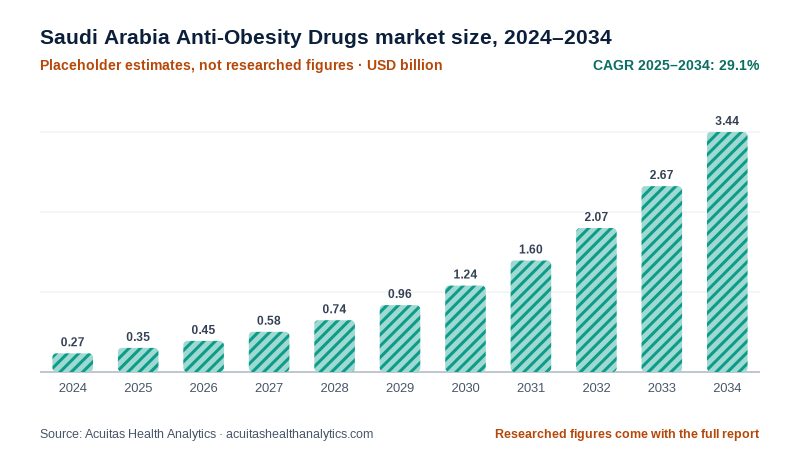
Values shown here are placeholder estimates, not researched figures. Researched 2024 historical, 2025 base-year and 2026–2034 forecast values are prepared with the full report.
Saudi Arabia (this report) at $345.5 Mn. Saudi Arabia (this report) at 29.1% a year.Source: Acuitas Health Analytics. Full methods, sources and usage terms come with report purchase.
$3.10 Bn total, 2026–2034
| Year | Market size | Change that year | Since 2025 |
|---|---|---|---|
| 2024 (estimate) | $267.6 Mn | — | — |
| 2025 (base) | $345.5 Mn | +$77.9 Mn | — |
| 2026 (forecast) | $446.0 Mn | +$100.5 Mn | +29.1% |
| 2027 (forecast) | $575.8 Mn | +$129.8 Mn | +66.7% |
| 2028 (forecast) | $743.4 Mn | +$167.6 Mn | +115.2% |
| 2029 (forecast) | $959.7 Mn | +$216.3 Mn | +177.8% |
| 2030 (forecast) | $1.24 Bn | +$279.3 Mn | +258.6% |
| 2031 (forecast) | $1.60 Bn | +$360.6 Mn | +363% |
| 2032 (forecast) | $2.07 Bn | +$465.5 Mn | +497.7% |
| 2033 (forecast) | $2.67 Bn | +$600.9 Mn | +671.6% |
| 2034 (forecast) | $3.44 Bn | +$775.8 Mn | +896.2% |
Placeholder estimates. Each year is projected from our earlier market estimate and its CAGR. Researched values come with the full report.
 US
$7.98 Bn
 China
$1.67 Bn
 Canada
$1.45 Bn
 Japan
$1.24 Bn
 Germany
$597.9 Mn
 France
$451.8 Mn
 UK
$432.1 Mn
 Italy
$439.5 Mn
 Brazil
$392.8 Mn
 Ecuador
$381.2 Mn
 India
$383.0 Mn
Saudi Arabia (this report)
$345.5 Mn
 Spain
$296.4 Mn
 Mexico
$291.4 Mn
 Australia
$216.8 Mn
 Russia
$193.7 Mn
 New Zealand
$182.6 Mn
 South Africa
$136.4 Mn
 UAE
$88.7 Mn
 Egypt
$49.3 Mn
 Philippines
$39.8 Mn
 Malaysia
$33.3 Mn
 Hong Kong
$30.0 Mn
 Thailand
$24.7 Mn
 Singapore
$20.1 Mn
 Kenya
$13.9 Mn
| Market size, 2025 | $345.5 Mn placeholder estimate |
|---|---|
| Forecast, 2034 | $3.44 Bn placeholder estimate |
| Growth (CAGR), 2025–2034 | 29.1% placeholder estimate |
| Years | 2024 historical · 2025 base year · 2026–2034 forecast |
| Segments | Drug class, route of administration and end user (see all) |
| Key players | Novo Nordisk A/S, Eli Lilly and Company, Boehringer Ingelheim GmbH, Amgen Inc., Currax Pharmaceuticals and 1 more (see all) |
| Regulator in Saudi Arabia | SFDASource: Saudi Food and Drug Authority. Checked 14 Nov 2026. |
| Formats | PDF, PPTX, XLSX |
Sizes and growth here are placeholder estimates, not researched figures. Researched figures come with the full report.
Anti-obesity drugs help people with obesity lose weight and keep it off by reducing appetite, increasing fullness or blocking fat absorption.
Key segments of the anti-Obesity Drugs market include drug class (GLP-1 Agonists, Dual and Triple Agonists and Lipase Inhibitors) and route of administration (Injectable and Oral).
Rising rates of obesity and type 2 diabetes, strong clinical results for new weight-loss medicines and growing acceptance of obesity as a chronic disease are driving the anti-Obesity Drugs market. Wider insurance coverage and more doctors trained in obesity care are adding to demand.
Oral formulations, combination therapies and use in heart, kidney and liver disease open new growth paths for the anti-Obesity Drugs market, especially in fast-growing emerging economies.
High treatment prices, limited reimbursement, supply shortages and side effects that lead some patients to stop treatment hold back the anti-Obesity Drugs market. Long-term safety data and lifestyle support are still needed for many patients.
The anti-Obesity Drugs market is moderately concentrated. Leading companies compete on product innovation, clinical evidence, pricing and geographic reach, and use partnerships and acquisitions to expand their portfolios.
 Novo Nordisk
 Eli Lilly and Company
 Boehringer Ingelheim
 Amgen
The Saudi Food and Drug Authority (SFDA) registers medicines before sale.[1] Citizens get free public care through the Ministry of Health, while most expatriate workers must have private health insurance, regulated by the Council of Health Insurance (CHI).[2] Obesity (adults): 40.1% of adults in 2024, the latest WHO figure for Saudi Arabia.[3]
[1] Saudi Food and Drug Authority. Checked 14 Nov 2026.
[2] Council of Health Insurance. Checked 14 Nov 2026.
[3] WHO Global Health Observatory, Obesity (adults) (% of adults). Retrieved 24 Nov 2026.
Regulators such as the US FDA, the European Medicines Agency and national drug authorities set approval, pricing and safety rules for anti-Obesity Drugs. Reimbursement decisions by public payers and insurers shape how fast new therapies reach patients in Saudi Arabia.
What doctors and scientists are doing in Anti-Obesity Drugs right now, from free public sources.
40.1 % of adults
Obesity (adults), Saudi Arabia, 2024 (WHO).
Compare every country on the Public Health DashboardSources: PubMed (US National Library of Medicine), ClinicalTrials.gov, WHO Global Health Observatory, World Bank. Fetched 24 Nov 2026. Papers and trials are found by search words, so the counts are a guide. Titles only; read each paper at its source.
[1] WHO Global Health Observatory, Obesity (adults) (% of adults). Retrieved 25 Nov 2026.
[2] World Bank Open Data, Health spending per person (US$ per person). Retrieved 25 Nov 2026.
[3] World Bank Open Data, Doctors (per 1,000 people). Retrieved 24 Nov 2026.
From our blog
Saudi Arabia · 3 shared keywords
Saudi Arabia · 2 shared keywords
Saudi Arabia · 2 shared keywords
Saudi Arabia · 2 shared keywords
Saudi Arabia · 2 shared keywords
Saudi Arabia · 2 shared keywords
Public Health · Saudi Arabia
Medical Devices · Saudi Arabia
Medical Devices · Saudi Arabia
Medical Devices · Saudi Arabia
Medical Devices · Saudi Arabia
Medical Devices · Saudi Arabia