 Novartis AG
 AbbVie Inc.
Ecuador at a glance
- Population
- 18.3 million 2025
- Life expectancy at birth
- 77.6 years, 2024
- People aged 65 and over
- 8.6 % of people, 2025
- Health spending per person
- 509 US$ per person, 2023
- Doctors
- 2.31 per 1,000 people, 2020
 Ecuador
Updated
 Reviewed by Vidhi Upadhyay
Ecuador Brain Imaging, Biomarkers and Neuroinformatics Market Analysis Industry Trends and Forecast to 2034: Segmented by (By Imaging Technology, By Biomarker Type, By Application, By End User, By Region) - Growth, Market Size, Future Prospects & Competitive Analysis, 2024-2034
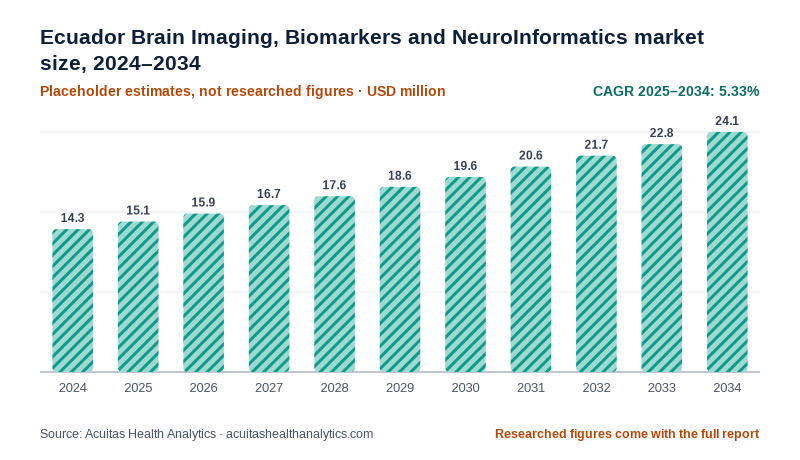
Ecuador · 2024–2034 · placeholder estimates
Values shown here are placeholder estimates, not researched figures. Researched 2024 historical, 2025 base-year and 2026–2034 forecast values are prepared with the full report.
 Brazil at $19.0 Mn. Brazil at 5.7% a year.
Source: Acuitas Health Analytics. Full methods, sources and usage terms come with report purchase.
$9.0 Mn total, 2026–2034
| Year | Market size | Change that year | Since 2025 |
|---|---|---|---|
| 2024 (estimate) | $14.3 Mn | — | — |
| 2025 (base) | $15.1 Mn | +$0.8 Mn | — |
| 2026 (forecast) | $15.9 Mn | +$0.8 Mn | +5.3% |
| 2027 (forecast) | $16.7 Mn | +$0.8 Mn | +10.9% |
| 2028 (forecast) | $17.6 Mn | +$0.9 Mn | +16.8% |
| 2029 (forecast) | $18.6 Mn | +$0.9 Mn | +23.1% |
| 2030 (forecast) | $19.6 Mn | +$1.0 Mn | +29.6% |
| 2031 (forecast) | $20.6 Mn | +$1.0 Mn | +36.5% |
| 2032 (forecast) | $21.7 Mn | +$1.1 Mn | +43.8% |
| 2033 (forecast) | $22.8 Mn | +$1.2 Mn | +51.4% |
| 2034 (forecast) | $24.1 Mn | +$1.2 Mn | +59.5% |
Placeholder estimates. Each year is projected from our earlier market estimate and its CAGR. Researched values come with the full report.
 US
$301.2 Mn
 China
$61.7 Mn
 Canada
$59.6 Mn
 Japan
$46.8 Mn
 Germany
$26.4 Mn
 France
$20.1 Mn
 UK
$18.7 Mn
Brazil
$19.0 Mn
 Italy
$17.7 Mn
Ecuador (this report)
$15.1 Mn
 Spain
$14.1 Mn
 India
$14.4 Mn
 Saudi Arabia
$13.1 Mn
 Mexico
$11.2 Mn
 Australia
$9.2 Mn
 South Africa
$4.9 Mn
 UAE
$3.8 Mn
 Egypt
$2.1 Mn
 Philippines
$1.7 Mn
 Hong Kong
$1.2 Mn
 Malaysia
$1.2 Mn
 Singapore
$0.9 Mn
 Thailand
$0.9 Mn
 Kenya
$0.6 Mn
| Market size, 2025 | $15.1 Mn placeholder estimate |
|---|---|
| Forecast, 2034 | $24.1 Mn placeholder estimate |
| Growth (CAGR), 2025–2034 | 5.33% placeholder estimate |
| Years | 2024 historical · 2025 base year · 2026–2034 forecast |
| Segments | Imaging technology, biomarker type, application and end user (see all) |
| Key players | Siemens Healthineers, GE Healthcare, Johnson & Johnson, Roche Diagnostics, Thermo Fisher Scientific Inc. and 1 more (see all) |
| Formats | PDF, PPTX, XLSX |
Sizes and growth here are placeholder estimates, not researched figures. Researched figures come with the full report.
A biomarker is defined as any characteristic that can be measured and assessed as an outcome of a biological condition, illness, or response to treatment. Neuroimaging biomarkers involves use of brain imaging techniques with the aim of imaging the morphology such as MRI, function as seen in MRI, the microenvironment for instance perfusion-MRI, the metabolism as illustrated by PET-FDG or the molecular content for instance the MR spectroscopy of the brain and its lesions (Boland 2014). Imaging biomarkers of AD are amyloid PET that shows beta-amyloid deposition, FDG-PET, which shows brain metabolic rate, and MRI that shows brain and hippocampal volume (Bateman et al. 2012).
The global market for brain imaging, biomarkers, and neuroinformatics is significant for the segmentation and management of neurological diseases such as Alzheimer’s and Parkinson’s diseases. This market is growing significantly due to the growing instances of these diseases, new developments in technology, and higher investment in research. Specific areas of interest include imaging technologies such as neuroMRI, molecular and imaging biomarkers, and data analysis tools in neuroinformatics. Possible drawbacks are high costs, the need to meet regulations, and data privacy. The regional markets that dominate the industry include North America and Asia-Pacific, which the latter currently displays fast growth. New opportunities are locked in the integration of AI into the market and the promise of expanding its horizons through the creation of non-invasive biomarkers.
Increased rates of neurodegenerative diseases including Alzheimer, Parkinson, and strokes, which require accurate diagnosis and management. Imaging techniques - MRI, PET and CT scans coupled with the introduction of multifaceted imaging approaches have enriched brain health evaluation. Another factor that is expanding the market is the increased interest in personalized medicine due to the need for targeted therapies. Further, technological advancement, increase in aging population across the world, the growing application of neuroinformatics, research grant for neurological disorders, and awareness about neurological disorders are some factors tilting the market towards the positive side.
AI and machine learning for improved diagnostics and individualised treatment. The need for infrastructures such as fMRI and better PET scans creates opportunities for innovation. It is possible to speak about growth in emerging markets because the healthcare system in the countries is constantly improving while the awareness of neurological disorders is gradually increasing. Allyship and partnerships are useful for both innovation and commercialization purposes, and progressive policies in regulation and reimbursement will increase the uptake of advanced imaging technologies.
Complex data interpretation based on brain imaging or neuroinformatics often involves specialized skills, which tends to be scarce. Challenges to regulatory approval and the cost of implementing new imaging methods can act as a detriment to implementation and adoption. Lack of knowledge about the HRS among both the providers of care and the patients, as well as data privacy concerns, also limit the market’s growth. Finally, the threat of new entrants in the diagnostic devices market is a threat to the established imaging and biomarker technologies.
 Siemens Healthineers
 GE Healthcare
 Johnson & Johnson
 Roche Diagnostics
December 2025, Quibim’s AI-based early-stage neurological disease quantification software for quantification of early brain atrophy and lesions authorized for use in US, EU & UK. Product significantly improves patient outcomes by enabling earlier diagnosis.
October 2022, The Foundation for the National Institutes of Health (FNIH) Biomarkers Consortium (BC) launched a project that signals a paradigm shift in our methods to image the brain. Using advances in PET (positron emission topography) technology, the project will focus on measuring the integrity of synapses—tiny gaps that connect neurons and communicate information to the brain. Loss of these synapse connections strongly correlates with cognitive decline in Alzheimer’s disease (AD).
November 2021, SWADESH, World’s First Multimodal Brain Imaging Data and Analytics, Developed at DBT-National Brain Research Centre, Haryana.
The Ministry of Public Health runs free public care, and the Ecuadorian Social Security Institute (IESS) covers formal workers.[1]
[1] Ministry of Public Health of Ecuador. Checked 14 Nov 2026.
To meet the increasing demand for brain imaging approaches and biomarkers literally, governments are streamlining the regulations and offering research grants. New technologies’ assessment and reimbursement are being influenced by the HTA; increased insurance coverage and value-based diagnosis are making these diagnostics more accessible. Further, clinical practice guidelines endorsing particular image and biomarker tests drive insurers to cover them, strengthening these specialized diagnostics’ adoption into practice.
What doctors and scientists are doing in Brain Imaging, Biomarkers and NeuroInformatics right now, from free public sources.
Sources: PubMed (US National Library of Medicine), ClinicalTrials.gov, World Bank. Fetched 9 Nov 2026. Papers and trials are found by search words, so the counts are a guide. Titles only; read each paper at its source.
[1] World Bank Open Data, Health spending per person (US$ per person). Retrieved 25 Nov 2026.
[2] World Bank Open Data, Doctors (per 1,000 people). Retrieved 24 Nov 2026.
[3] World Bank Open Data, People aged 65 and over (% of people). Retrieved 24 Nov 2026.
From our blog
Ecuador · 2 shared keywords
Ecuador · 2 shared keywords
Ecuador · 2 shared keywords
Ecuador · 2 shared keywords
Ecuador · 1 shared keyword
Ecuador · 1 shared keyword
Medical Devices · Ecuador
Pharmaceuticals · Ecuador
Pharmaceuticals · Ecuador
Medical Devices · Ecuador
Healthcare Services · Ecuador
Pharmaceuticals · Ecuador