
Clinical trials
1 active trial in Hong Kong
Recruiting, about to start, or running now.
- 3D-Printed Patient-Specific Surgical Plates Versus Conventional Surgical Plates in Jaw Reconstruction NCT04635865
 Hong Kong
Updated
 Reviewed by Chandani Patel
Hong Kong 3D Printed Implants Market Industry Trends and Forecast to 2034: Segmented by (Application, End-user, Region) - Growth, Market Size, Future Prospects & Competitive Analysis, 2024-2034
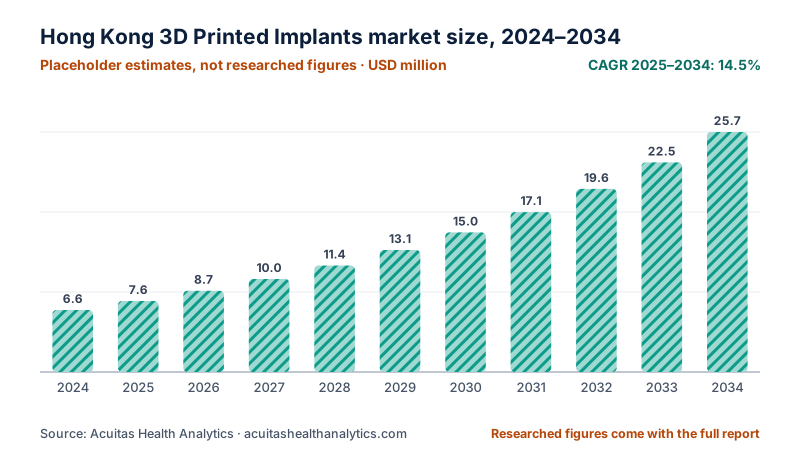
Hong Kong · 2024–2034 · placeholder estimates
Values shown here are placeholder estimates, not researched figures. Researched 2024 historical, 2025 base-year and 2026–2034 forecast values are prepared with the full report.
 China at $382.7 Mn.
 India at 16.5% a year.
Source: Acuitas Health Analytics. Full methods, sources and usage terms come with report purchase.
$18.1 Mn total, 2026–2034
| Year | Market size | Change that year | Since 2025 |
|---|---|---|---|
| 2024 (estimate) | $6.6 Mn | — | — |
| 2025 (base) | $7.6 Mn | +$1.0 Mn | — |
| 2026 (forecast) | $8.7 Mn | +$1.1 Mn | +14.5% |
| 2027 (forecast) | $10.0 Mn | +$1.3 Mn | +31.1% |
| 2028 (forecast) | $11.4 Mn | +$1.4 Mn | +50.1% |
| 2029 (forecast) | $13.1 Mn | +$1.7 Mn | +71.9% |
| 2030 (forecast) | $15.0 Mn | +$1.9 Mn | +96.8% |
| 2031 (forecast) | $17.1 Mn | +$2.2 Mn | +125.3% |
| 2032 (forecast) | $19.6 Mn | +$2.5 Mn | +158% |
| 2033 (forecast) | $22.5 Mn | +$2.8 Mn | +195.4% |
| 2034 (forecast) | $25.7 Mn | +$3.3 Mn | +238.3% |
Placeholder estimates. Each year is projected from our earlier market estimate and its CAGR. Researched values come with the full report.
 US
$1.88 Bn
China
$382.7 Mn
 Canada
$371.0 Mn
 Japan
$290.9 Mn
 Germany
$164.4 Mn
 France
$125.3 Mn
 UK
$116.4 Mn
 Brazil
$118.0 Mn
 Italy
$110.3 Mn
 Ecuador
$93.8 Mn
 Spain
$88.0 Mn
India
$88.9 Mn
 Saudi Arabia
$80.9 Mn
 Mexico
$69.9 Mn
 Australia
$57.1 Mn
 South Africa
$30.8 Mn
 UAE
$23.6 Mn
 Egypt
$13.4 Mn
 Philippines
$10.3 Mn
Hong Kong (this report)
$7.6 Mn
 Malaysia
$7.5 Mn
 Singapore
$5.6 Mn
 Thailand
$5.6 Mn
 Kenya
$3.3 Mn
| Market size, 2025 | $7.6 Mn placeholder estimate |
|---|---|
| Forecast, 2034 | $25.7 Mn placeholder estimate |
| Growth (CAGR), 2025–2034 | 14.5% placeholder estimate |
| Years | 2024 historical · 2025 base year · 2026–2034 forecast |
| Segments | Application and end-user (see all) |
| Key players | 3D Systems Corporation, Stratasys Ltd., Materialise NV, Stryker, Zimmer Biomet Holdings, Inc. and 5 more (see all) |
| Active clinical trials | 1 in Hong KongSource: ClinicalTrials.gov, Studies recruiting, active or not yet recruiting, in Hong Kong. Retrieved 9 Nov 2026. |
| Formats | PDF, PPTX, XLSX |
Sizes and growth here are placeholder estimates, not researched figures. Researched figures come with the full report.
3D printed implants can be defined as human medical artificial parts produced through advanced manufacturing technique known as additive manufacturing. They can be also designed to conform with patients’ anatomic characteristics which can enhance performance of surgical procedures and minimizes post-surgical recovery period. Some of the uses include; orthopaedics implants, dental prosthetics, cranial plates among others.
The scenario for the international market of 3D printed implants is in constant progress, and the application of such technology is extended to more and more fields of medicine. Researches show that this technology is a result of increased requirement of patient centred solutions. Adoption rates are increasing as more healthcare facilities begin to appreciate the application of 3D printing, such as shorten implant manufacturing time by 50%, and the general cost of surgery is lowered by roughly 30% because of lesser operating time and enhanced patient results.
Although existing countries like the U. S. are coming up with measures to regulate the use of the 3D printed implants through the Food and Drug Administration Body. To date, over a 100 medical devices printed through 3D printing have received FCC approval, entrusting this technology’s acceptance to progressive healthcare facilities. Some of the countries that are pioneering the use of 3D printing are the U. S, Germany, and the Netherlands that have shown many clinical solutions proving the efficiency of 3D print implants in enhancing the quality of life. It can be concluded that the application of additive manufacturing to produce implants will become a significant part of advanced medicine in the future, which will need to be tailored specifically to the patient
The use of 3D printed implants is positively impacted by their capacity to produce customized solutions that can also improve their patient’s results. Some of these studies suggest that such implants can be custom developed to match the size and shape of a patient’s anatomy, with a consequent increase in the accuracy and efficacy of surgery, and a simultaneous reduction in post-surgical healing periods. A paper on Additive Manufacturing revealed that the use of 3D printed implants has the ability of reducing surgery time by as much as 50%, an improvement that cuts across on efficiency as well as patient safety. In addition, expanding awareness of the additive manufacturing technologies among the health care providers and progress in the existing legislation act as a catalyst for implementation of the 3D printed implants in clinic that makes them available for patients.
Opportunity includes biodegradable implants, used to dissolve in the body after the required purpose, therefore, eliminating the need for a follow-up surgery or operation. This is especially useful in children, for they need tissue expanders that are used for a limited time only. Furthermore, the bio printing is expanding as a revolutionary procedure in which patients can get living tissues and organs from viable cells and can bring drastic change in the field of transplant medicine
However, there are certain challenges that have posed a challenge around 3D printed implants to gain popularity among patients and clinicians. This is because there is an evidently high level of regulatory scrutiny when it comes to approval of such devices. The lack of standardized regulations and guidelines for 3D printed medical devices can lead to delays in approval processes, creating uncertainty for manufacturers and healthcare providers. Furthermore, long-term stability and biocompatibility of the used materials could be another reason for the clinicians’ reticence to adopt the 3D printed materials fully. Since 3D printing requires immense capital investment upfront, especially in hospitals, the factors such as specialized training negate the idea, making it challenging for many facilities and healthcare organizations to consider it as a viable solution.
 Stratasys Ltd.
 Stryker Corporation
 Zimmer Biomet Holdings, Inc.
 Johnson & Johnson Services, Inc.
 Medtronic plc
 EOS GmbH
 Renishaw plc
September 2025, DeGen Medical, Inc. has launched the Solar AM implant, a new addition to their Puri-Ti portfolio for anterior lumbar interbody fusion (ALIF) procedures. This spinal implant features a proprietary additive manufacturing process, setting a new industry standard with innovative features.
August 2025, Theken Companies, an Ohio-based medical implant conglomerate, has acquired VisionAir Solutions, a spinout from the Cleveland Clinic. VisionAir’s flagship technology produces 3D-printed airway stents tailored to each patient’s anatomy
Public hospitals and clinics, run by the Hospital Authority, are heavily subsidised by the government.[1] ClinicalTrials.gov lists 1 study on 3D Printed Implants that is recruiting, active or about to start in Hong Kong.[2]
[1] Hospital Authority. Checked 14 Nov 2026.
[2] ClinicalTrials.gov, Studies recruiting, active or not yet recruiting, in Hong Kong. Retrieved 9 Nov 2026.
Policy changes and Reimbursement scenario
It is important to know that the use of 3D printed implants is still in its early days and while governments and major bureaus are trying to adapt legislation to accommodate such technology the major regulatory organizations such as the U. S. FDA are establishing guidelines in order to assure safety and effectiveness of implant usage. This is important in gaining confidence with clinician and the patients on the application of telemedicine. As for the reimbursement, there is the awareness of many patients requiring reimbursement for 3D printed implants and this has been noted as a concern especially with increased adoption of value-based care. The two major health insurers of the Americans, Medicare and Medicaid are now in the process of implementing these technologies into their payment methodologies to make patients have easy access. Also, the global work towards increasing regulatory comparability will support a quicker market presence’s improvements which will help patients from all around the world.
What doctors and scientists are doing in 3D Printed Implants right now, from free public sources.
1 active trial in Hong Kong
Recruiting, about to start, or running now.
Sources: PubMed (US National Library of Medicine), ClinicalTrials.gov, World Bank. Fetched 9 Nov 2026. Papers and trials are found by search words, so the counts are a guide. Titles only; read each paper at its source.
[1] World Bank Open Data, People aged 65 and over (% of people). Retrieved 16 Nov 2026.
From our blog
Hong Kong · 6 shared keywords
Hong Kong · 5 shared keywords
Hong Kong · 3 shared keywords
Hong Kong · 3 shared keywords
Hong Kong · 3 shared keywords
Hong Kong · 3 shared keywords
Medical Devices · Hong Kong
Pharmaceuticals · Hong Kong
Pharmaceuticals · Hong Kong
OTC & Nutraceuticals · Hong Kong
Healthcare Services · Hong Kong
Pharmaceuticals · Hong Kong