Hong Kong at a glance
- Population
- 7.5 million 2025
- Life expectancy at birth
- 85.4 years, 2024
- People aged 65 and over
- 23.7 % of people, 2025
 Hong Kong
Updated
 Reviewed by Vidhi Upadhyay
Hong Kong Bone & Joint Health Supplements Market Industry Trends and Forecast to 2034: Segmented by (Application, Form, Region) - Growth, Market Size, Future Prospects & Competitive Analysis, 2024-2034
Hong Kong · 2024–2034 · placeholder estimates
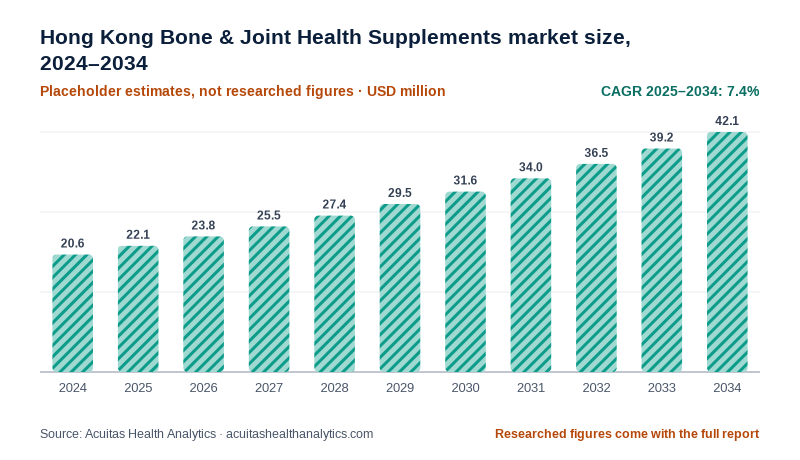
Values shown here are placeholder estimates, not researched figures. Researched 2024 historical, 2025 base-year and 2026–2034 forecast values are prepared with the full report.
 China at $1.12 Bn.
 India at 9.4% a year.
Source: Acuitas Health Analytics. Full methods, sources and usage terms come with report purchase.
$20.0 Mn total, 2026–2034
| Year | Market size | Change that year | Since 2025 |
|---|---|---|---|
| 2024 (estimate) | $20.6 Mn | — | — |
| 2025 (base) | $22.1 Mn | +$1.5 Mn | — |
| 2026 (forecast) | $23.8 Mn | +$1.6 Mn | +7.4% |
| 2027 (forecast) | $25.5 Mn | +$1.8 Mn | +15.3% |
| 2028 (forecast) | $27.4 Mn | +$1.9 Mn | +23.9% |
| 2029 (forecast) | $29.5 Mn | +$2.0 Mn | +33.1% |
| 2030 (forecast) | $31.6 Mn | +$2.2 Mn | +42.9% |
| 2031 (forecast) | $34.0 Mn | +$2.3 Mn | +53.5% |
| 2032 (forecast) | $36.5 Mn | +$2.5 Mn | +64.8% |
| 2033 (forecast) | $39.2 Mn | +$2.7 Mn | +77% |
| 2034 (forecast) | $42.1 Mn | +$2.9 Mn | +90.1% |
Placeholder estimates. Each year is projected from our earlier market estimate and its CAGR. Researched values come with the full report.
 US
$5.49 Bn
China
$1.12 Bn
 Canada
$1.09 Bn
 Japan
$852.4 Mn
 Germany
$480.5 Mn
 France
$366.6 Mn
 UK
$340.1 Mn
 Brazil
$346.0 Mn
 Italy
$323.0 Mn
 Ecuador
$274.9 Mn
 Spain
$257.3 Mn
India
$261.1 Mn
 Saudi Arabia
$237.5 Mn
 Mexico
$204.7 Mn
 Australia
$167.7 Mn
 South Africa
$90.4 Mn
 UAE
$69.2 Mn
 Egypt
$39.1 Mn
 Philippines
$30.2 Mn
 Malaysia
$21.9 Mn
Hong Kong (this report)
$22.1 Mn
 Singapore
$16.5 Mn
 Thailand
$16.4 Mn
 Kenya
$9.7 Mn
| Market size, 2025 | $22.1 Mn placeholder estimate |
|---|---|
| Forecast, 2034 | $42.1 Mn placeholder estimate |
| Growth (CAGR), 2025–2034 | 7.4% placeholder estimate |
| Years | 2024 historical · 2025 base year · 2026–2034 forecast |
| Segments | Application and form (see all) |
| Key players | Amway, Arazo Nutrition, ADM, Bayer AG, BASF SE and 5 more (see all) |
| Regulator in Hong Kong | Drug Office and Centre for Food SafetySource: Drug Office, Department of Health. Checked 14 Nov 2026.Source: Centre for Food Safety. Checked 14 Nov 2026. |
| Formats | PDF, PPTX, XLSX |
Sizes and growth here are placeholder estimates, not researched figures. Researched figures come with the full report.
Bone and joint health supplements are dietary products designed to support the health of bones and joints, often containing a combination of vitamins, minerals, and other nutrients. Key ingredients typically include calcium, vitamin D, glucosamine, chondroitin, and omega-3 fatty acids. These supplements aim to improve bone density, reduce the risk of osteoporosis, alleviate joint pain, and enhance overall mobility. They are particularly popular among older adults, athletes, and individuals with conditions like arthritis.
Globally, the scenario for bone and joint health supplements is characterized by a growing awareness of the importance of maintaining bone and joint health as populations age. Research indicates that approximately 200 million people worldwide suffer from osteoporosis, highlighting the need for effective preventive strategies. The adoption of these supplements is increasing, with studies showing that around 30% of older adults in the U.S. regularly take dietary supplements for bone health. Additionally, rising interest in preventive healthcare and natural remedies has driven demand for these products. However, challenges such as misinformation about efficacy and concerns over product quality and safety remain prevalent, necessitating informed consumer choices in this expanding market.
The adoption of bone and joint health supplements globally is positively influenced by an increasing awareness of the importance of musculoskeletal health, particularly among aging populations. Research indicates that as individuals age, they face a higher risk of conditions such as osteoporosis and osteoarthritis, leading to a proactive approach to maintaining bone and joint health. For example, studies show that adequate intake of calcium and vitamin D is crucial for preventing bone density loss. Additionally, the rise in interest surrounding preventive healthcare has prompted individuals to seek out supplements that can support joint function and mobility. The availability of diverse formulations, including those with glucosamine, chondroitin, and collagen, caters to varying consumer preferences and needs, further driving the adoption of these products.
There is an increased awareness of the benefits of diet supplementation, particularly for nutrients like calcium which aids in bone strength. This presents an opportunity for companies to market their bone and joint supplements to acquire a larger market share. As consumers become more aware of the benefits of preventive health and also have more disposable incomes, there will be an increase in the purchase of dietary supplements like bone and joint health supplements.
One significant issue is the lack of robust scientific evidence supporting the efficacy of many products on the market. Research indicates that while some ingredients like glucosamine may provide benefits for joint health, others have inconsistent results, leading to consumer skepticism. Additionally, concerns about potential side effects and interactions with other medications can deter individuals from using these supplements. The high cost associated with quality bone and joint health supplements may also limit access for certain populations, particularly in lower-income groups. Furthermore, regulatory inconsistencies regarding labeling and marketing claims can create confusion among consumers about which products are genuinely effective, ultimately affecting their willingness to adopt these supplements.
 Arazo Nutrition
 Archer Daniels Midland
 Bayer AG
 Nature's Sunshine Products
 Pfizer
 Procter & Gamble
 Reckitt Benckiser
 Vita Life Sciences Ltd
In July 2022, Infinitus launched a new line of Mai Jian supplements for bone and joint health.
In February 2022, Nutrilite, a brand under Amway, launched vitamin jelly strips.
In January 2022, Nutrazee launched Calcium and Vitamin D gummies for children and adults.
In December 2021, Flavor Infusion International was acquired by ADM in order to strengthen their ties in Latin America and the Caribbean.
In November 2020, Bayer acquired a majority stake in Care/of which manufactures vitamins, supplements and powders.
Pharmaceutical products must be registered with the Pharmacy and Poisons Board before sale, through the Drug Office of the Department of Health.[1] Health supplements are generally regulated as food, overseen by the Centre for Food Safety; proprietary Chinese medicines must be registered with the Chinese Medicine Council.[2]
[1] Drug Office, Department of Health. Checked 14 Nov 2026.
[2] Centre for Food Safety. Checked 14 Nov 2026.
Bone and joint health supplements are considered dietary supplements in most regions, so they must meet the safety requirements, labelling standards and product certifications set out by the various regulatory bodies. Although laws around dietary supplements may be similar across continents, they are not identical and this makes launching products simultaneously in different countries difficult. Additionally all health claims made about bone and joint health supplements must be substantiated by scientific proof in order for companies to get approval to launch their products.
What doctors and scientists are doing in Bone & Joint Health Supplements right now, from free public sources.
Sources: PubMed (US National Library of Medicine), ClinicalTrials.gov, World Bank. Fetched 9 Nov 2026. Papers and trials are found by search words, so the counts are a guide. Titles only; read each paper at its source.
[1] World Bank Open Data, People aged 65 and over (% of people). Retrieved 22 Nov 2026.
From our blog
Hong Kong · 6 shared keywords
Hong Kong · 5 shared keywords
Hong Kong · 5 shared keywords
Hong Kong · 5 shared keywords
Hong Kong · 5 shared keywords
Hong Kong · 4 shared keywords
Digital Health · Hong Kong
Medical Devices · Hong Kong
Pharmaceuticals · Hong Kong
Pharmaceuticals · Hong Kong
Healthcare Services · Hong Kong
Pharmaceuticals · Hong Kong