 McKesson Corporation
Hong Kong at a glance
- Population
- 7.5 million 2025
- Life expectancy at birth
- 85.4 years, 2024
- People aged 65 and over
- 23.7 % of people, 2025
 Hong Kong
Updated
 Reviewed by Vidhi Upadhyay
Hong Kong Artificial Intelligence (AI) in Radiology Market Analysis Industry Trends and Forecast to 2034: Segmented by (Modality, Application, End-user, Region) - Growth, Market Size, Future Prospects & Competitive Analysis, 2024-2034
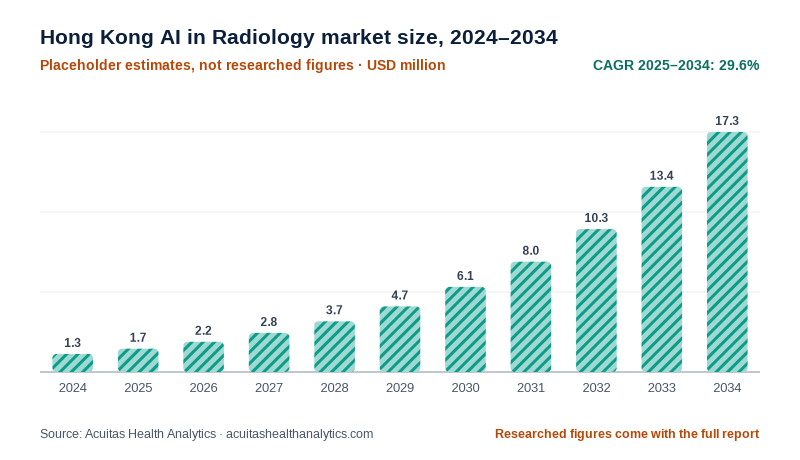
Hong Kong · 2024–2034 · placeholder estimates
Values shown here are placeholder estimates, not researched figures. Researched 2024 historical, 2025 base-year and 2026–2034 forecast values are prepared with the full report.
 China at $81.6 Mn.
 India at 31.6% a year.
Source: Acuitas Health Analytics. Full methods, sources and usage terms come with report purchase.
$15.6 Mn total, 2026–2034
| Year | Market size | Change that year | Since 2025 |
|---|---|---|---|
| 2024 (estimate) | $1.3 Mn | — | — |
| 2025 (base) | $1.7 Mn | +$0.4 Mn | — |
| 2026 (forecast) | $2.2 Mn | +$0.5 Mn | +29.6% |
| 2027 (forecast) | $2.8 Mn | +$0.6 Mn | +68% |
| 2028 (forecast) | $3.7 Mn | +$0.8 Mn | +117.7% |
| 2029 (forecast) | $4.7 Mn | +$1.1 Mn | +182.1% |
| 2030 (forecast) | $6.1 Mn | +$1.4 Mn | +265.6% |
| 2031 (forecast) | $8.0 Mn | +$1.8 Mn | +373.8% |
| 2032 (forecast) | $10.3 Mn | +$2.4 Mn | +514.1% |
| 2033 (forecast) | $13.4 Mn | +$3.1 Mn | +695.9% |
| 2034 (forecast) | $17.3 Mn | +$4.0 Mn | +931.4% |
Placeholder estimates. Each year is projected from our earlier market estimate and its CAGR. Researched values come with the full report.
 US
$403.9 Mn
China
$81.6 Mn
 Canada
$79.4 Mn
 Japan
$62.2 Mn
 Germany
$35.4 Mn
 France
$26.9 Mn
 UK
$25.0 Mn
 Brazil
$25.2 Mn
 Italy
$23.6 Mn
 Ecuador
$20.0 Mn
 Spain
$18.9 Mn
India
$18.9 Mn
 Saudi Arabia
$17.3 Mn
 Mexico
$14.9 Mn
 Australia
$12.2 Mn
 South Africa
$6.6 Mn
 UAE
$5.0 Mn
 Egypt
$2.9 Mn
 Philippines
$2.2 Mn
Hong Kong (this report)
$1.7 Mn
 Malaysia
$1.7 Mn
 Singapore
$1.2 Mn
 Thailand
$1.2 Mn
 Kenya
$0.7 Mn
| Market size, 2025 | $1.7 Mn placeholder estimate |
|---|---|
| Forecast, 2034 | $17.3 Mn placeholder estimate |
| Growth (CAGR), 2025–2034 | 29.6% placeholder estimate |
| Years | 2024 historical · 2025 base year · 2026–2034 forecast |
| Segments | Modality, application and end-user (see all) |
| Key players | IBM Watson Health, Siemens Healthineers, GE Healthcare, Philips Healthcare, NVIDIA Corporation and 5 more (see all) |
| Formats | PDF, PPTX, XLSX |
Sizes and growth here are placeholder estimates, not researched figures. Researched figures come with the full report.
AI in radiology can be defined as the utilization of machine learning, especially deep learning, on the scope of several processes in radiology. AI has also performed well in image analysis and this has made it easier to detect diseases automatically, characterize them and even monitor them.
The advancement of AI in the international market is rapidly growing because of its potentials in enhancing workflow, decreasing the possibility of errors, and formulating measurements of radiographic attributes. Researchers determined in the study done in Insights into Imaging that 100% majority of the members of the European Society of Radiology are of the opinion that radiologists will assume the mantle of key players in the establishment and validation of AI in medical imaging.
Yet there are problems like that of standardising regulation for them, issues of privacy and fair use of big data, and scarcity of professionals in this field. U. S Food and Drug Administration (FDA) has their guidelines on the application of AI into medical devices to enhance safety.
Nevertheless, the market for AI in medical imaging has the potential for growth on the global level. The study conducted by Nature Reviews Drug Discovery points out that application of AI can reduce the yearly expenditures of the drug manufacturing businesses by up to $50 Bn by increasing the efficiency of their R & D. Given the global focus on AI integration in more efficient patient care bringing AI to radiology will only step up in the future years.
The use of AI in radiology is driven by the ability to increase the diagnostic precision and optimise the process. A radiologist can use such AI algorithms to analyze medical images at a much faster rate as compared to the human eye and with much higher levels of accuracy. Research conducted in Nature Reviews Radiology reveal that AI has the potential of cutting down on diagnostic mistakes by about 30%, a factor which is very beneficial to the health of patients. Besides, the advancement of employing imaging services because of an aging population and a higher rate of chronic diseases continue to elevate team workloads and implement AI expertise in radiology subsections.
Ventures such as Medivis are in the process of creating apps that will make use of AR to give radiologists a way to not only view but also interact with medical images in a way that could further improve the capacity of diagnostic functionality as well as the system of communication with other relevant personnel
On the other hand, there are several factors that pose a challenge of artificial intelligence in radiology. One more challenge that has to be taken into consideration is the resistance from radiologists who will not accept AI as a tool which can help them in their work and can threat them. A Clinical Radiology study shows that a significant proportion of radiologists feels that there is uncertainty related to the accuracy of AI algorithms and the emergence of biased AI results. In addition, the requirement of big and clean data that are required to be fed into the AI is another issue, since such data can be quite hard to come by because of issues of privacy as well as ethical concerns. Furthermore, the lack of clear regulatory guidelines regarding the use and development of AI in imaging means that standardisation in the adopting of such technologies is ambiguous, thereby hampering the implementation of AI in clinical settings.
 IBM Watson Health
 Siemens Healthineers
 GE Healthcare
 Philips Healthcare
 NVIDIA Corporation
 Aidoc
 Zebra Medical Vision
June 2024, Qure.ai, a leader in healthcare AI, formed a partnership with Strategic Radiology, a coalition of independent radiology practices. This collaboration aims to enhance clinical accuracy and operational efficiency by providing easier access to advanced AI imaging technologies, ultimately benefiting over 1,700 radiologists in the U.S.
July 2024, Deepc, a Munich-based AI-driven software company, announced its acquisition of the Osimis medical imaging software platform. This acquisition aims to enhance Deepc's capabilities in providing AI-powered radiology solutions, allowing for streamlined workflows and improved interoperability between systems
July 2024, GE HealthCare announced plans to acquire an AI business from an ultrasound firm for $51 million, indicating a strategic move to enhance its portfolio of AI applications in medical imaging
Public hospitals and clinics, run by the Hospital Authority, are heavily subsidised by the government.[1]
[1] Hospital Authority. Checked 14 Nov 2026.
There is on-going development of healthcare policies and regulations concerning the use of the AI in radiology so as to embrace the technologies safely ad efficiently. The U. S Food and Drug Administration – FDA for short – has provided some of the guidelines when it comes to the use of AI devices in the medical field, including aspects like algorithm creation and evaluation and continuous tracking and evaluation processes. It can therefore be anticipated that, as additional countries implement such legislation, the use of AI in radiology will increase at a worldwide level. In the reimbursement context, there is slowly beginning to be appreciation for insurance coverage policies that entitle the use of AI-based diagnostic instruments. Cooperation involving manufacturers, medical facilities, and regulators will be vital to enhance the use of AI in radiology and enhance patients’ well-being and safety.
What doctors and scientists are doing in Artificial Intelligence (AI) in Radiology right now, from free public sources.
Sources: PubMed (US National Library of Medicine), ClinicalTrials.gov, World Bank. Fetched 9 Nov 2026. Papers and trials are found by search words, so the counts are a guide. Titles only; read each paper at its source.
[1] World Bank Open Data, People aged 65 and over (% of people). Retrieved 24 Nov 2026.
From our blog
Hong Kong · 13 shared keywords
Hong Kong · 5 shared keywords
Hong Kong · 5 shared keywords
Hong Kong · 5 shared keywords
Hong Kong · 3 shared keywords
Hong Kong · 3 shared keywords
Pharmaceuticals · Hong Kong
Medical Devices · Hong Kong
Medical Devices · Hong Kong
Medical Devices · Hong Kong
Medical Devices · Hong Kong
Healthcare Services · Hong Kong