
Clinical trials
1 active trial in Hong Kong
Recruiting, about to start, or running now.
- 3D-Printed Patient-Specific Surgical Plates Versus Conventional Surgical Plates in Jaw Reconstruction NCT04635865
 Hong Kong
Updated
 Reviewed by Chandani Patel
Hong Kong Dental 3D Printing Market Analysis Industry Trends and Forecast to 2034: Segmented by (By Technology, By Application, By End User, By Region) - Growth, Market Size, Future Prospects & Competitive Analysis, 2024-2034
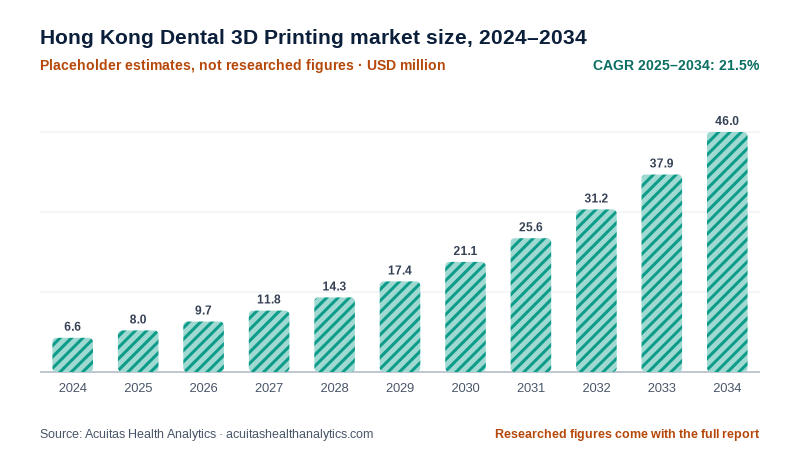
Hong Kong · 2024–2034 · placeholder estimates
Values shown here are placeholder estimates, not researched figures. Researched 2024 historical, 2025 base-year and 2026–2034 forecast values are prepared with the full report.
 China at $405.6 Mn.
 India at 23.5% a year.
Source: Acuitas Health Analytics. Full methods, sources and usage terms come with report purchase.
$38.0 Mn total, 2026–2034
| Year | Market size | Change that year | Since 2025 |
|---|---|---|---|
| 2024 (estimate) | $6.6 Mn | — | — |
| 2025 (base) | $8.0 Mn | +$1.4 Mn | — |
| 2026 (forecast) | $9.7 Mn | +$1.7 Mn | +21.5% |
| 2027 (forecast) | $11.8 Mn | +$2.1 Mn | +47.6% |
| 2028 (forecast) | $14.3 Mn | +$2.5 Mn | +79.4% |
| 2029 (forecast) | $17.4 Mn | +$3.1 Mn | +117.9% |
| 2030 (forecast) | $21.1 Mn | +$3.7 Mn | +164.8% |
| 2031 (forecast) | $25.6 Mn | +$4.5 Mn | +221.7% |
| 2032 (forecast) | $31.2 Mn | +$5.5 Mn | +290.9% |
| 2033 (forecast) | $37.9 Mn | +$6.7 Mn | +374.9% |
| 2034 (forecast) | $46.0 Mn | +$8.1 Mn | +477% |
Placeholder estimates. Each year is projected from our earlier market estimate and its CAGR. Researched values come with the full report.
 US
$2.00 Bn
China
$405.6 Mn
 Canada
$393.8 Mn
 Japan
$308.5 Mn
 Germany
$174.9 Mn
 France
$133.1 Mn
 UK
$123.7 Mn
 Brazil
$125.2 Mn
 Italy
$117.2 Mn
 Ecuador
$99.5 Mn
 Spain
$93.4 Mn
India
$94.1 Mn
 Saudi Arabia
$85.7 Mn
 Mexico
$74.1 Mn
 Australia
$60.6 Mn
 South Africa
$32.6 Mn
 UAE
$24.9 Mn
 Egypt
$14.1 Mn
 Philippines
$11.0 Mn
 Malaysia
$8.0 Mn
Hong Kong (this report)
$8.0 Mn
 Singapore
$6.0 Mn
 Thailand
$6.0 Mn
 Kenya
$3.5 Mn
| Market size, 2025 | $8.0 Mn placeholder estimate |
|---|---|
| Forecast, 2034 | $46.0 Mn placeholder estimate |
| Growth (CAGR), 2025–2034 | 21.5% placeholder estimate |
| Years | 2024 historical · 2025 base year · 2026–2034 forecast |
| Segments | Technology, application and end user (see all) |
| Key players | Stratasys Ltd., 3D Systems Corporation, EnvisionTEC, Inc., DWS Systems, Renishaw plc and 2 more (see all) |
| Active clinical trials | 1 in Hong KongSource: ClinicalTrials.gov, Studies recruiting, active or not yet recruiting, in Hong Kong. Retrieved 9 Nov 2026. |
| Formats | PDF, PPTX, XLSX |
Sizes and growth here are placeholder estimates, not researched figures. Researched figures come with the full report.
3D printing, also referred to as additive manufacturing (AM) - has found a place in dental offices and practises all over the world. Dental 3D printing serves dentists as tools or fixtures to print parts and for the creation of parts that will be used by the patient. These parts can be as small as models of teeth and dental aligners or as large as full sets of dentures. Dental practitioners in the past relied on scans, radiology, and even the impressions of the teeth to acquire clear images of patients. These pictures were then used to build a set of specialized implants that would be suitable for the patient. And now, with the help of a technology such as 3D printing, dental providers can both offer more individualized implants and address customers more quickly. It is crucial to recognize that untreated dental caries in permanent teeth are considered the most common disease in the world, affecting 2. 3 billion people have it, and it is estimated that severe periodontitis affects 1 billion people worldwide.
The dental 3D printing market is still booming as is evident from regular technological innovations, high demand for customized dental solutions, and the value added through efficient cost. The market covers applications such as prosthetics, orthodontics, implants, and surgical guides, with key technologies being stereolithography (SLA), digital light processing (DLP), and fused deposition modeling (FDM). Key players are 3D Systems Corporation, Stratasys Ltd. and Formlabs Inc. Growth is constant in North America and Europe while Asia-Pacific exhibits exponential growth. Obstacles involve higher costs and licensing procedures; however, industry trends suggest improved compatibility with digital environments and an increased range of materials, which ought to keep the market’s evolution and application forward.
The increasing prevalence of dental problems and the proliferation of dental care companies are driving the demand for dental 3D printing solutions. New biocompatible resins, plastics, metals, and ceramics widen the range of the technology, while SLA, DLP, and FDM introduced the novel methods that step-up precision and increase the production rates. By applying 3D printing in the production of dental appliances, it is considerably shorter compared to the conventional methods that have also minimized the wastage of material. In addition to awareness of its advantages such as cost-saving and personalization, a favourable legal climate for this procedure contributes to its adoption among dental care workers and customers.
Application of 3D printing in the dental industry is in customization and personalization since patients are looking forward to receiving specialized treatment such us implants and crowns. Asia-Pacific, Latin-American, and African emerging markets, in particular, reveal great growth potential as the oral health literacy rises and dental services expand. Adoption with digital dentistry technologies, innovative developments in biocompatible materials, and in dental laboratories improves effectiveness and portfolio. Government support, telehealth, and other remote solutions also contribute to the ever-evolving market. Partnerships with educational and research institutions also hold the potential for innovation, thus propelling further advancement of dental 3D printing market.
Initial costs for 3D printers are from USD 40000 to 300000 depending on the kind of 3D printer and more so for the raw materials such as bio compatible resins and metal powders acts as a constraint especially to several of the practices within developing nations. Lack of qualified personnel to manage sophisticated machinery and high standards in safety and compliance also increase the cost of operation. However, the markets for these products are relatively small and this means that necessary economies of scale cannot be achieved to help make such items affordable and available to a cross section of the population. All these factors combined present major barriers and constraints to the advancement and pervasiveness of dental 3D printing solutions.
 Stratasys Ltd.
 Renishaw Plc.
 Formlabs
 Prodways Group
July 2024, Stratasys launched the DentaJet XL, a new high-speed 3D printer designed to further improve dental lab productivity and reduce costs. Its boost in productivity and reduction in costs comes from its larger resin cartridges, large print tray, 'Super High-Speed' mode and minimal post-processing workflow.
May 2024, Dental 3D printing brand SprintRay launched its Pro 2 line of desktop 3D printing systems alongside two new resins from the company’s BioMaterial Innovation Lab. Pro 2 is the first 3D printer from SprintRay to be powered by Optical Panel technology, featuring a 35-micron XY resolution and 385 nm UV light.
March 2024, UnionTech, an experienced global leader in stereolithography, made a significant appearance with its new fully automated 3D printer EvoDent D300 at Dental South China.
February 2024, 3D Systems launches new multi-material, jetted 3D printed denture solution in “industry first”.
October 2025, Formlabs announces new flexible BioMed and Dental 3D printing resins. Adoption of 3D printing is accelerating in healthcare and dentistry, bringing patients the benefit of personalized care that improves comfort and outcomes.
April 2024, Ivoclar and SprintRay enter dental 3D printing partnership. Combining state-of-the-art solutions for 3D printing with high-quality materials.
September 2025, Align Technology to acquire Cubicure. The Austrian startup’s hot lithography 3D printing technology and materials will help drive innovation in digital orthodontics.
May 2022, Oqton and Eplus3D enter dental 3D printing partnership. Making Oqton’s AI-powered Manufacturing OS platform available to users of Eplus3D’s metal 3D printers.
Public hospitals and clinics, run by the Hospital Authority, are heavily subsidised by the government.[1] ClinicalTrials.gov lists 1 study on Dental 3D Printing that is recruiting, active or about to start in Hong Kong.[2]
[1] Hospital Authority. Checked 14 Nov 2026.
[2] ClinicalTrials.gov, Studies recruiting, active or not yet recruiting, in Hong Kong. Retrieved 9 Nov 2026.
Changes in the policies that govern the manufacturing of dental equipment, and change in reimbursement scenarios that is affecting the dental 3D printing market. Governments through bodies like the FDA and MHRA maintain the safety and compatibility of materials to be used in 3D printing, but this comes at the expense of high costs and time to regulatory approval. Governments are contributing to digital dentistry through subsidies and enhancements of the infrastructure and R&D incentives for 3D technologies in the field of printing. With insurance plans continuing to cover 3D-printed dental procedures and more care reimbursement models embracing value-based payment, the use of such technologies will continue to increase. Investments in healthcare system are expected to result in better reimbursement policies and rising popularity of dental 3D printing as a process in emerging markets.
What doctors and scientists are doing in Dental 3D Printing right now, from free public sources.
1 active trial in Hong Kong
Recruiting, about to start, or running now.
Sources: PubMed (US National Library of Medicine), ClinicalTrials.gov, World Bank. Fetched 9 Nov 2026. Papers and trials are found by search words, so the counts are a guide. Titles only; read each paper at its source.
[1] World Bank Open Data, People aged 65 and over (% of people). Retrieved 27 Nov 2026.
From our blog
Hong Kong · 2 shared keywords
Hong Kong · 2 shared keywords
Hong Kong · 1 shared keyword
Hong Kong · 1 shared keyword
Hong Kong · 1 shared keyword
Hong Kong · 1 shared keyword
Medical Devices · Hong Kong
Medical Devices · Hong Kong
Medical Devices · Hong Kong
Medical Devices · Hong Kong
Healthcare Services · Hong Kong
Medical Devices · Hong Kong