US Aging in Place Technology Market Industry Trends and Forecast to 2034: Segmented by (Product, Payer, End User, Region) - Growth, Market Size, Future Prospects & Competitive Analysis, 2024-2034
Overview
Market Dashboard
US · 2024–2034 · placeholder estimates
Values shown here are placeholder estimates, not researched figures. Researched 2024 historical, 2025 base-year and 2026–2034 forecast values are prepared with the
full report.
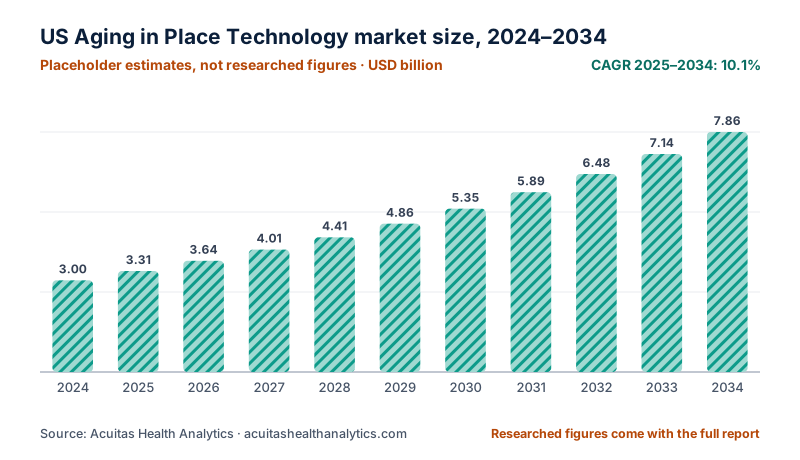
Estimate 2024$3.00 BnPlaceholder estimate
Estimate 2025$3.31 Bn43.9% of the global market
Projected 2034$7.86 Bn 137.7%Adds $4.55 Bn over 9 forecast years
CAGR 2025–203410.1%Faster than 27% of 100 Digital Health markets here
393 in the USSource: ClinicalTrials.gov, Studies recruiting, active or not yet recruiting, in the US. Retrieved 12 Nov 2026.
Formats
PDF, PPTX, XLSX
Sizes and growth here are placeholder estimates, not researched figures. Researched figures come with the full report.
The US Aging in Place Technology Market Analysis Executive Summary
Aging in place technology helps older adults live safely at home, with fall detection, smart sensors, medication reminders and remote check-ins.
Key segments of the aging in Place Technology market include product (Fall Detection and PERS, Smart Home Sensors and Medication Management) and payer (Self-Pay, Insurance and Government Programs).
US Aging in Place Technology market size, 2024–2034. Placeholder estimates; researched figures come with the full report. Source: Acuitas Health Analytics.
US Aging in Place Technology Market Dynamics
Market Growth Drivers
An ageing population, longer life expectancy, rising interest in healthy ageing and new science on how the body ages are driving the aging in Place Technology market. Older adults and their families are spending more on staying active and independent.
Opportunity
Preventive care, personalised plans based on biomarkers and home-based services give the aging in Place Technology market room to grow, especially in fast-ageing countries in Asia and Europe.
Market Restraints
Limited clinical proof for some longevity products, high out-of-pocket costs, regulation that does not treat ageing as a disease and uneven access hold back the aging in Place Technology market.
Competitive Landscape for Aging in Place Technology Market in US
The aging in Place Technology market is moderately concentrated. Leading companies compete on product innovation, clinical evidence, pricing and geographic reach, and use partnerships and acquisitions to expand their portfolios.
Healthcare Policies and Regulatory Landscape for Aging in Place Technology Market in US
Aging in Place Technology in the US: rules, payment and research
The FDA regulates software that works as a medical device, and runs a Digital Health Center of Excellence.[1] Medicare covers people aged 65 and over and some younger people with disabilities, and Medicaid covers many people on low incomes; both are run with the Centers for Medicare & Medicaid Services (CMS).[2] ClinicalTrials.gov lists 393 studies on Aging in Place Technology that are recruiting, active or about to start in the US.[3] People aged 65 and over: 18.4% of people in 2025, the latest WHO figure for the US.[4]
Rules on software as a medical device, data privacy (such as HIPAA and GDPR) and telehealth reimbursement shape the aging in Place Technology market. Government digital health programs in US are speeding up adoption.
2.2 Market Size, Growth Prospects and Key findings
3 Market Dynamics
3.1 Market Growth Drivers Analysis
3.2 Market Restraints Analysis
4 Market Segmentation
4.1 By Product
4.2 By Payer
4.3 By End User
5 By Market Share
5.1 Market Analysis, Insights and Forecast – By Revenue
6 Competitive Landscape
6.1 Major Top Market Players Products in Pipeline
6.2 R&D Initiatives
6.3 Notable recent Deals
6.3.1 Strategic Divestments
6.3.2 Mergers & Acquisitions
6.3.3 Partnerships
6.3.4 Joint Ventures
7 Key Company Profiles
7.1 Philips
7.2 Best Buy Health (Lively)
7.3 Medical Guardian
7.4 Vayyar
7.5 CarePredict
7.6 ADT
8 Healthcare Policies and Regulatory Landscape
8.1 Policy changes and Reimbursement scenario
8.2 Government Initiatives / Intervention programs
The aging in Place Technology market can be segmented based on various criteria, including product, payer and end user. Here's a breakdown of the market segmentation
Other companies that free public records show in this market: trials they lead, US approvals and WHO prequalification. They are not part of our key players research. Each count opens its source.
Also active in this area, from free public records
Source: ClinicalTrials.gov, Active studies (recruiting, about to start or running) each company leads, found with this market's trial search, worldwide. Retrieved 13 Nov 2026.
Source: FDA 510(k) and PMA databases, 510(k) clearances and PMA approvals since 2015 for devices whose name has this market's words. Retrieved 13 Nov 2026.
Beyond the market numbers
Research, trials and patients
What doctors and scientists are doing in Aging in Place Technology right now, from free public sources.
How big is the Aging in Place Technology market in the US?
Placeholder estimate: about $3.31 Bn in 2025, rising to about $7.86 Bn by 2034. These are early estimates, not researched figures; the researched values come with the full report.
How fast is the Aging in Place Technology market in the US growing?
Placeholder estimate: about 10.1% a year (CAGR, 2025–2034). The researched growth rate comes with the full report.
What segments does the Aging in Place Technology market report cover?
The report splits the market by product (Fall Detection and PERS, Smart Home Sensors, Medication Management, Telehealth Devices), payer (Self-Pay, Insurance, Government Programs) and end user (Healthcare Providers, Patients, Payers, Pharmaceutical Companies).
Who are the key players in the Aging in Place Technology market?
Key players include Philips Healthcare, Best Buy Health (Lively), Medical Guardian, Vayyar, CarePredict and ADT.
What is driving the Aging in Place Technology market?
An ageing population, longer life expectancy, rising interest in healthy ageing and new science on how the body ages are driving the aging in Place Technology market. Older adults and their families are spending more on staying active and independent.
Who regulates Aging in Place Technology in the US?
The FDA regulates software that works as a medical device, and runs a Digital Health Center of Excellence. Source: US Food and Drug Administration. Checked 14 Nov 2026.
How is healthcare paid for in the US?
Medicare covers people aged 65 and over and some younger people with disabilities, and Medicaid covers many people on low incomes; both are run with the Centers for Medicare & Medicaid Services (CMS). Source: Centers for Medicare & Medicaid Services. Checked 14 Nov 2026.
How many clinical trials on Aging in Place Technology are running in the US?
393 studies are recruiting, active or about to start in the US, according to ClinicalTrials.gov. Source: ClinicalTrials.gov, Studies recruiting, active or not yet recruiting, in the US. Retrieved 12 Nov 2026.
What does WHO report for the US?
People aged 65 and over: 18.4% of people in 2025, the latest WHO figure. Source: WHO Global Health Observatory, People aged 65 and over (% of people). Retrieved 15 Nov 2026.
How much research is published on Aging in Place Technology?
PubMed lists 166 papers on Aging in Place Technology added since January 2021, worldwide. Source: PubMed, Papers added since 1 January 2021 matching this market. Retrieved 12 Nov 2026.
 US


 Canada
 Japan
 China
 Germany
 France
 UK
 Brazil
 Ecuador
 Italy
 India
 Saudi Arabia
 Spain
 Mexico
 Australia
 New Zealand
 Russia
 South Africa
 UAE
 Egypt
 Philippines
 Hong Kong
 Malaysia
 Singapore
 Thailand
 Kenya
 Roche