US Artificial Intelligence (AI) in Drug Discovery Market Analysis Industry Trends and Forecast to 2034: Segmented by (Offering, Technology, Application, End-user, Region) - Growth, Market Size, Future Prospects & Competitive Analysis, 2024-2034.
Overview
Market Dashboard
US · 2024–2034 · placeholder estimates
Values shown here are placeholder estimates, not researched figures. Researched 2024 historical, 2025 base-year and 2026–2034 forecast values are prepared with the
full report.
Estimate 2024$312.7 MnPlaceholder estimate
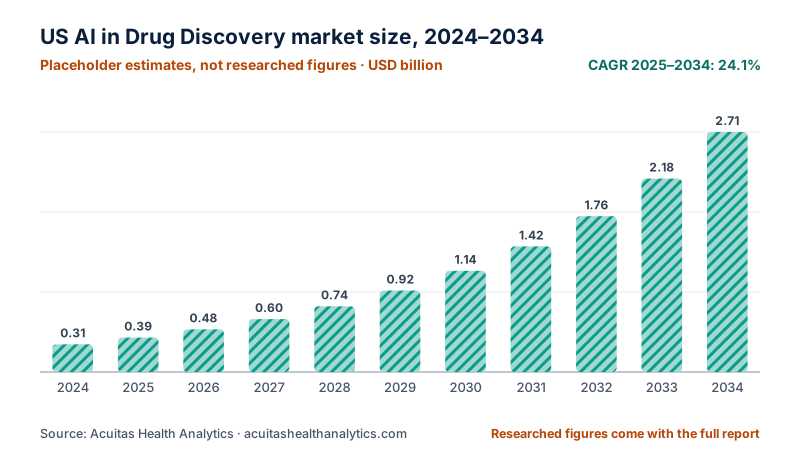
Estimate 2025$388.1 Mn40.7% of the global market
Projected 2034$2.71 Bn 598.1%Adds $2.32 Bn over 9 forecast years
CAGR 2025–203424.1%Faster than 84% of 100 Digital Health markets here
Sizes and growth here are placeholder estimates, not researched figures. Researched figures come with the full report.
The US Artificial Intelligence (AI) in Drug Discovery Market Analysis Executive Summary
AI in drug discovery presents the utilization of superior computing methodologies in the improvement of the drug discovery process and time effectiveness. Conventional drug discovery is a slow and an expensive process, it can take several years and billions of funds. Advanced tools of artificial intelligence like machine learning and natural language processing are changing this landscape through enhancing identification of targets, and/or properties of drugs, and/or designs of molecules. For example, it can mine large databases to find potential drugs and also predict how molecules would behave, thus lessening the use of large amounts of lab tests.
Currently, the utilization of AI in drug discovery is rapidly growing across the world; major investments are being made in this field. Based on the FDA, there were more than one hundred drug applications that included elements of AI/ML last year, proving their increased use. Furthermore, according to a report by Nature Medicine, while AI is still theoretical in many areas, new drugs developed by machine intelligence have gone into clinical trials. As the technology of AI advances further, it is believed to cut down the time for drug discovery and may result in the identification of new treatments for diseases that currently cannot be treated, thus improving the world’s health care systems.
US AI in Drug Discovery market size, 2024–2034. Placeholder estimates; researched figures come with the full report. Source: Acuitas Health Analytics.
Market Dynamics for Artificial Intelligence (AI) in Drug Discovery Market in the US
Market Growth Drivers
The integration of AI in drug discovery is importantly boosted by the capacity of AI in compressing the drug development cycle. AI technologies also can perform screenings and determine the efficacy of the drugs with a relative quicker and more efficient way as compared to traditional methods. For example, AI can make the expense of creating a new medicine less on average since the cost of launching a new drug is about $2. 6 Bn, by the enhancement of the medicinal discovery value chain. In addition, the FDA received over 100 submissions related to AI/ML in 2021 and thus, these technologies are being acceptance and integrated by more and more pharmaceutical companies to foster new innovation and new cooperation between the different stakeholders.
Opportunity
AI has already started promising brighter future in drug discovery and there is much more to discover in approaching technology and applications. AI will enhance identification and validation of targets in drug development cutting the costs and time in the first stages of the process. It will also increase the level of personalized medicine by identifying patients for therapies depending on their genetic make-up. Some of these firms are Atomwise and BenevolentAI that are embracing AI with conventional drug making procedures. Even governmental agencies have begun to update regulations on artificial intelligence being approved by the FDA and making it possible for the discovery of drugs to be a quicker a more efficient process.
Market Restraints
Despite the envisaged benefits of utilizing AI in drug discovery, there are a number of Barriers to its use. One of them is the scarcity of qualified personnel to apply and analyze the outcomes from the incorporation of AI practices. Further, AI produces uncertain results mainly because of the unexplained and opaque working of the models. This may result in rejection from the traditional researchers since they may not trust the AI systems more than the conventional methods that they have been trained on. Therefore, these factors can cause the slow implementation of AI in drug discovery, thus restraining the innovation created by the practice in the pharmaceutical field.
Competitive Landscape for Artificial Intelligence (AI) in Drug Discovery Market in the US
December 2025, Merck launched the first AI solution integrating drug discovery and synthesis. This innovative tool combines generative AI, machine learning, and computer-aided drug design to screen over 60 Bn chemical targets, enhancing the success and efficiency of new drug development
Mergers and Acquisitions
January 2024, Vision Sensing Acquisition Corp. (VSAC) announced a merger with Mediforum Co., Ltd., a Korean biotechnology company specializing in ethical drugs and diagnostic reagents
Healthcare Policies and Regulatory Landscape for Artificial Intelligence (AI) in Drug Discovery Market in the US
Artificial Intelligence (AI) in Drug Discovery in the US: rules and payment
The FDA regulates software that works as a medical device, and runs a Digital Health Center of Excellence.[1] Medicare covers people aged 65 and over and some younger people with disabilities, and Medicaid covers many people on low incomes; both are run with the Centers for Medicare & Medicaid Services (CMS).[2]
The roles of the most recent healthcare policies and regulations for the implementation of artificial intelligence in drug discovery for the pharmaceutical sector have somewhat improved and are continuing to advance. More regulatory authorities are paying attention to the accreditation of AI applications that have regulatory oversight. For example, drugs and health IT agencies such as the FDA has started establishing guidelines for the use of AI and machine learning in drug development, especially in areas of transparency of such algorithms. Such modifications’ purpose involves implementing improvements in one’s research and development processes to innovate, protect patients, and maintain the confidentiality of patient information.
As for re-imbursements there is an increasing awareness of the necessity to cover AI-based drug discovery processes among insurance policies. With the advent of value-driven healthcare, the policies are being written that would allow utilization of the AI technologies that may advance the delivery of the new generations of the therapies.
8.2 Government Initiatives / Intervention programs
The Artificial Intelligence (AI) in Drug Discovery Market Analysis is divided into following segments: Offering, Technology, Application, End-user, and Region. As these segments grow, you will be able to analyze the industries' meagre growth areas and give users useful market insights and an overview to aid in their strategic decision-making when it comes to selecting key market applications.
Sources:PubMed (US National Library of Medicine),
ClinicalTrials.gov,
World Bank.
Fetched 9 Nov 2026. Papers and trials are found by search words, so the counts are a guide. Titles only; read each paper at its source.
Public data, with sources
Artificial Intelligence (AI) in Drug Discovery in context
The US compared
Health spending per person: 13,473 US$ per person (2023). World: 1,317 US$ per person (2023).[1]
Doctors: 3.68 per 1,000 people (2022). World: 1.86 per 1,000 people (2022).[2]
People aged 65 and over: 18.4% of people (2025). World: 10.4% of people (2025).[3]
[1]World Bank Open Data, Health spending per person (US$ per person). Retrieved 19 Nov 2026.
How big is the AI in Drug Discovery market in the US?
Placeholder estimate: about $388.1 Mn in 2025, rising to about $2.71 Bn by 2034. These are early estimates, not researched figures; the researched values come with the full report.
How fast is the AI in Drug Discovery market in the US growing?
Placeholder estimate: about 24.1% a year (CAGR, 2025–2034). The researched growth rate comes with the full report.
What segments does the AI in Drug Discovery market report cover?
The report splits the market by offering (Software, Services), technology (Machine Learning, Deep Learning, Natural Language Processing, Others), application (Drug Optimization and Repurposing, Preclinical Testing, Clinical Trial Design, Others) and end-user (Pharmaceutical and Biotechnology Companies, Contract Research Organizations, Academic and Research Institutes).
Who are the key players in the AI in Drug Discovery market?
Key players include Atomwise, Inc., BenevolentAI, Exscientia, Insilico Medicine, Schrödinger and Cyclica, among 10 companies the report profiles.
Who regulates AI in Drug Discovery in the US?
The FDA regulates software that works as a medical device, and runs a Digital Health Center of Excellence. Source: US Food and Drug Administration. Checked 14 Nov 2026.
How is healthcare paid for in the US?
Medicare covers people aged 65 and over and some younger people with disabilities, and Medicaid covers many people on low incomes; both are run with the Centers for Medicare & Medicaid Services (CMS). Source: Centers for Medicare & Medicaid Services. Checked 14 Nov 2026.
 US



 Canada
 China
 Japan
 Germany
 France
 UK
 Brazil
 Italy
 Ecuador
 Spain
 India
 Saudi Arabia
 Mexico
 Australia
 South Africa
 UAE
 Egypt
 Philippines
 Hong Kong
 Malaysia
 Singapore
 Thailand
 Kenya
 BERG Health