Patients
| Country | Value | Year |
|---|---|---|
| Iraq | 3.4 | 2025 |
| Israel | 12.7 | 2025 |
| Jordan | 4.8 | 2025 |
| Lebanon | 10.4 | 2025 |
| Palestine | 3.9 | 2025 |
| Qatar | 1.7 | 2025 |
| Saudi Arabia | 3.1 | 2025 |
| Syria | 4.8 | 2025 |
| UAE | 1.8 | 2025 |
| Yemen | 2.5 | 2025 |
Updated
 Reviewed by Vidhi Upadhyay
Middle East Regenerative Aesthetics Market Industry Trends and Forecast to 2034: Segmented by (Treatment, Area, End User, Region) - Growth, Market Size, Future Prospects & Competitive Analysis, 2024-2034
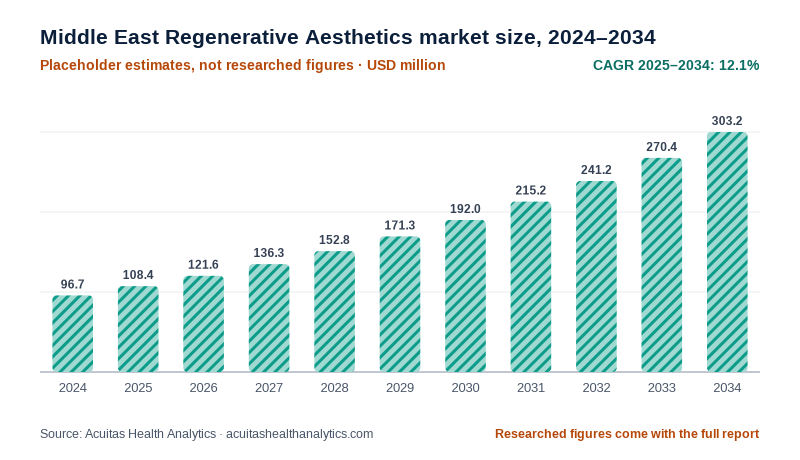
Values shown here are placeholder estimates, not researched figures. Researched 2024 historical, 2025 base-year and 2026–2034 forecast values are prepared with the full report.


Source: Acuitas Health Analytics. Full methods, sources and usage terms come with report purchase.
$194.7 Mn total, 2026–2034
| Year | Market size | Change that year | Since 2025 |
|---|---|---|---|
| 2024 (estimate) | $96.7 Mn | — | — |
| 2025 (base) | $108.4 Mn | +$11.7 Mn | — |
| 2026 (forecast) | $121.6 Mn | +$13.1 Mn | +12.1% |
| 2027 (forecast) | $136.3 Mn | +$14.7 Mn | +25.7% |
| 2028 (forecast) | $152.8 Mn | +$16.5 Mn | +40.9% |
| 2029 (forecast) | $171.3 Mn | +$18.5 Mn | +57.9% |
| 2030 (forecast) | $192.0 Mn | +$20.7 Mn | +77% |
| 2031 (forecast) | $215.2 Mn | +$23.2 Mn | +98.4% |
| 2032 (forecast) | $241.2 Mn | +$26.0 Mn | +122.5% |
| 2033 (forecast) | $270.4 Mn | +$29.2 Mn | +149.4% |
| 2034 (forecast) | $303.2 Mn | +$32.7 Mn | +179.5% |
Placeholder estimates. Each year is projected from our earlier market estimate and its CAGR. Researched values come with the full report.
 US
$1.08 Bn
 Canada
$200.1 Mn
 Japan
$191.3 Mn
 China
$193.9 Mn
 Germany
$103.0 Mn
 UK
$70.6 Mn
 Italy
$70.0 Mn
 France
$64.4 Mn
 Brazil
$60.1 Mn
 India
$58.7 Mn
 Spain
$49.7 Mn
 Ecuador
$47.8 Mn
 Mexico
$44.2 Mn
 Saudi Arabia
$42.3 Mn
 Australia
$32.9 Mn
 Russia
$28.4 Mn
 New Zealand
$27.3 Mn
 South Africa
$17.8 Mn
 UAE
$15.0 Mn
 Egypt
$8.2 Mn
 Philippines
$5.5 Mn
 Malaysia
$4.2 Mn
 Hong Kong
$3.9 Mn
 Singapore
$3.7 Mn
 Thailand
$3.6 Mn
 Kenya
$1.6 Mn
| Market size, 2025 | $108.4 Mn placeholder estimate |
|---|---|
| Forecast, 2034 | $303.2 Mn placeholder estimate |
| Growth (CAGR), 2025–2034 | 12.1% placeholder estimate |
| Years | 2024 historical · 2025 base year · 2026–2034 forecast |
| Segments | Treatment, area and end user (see all) |
| Key players | Galderma S.A., Allergan, Merz Aesthetics, Croma Pharma, Benev (see all) |
| Formats | PDF, PPTX, XLSX |
Sizes and growth here are placeholder estimates, not researched figures. Researched figures come with the full report.
Regenerative aesthetics use treatments such as platelet-rich plasma, exosomes and biostimulators to repair and rejuvenate the skin.
Key segments of the regenerative Aesthetics market include treatment (Platelet-Rich Plasma, Biostimulatory Fillers and Exosome Therapy) and area (Face, Hair and Body).
An ageing population, longer life expectancy, rising interest in healthy ageing and new science on how the body ages are driving the regenerative Aesthetics market. Older adults and their families are spending more on staying active and independent.
Preventive care, personalised plans based on biomarkers and home-based services give the regenerative Aesthetics market room to grow, especially in fast-ageing countries in Asia and Europe.
Limited clinical proof for some longevity products, high out-of-pocket costs, regulation that does not treat ageing as a disease and uneven access hold back the regenerative Aesthetics market.
The regenerative Aesthetics market is moderately concentrated. Leading companies compete on product innovation, clinical evidence, pricing and geographic reach, and use partnerships and acquisitions to expand their portfolios.
How care is paid for in some of these countries: free public care and CHI-regulated insurance (Saudi Arabia)[1], mandatory health insurance (UAE)[2], public care and compulsory insurance (Qatar)[3] and four health funds (Israel)[4].
[1] Council of Health Insurance. Checked 14 Nov 2026.
[2] Ministry of Human Resources and Emiratisation. Checked 14 Nov 2026.
[3] Ministry of Public Health, Qatar. Checked 19 Nov 2026.
[4] Israel Ministry of Health. Checked 19 Nov 2026.
Licensing, quality standards and payment models from public and private payers shape how regenerative Aesthetics services are delivered and paid for in Middle East. Government health programs and insurance coverage are key to access.
What doctors and scientists are doing in Regenerative Aesthetics right now, from free public sources.
| Country | Value | Year |
|---|---|---|
| Iraq | 3.4 | 2025 |
| Israel | 12.7 | 2025 |
| Jordan | 4.8 | 2025 |
| Lebanon | 10.4 | 2025 |
| Palestine | 3.9 | 2025 |
| Qatar | 1.7 | 2025 |
| Saudi Arabia | 3.1 | 2025 |
| Syria | 4.8 | 2025 |
| UAE | 1.8 | 2025 |
| Yemen | 2.5 | 2025 |
Sources: PubMed (US National Library of Medicine), ClinicalTrials.gov, World Bank. Fetched 23 Nov 2026. Papers and trials are found by search words, so the counts are a guide. Titles only; read each paper at its source.
From our blog
Middle East
Middle East
Middle East
Middle East
Middle East
Middle East
Pharmaceuticals · Middle East
Medical Devices · Middle East
Medical Devices · Middle East
Digital Health · Middle East
Pharmaceuticals · Middle East
Pharmaceuticals · Middle East