Patients
7.4 % of people
People aged 65 and over, India, 2025 (WHO).
Compare every country on the Public Health Dashboard India
Updated
 Reviewed by Vidhi Upadhyay
India Personal Emergency Response Systems Market Industry Trends and Forecast to 2034: Segmented by (Type, Feature, End User, Region) - Growth, Market Size, Future Prospects & Competitive Analysis, 2024-2034
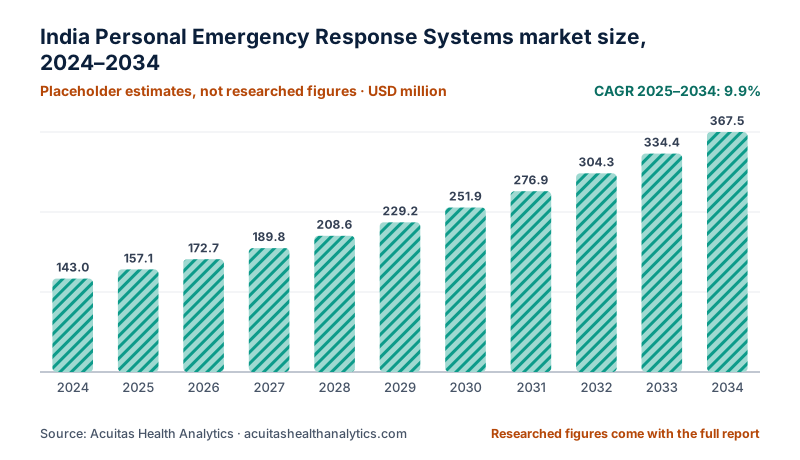
India · 2024–2034 · placeholder estimates
Values shown here are placeholder estimates, not researched figures. Researched 2024 historical, 2025 base-year and 2026–2034 forecast values are prepared with the full report.
 China at $819.5 Mn. India (this report) at 9.9% a year.
Source: Acuitas Health Analytics. Full methods, sources and usage terms come with report purchase.
$210.4 Mn total, 2026–2034
| Year | Market size | Change that year | Since 2025 |
|---|---|---|---|
| 2024 (estimate) | $143.0 Mn | — | — |
| 2025 (base) | $157.1 Mn | +$14.2 Mn | — |
| 2026 (forecast) | $172.7 Mn | +$15.6 Mn | +9.9% |
| 2027 (forecast) | $189.8 Mn | +$17.1 Mn | +20.8% |
| 2028 (forecast) | $208.6 Mn | +$18.8 Mn | +32.7% |
| 2029 (forecast) | $229.2 Mn | +$20.6 Mn | +45.9% |
| 2030 (forecast) | $251.9 Mn | +$22.7 Mn | +60.3% |
| 2031 (forecast) | $276.9 Mn | +$24.9 Mn | +76.2% |
| 2032 (forecast) | $304.3 Mn | +$27.4 Mn | +93.6% |
| 2033 (forecast) | $334.4 Mn | +$30.1 Mn | +112.8% |
| 2034 (forecast) | $367.5 Mn | +$33.1 Mn | +133.9% |
Placeholder estimates. Each year is projected from our earlier market estimate and its CAGR. Researched values come with the full report.
 US
$3.54 Bn
China
$819.5 Mn
 Canada
$750.3 Mn
 Japan
$621.3 Mn
 Germany
$279.4 Mn
 France
$244.9 Mn
 Italy
$226.6 Mn
 Brazil
$229.8 Mn
 UK
$212.0 Mn
 Ecuador
$183.0 Mn
India (this report)
$157.1 Mn
 Spain
$142.1 Mn
 Saudi Arabia
$140.2 Mn
 Mexico
$120.1 Mn
 Russia
$97.4 Mn
 Australia
$97.5 Mn
 New Zealand
$72.0 Mn
 South Africa
$54.6 Mn
 UAE
$43.1 Mn
 Egypt
$27.6 Mn
 Philippines
$22.0 Mn
 Hong Kong
$15.1 Mn
 Malaysia
$13.3 Mn
 Thailand
$9.3 Mn
 Singapore
$9.1 Mn
 Kenya
$5.3 Mn
| Market size, 2025 | $157.1 Mn placeholder estimate |
|---|---|
| Forecast, 2034 | $367.5 Mn placeholder estimate |
| Growth (CAGR), 2025–2034 | 9.9% placeholder estimate |
| Years | 2024 historical · 2025 base year · 2026–2034 forecast |
| Segments | Type, feature and end user (see all) |
| Key players | ADT, Medical Guardian, Lifeline (Connect America), Bay Alarm Medical, Best Buy Health (Lively) (see all) |
| Regulator in India | CDSCOSource: Central Drugs Standard Control Organisation. Checked 14 Nov 2026. |
| Formats | PDF, PPTX, XLSX |
Sizes and growth here are placeholder estimates, not researched figures. Researched figures come with the full report.
Personal emergency response systems let older people call for help with a button or watch, often with automatic fall detection.
Key segments of the personal Emergency Response Systems market include type (Landline-Based, Mobile GPS and Standalone) and feature (Fall Detection, GPS Tracking and Medication Reminders).
An ageing population, more people living with serious illness, family caregiver strain and payer focus on care at home are driving the personal Emergency Response Systems market.
Home-based models, technology for caregivers and value-based payment give the personal Emergency Response Systems market room to grow.
Caregiver shortages, low payment rates, uneven quality and limited awareness of services hold back the personal Emergency Response Systems market.
The personal Emergency Response Systems market is moderately concentrated. Leading companies compete on product innovation, clinical evidence, pricing and geographic reach, and use partnerships and acquisitions to expand their portfolios.
Since October 2023, every medical device sold in India needs a licence under the Medical Devices Rules, 2017, from the Central Drugs Standard Control Organisation (CDSCO) or, for some lower-risk devices made in India, a state authority.[1] Ayushman Bharat PM-JAY gives eligible families hospital cover of up to ₹5 lakh a year.[2] People aged 65 and over: 7.4% of people in 2025, the latest WHO figure for India.[3]
[1] Central Drugs Standard Control Organisation. Checked 14 Nov 2026.
[2] National Health Authority (PM-JAY). Checked 14 Nov 2026.
[3] WHO Global Health Observatory, People aged 65 and over (% of people). Retrieved 15 Nov 2026.
Medical device rules, such as the US FDA 510(k) and PMA pathways and the EU Medical Device Regulation, govern how personal Emergency Response Systems products are approved and monitored. Reimbursement codes and hospital purchasing policies decide how widely they are used in India.
What doctors and scientists are doing in Personal Emergency Response Systems right now, from free public sources.
7.4 % of people
People aged 65 and over, India, 2025 (WHO).
Compare every country on the Public Health DashboardSources: PubMed (US National Library of Medicine), ClinicalTrials.gov, WHO Global Health Observatory, World Bank. Fetched 15 Nov 2026. Papers and trials are found by search words, so the counts are a guide. Titles only; read each paper at its source.
[1] World Bank Open Data, People aged 65 and over (% of people). Retrieved 15 Nov 2026.
[2] World Bank Open Data, Health spending per person (US$ per person). Retrieved 14 Nov 2026.
[3] World Bank Open Data, Doctors (per 1,000 people). Retrieved 14 Nov 2026.
From our blog
India · 1 shared keyword
India · 1 shared keyword
India
India
India
India
Healthcare Services · India
Digital Health · India
Pharmaceuticals · India
Digital Health · India
Digital Health · India
Healthcare Services · India