Malaysia at a glance
- Population
- 36.0 million 2025
- Life expectancy at birth
- 76.8 years, 2024
- People aged 65 and over
- 8.0 % of people, 2025
- Health spending per person
- 450 US$ per person, 2023
- Doctors
- 2.34 per 1,000 people, 2023
 Malaysia
Updated
 Reviewed by Vidhi Upadhyay
Malaysia Audiology Devices Market Analysis Industry Trends and Forecast to 2034: Segmented by (By Product Type, By Technology, By Patient Demographics, By Distribution Channel, By Region) - Growth, Market Size, Future Prospects & Competitive Analysis, 2024-2034
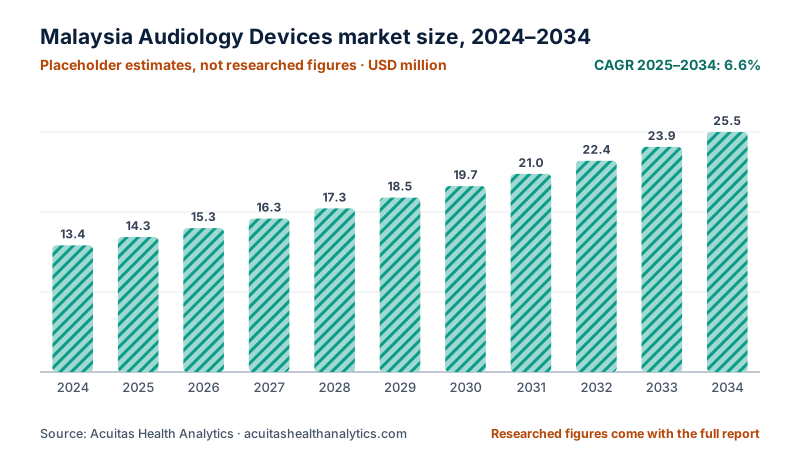
Malaysia · 2024–2034 · placeholder estimates
Values shown here are placeholder estimates, not researched figures. Researched 2024 historical, 2025 base-year and 2026–2034 forecast values are prepared with the full report.
 China at $732.8 Mn.
 India at 9.4% a year.
Source: Acuitas Health Analytics. Full methods, sources and usage terms come with report purchase.
$11.1 Mn total, 2026–2034
| Year | Market size | Change that year | Since 2025 |
|---|---|---|---|
| 2024 (estimate) | $13.4 Mn | — | — |
| 2025 (base) | $14.3 Mn | +$0.9 Mn | — |
| 2026 (forecast) | $15.3 Mn | +$0.9 Mn | +6.6% |
| 2027 (forecast) | $16.3 Mn | +$1.0 Mn | +13.6% |
| 2028 (forecast) | $17.3 Mn | +$1.1 Mn | +21.1% |
| 2029 (forecast) | $18.5 Mn | +$1.1 Mn | +29.1% |
| 2030 (forecast) | $19.7 Mn | +$1.2 Mn | +37.7% |
| 2031 (forecast) | $21.0 Mn | +$1.3 Mn | +46.7% |
| 2032 (forecast) | $22.4 Mn | +$1.4 Mn | +56.4% |
| 2033 (forecast) | $23.9 Mn | +$1.5 Mn | +66.7% |
| 2034 (forecast) | $25.5 Mn | +$1.6 Mn | +77.8% |
Placeholder estimates. Each year is projected from our earlier market estimate and its CAGR. Researched values come with the full report.
 US
$3.58 Bn
China
$732.8 Mn
 Canada
$709.1 Mn
 Japan
$556.2 Mn
 Germany
$313.6 Mn
 France
$239.2 Mn
 UK
$221.9 Mn
 Brazil
$225.9 Mn
 Italy
$210.7 Mn
 Ecuador
$179.4 Mn
 Spain
$167.9 Mn
India
$170.4 Mn
 Saudi Arabia
$155.0 Mn
 Mexico
$133.5 Mn
 Australia
$109.4 Mn
 South Africa
$59.0 Mn
 UAE
$45.2 Mn
 Egypt
$25.5 Mn
 Philippines
$19.7 Mn
Malaysia (this report)
$14.3 Mn
 Hong Kong
$14.4 Mn
 Singapore
$10.8 Mn
 Thailand
$10.7 Mn
 Kenya
$6.4 Mn
| Market size, 2025 | $14.3 Mn placeholder estimate |
|---|---|
| Forecast, 2034 | $25.5 Mn placeholder estimate |
| Growth (CAGR), 2025–2034 | 6.6% placeholder estimate |
| Years | 2024 historical · 2025 base year · 2026–2034 forecast |
| Segments | Product type, technology, patient demographics and distribution channel (see all) |
| Key players | Amplifon, Audina Hearing Instruments, Inc., Sonova Holding AG, Demant A/S, Audifon GmbH & Co. KG and 4 more (see all) |
| Regulator in Malaysia | MDASource: Medical Device Authority. Checked 14 Nov 2026. |
| Formats | PDF, PPTX, XLSX |
Sizes and growth here are placeholder estimates, not researched figures. Researched figures come with the full report.
Audiology devices refer to any tools that can be used to help people with hearing problems or hearing impairment. These devices include hearing aid, which helps to capture sound to be heard by the ears and the assistive listening devices, which amplify specific sounds in given settings such as during conversations and when watching television. While various hearing aid models have digital technology nowadays, it is possible to find additional features such as active sound therapy, directional microphones, and wireless connectivity. Such devices include hearing aid, cochlear implants, audiometer and bone anchored hearing systems which facilitate enhanced hearing capacity and auditory well-being.
The increase in the global percentage of people aged 60 years and above will be about 1. 4 Bn by 2030, is a key driver of the demand for internet services across the globe. The growth in the global aging population combined with higher incidence of hearing impairments, enhanced awareness, advances in audiology technology and the emergence of new audiology devices are key factors that are steadily fueling the audiology devices market. The European and American markets are most developed in this aspect while the Asia-Pacific region is showing the most growth due to increasing disposable income and increasing healthcare costs. The future of the audiology device market is optimistic due to large population of patients and technological developments while the procedure may have its drawbacks such as high costs and potential backlash from society.
Technological progression like integration of Artificial Intelligence and smart hearing devices are improving the usage levels. New markets in Asia, Africa, and the Middle East are significant for growth due to advancing healthcare infrastructure; governmental actions, including the U. S. FDA’s regulations, facilitate enhanced accessibility.
The audiology devices market has immense potential for continued growth due to innovations such as AI, tele-audiology, IoT, and others that make hearing aids more comfortable and convenient for users. New markets are developing in Asia and Africa, and awareness campaigns are being held by governments. The latter is also a resultant of aging population and increased dependency on sustainable and eco-friendly devices that fall under this category thus offering a good potential for growth that can be tapped through investment and enhanced innovation.
Expenses due to the use of advanced technology and costs in research and development also lead to some devices being expensive and thus unavailable for individuals in the low and middle-income countries. There is also a lack of awareness, especially in developing countries, leading to delayed treatment, and despite the availability of hearing aids, there is still a stigma associated with their use. The policies covering reimbursement are also restricted, and the equipment also requires frequent servicing, which are some of the factors that have a negative impact on the growth of the market.
Key Players
 Amplifon
 Sonova Holding AG
 Demant A/S
 Starkey Hearing Technologies
 Unitron
August 2024, Switzerland's Sonova, introduced a hearing aid that utilises real-time artificial intelligence to improve speech clarity from background noise, the first such product in the global market, sending its shares 5% higher.
February 2024, Starkey Launches Genesis AI Hearing Aids in India.
April 2024, Amplifon, a global leader in hearing care services, announced the acquisition of Hearing Instruments, Inc. and Precision Hearing Aid, LLC, two companies owned by a major Miracle-Ear franchisee. This acquisition includes around 35 points of sale in the U.S., the world’s largest hearing care market.
May 2024, Cochlear concludes Oticon Medical cochlear implant acquisition. Cochlear is set to integrate the acquired business over the coming months.
Medical devices must be registered with the Medical Device Authority (MDA) under the Medical Device Act 2012.[1] Public clinics and hospitals run by the Ministry of Health give heavily subsidised care.[2]
[1] Medical Device Authority. Checked 14 Nov 2026.
[2] Ministry of Health Malaysia. Checked 14 Nov 2026.
Currently under Medicare, reimbursement for hearing aids and audiological assessment is only partial and under Medicaid its availability depends on the state. The move from packaged rates to episodic fee structure, like charging the patient separately for aftercare services, is getting prevalent but it lowers the cap on payments for audiologists. Globally, France has implemented a policy limiting the expenditure on hearing aids to €950 per ear in an effort to increase access. Limited reimbursement policies and awareness of such policies exist in the developed countries hence limiting the use of audiological devices, however with improvement in the health care system the reimbursement policies will improve and hence lead to better access to the audiological devices.
What doctors and scientists are doing in Audiology Devices right now, from free public sources.
Sources: PubMed (US National Library of Medicine), ClinicalTrials.gov, World Bank. Fetched 9 Nov 2026. Papers and trials are found by search words, so the counts are a guide. Titles only; read each paper at its source.
[1] World Bank Open Data, Health spending per person (US$ per person). Retrieved 16 Nov 2026.
[2] World Bank Open Data, Doctors (per 1,000 people). Retrieved 17 Nov 2026.
[3] World Bank Open Data, People aged 65 and over (% of people). Retrieved 16 Nov 2026.
From our blog
Malaysia · 2 shared keywords
Malaysia · 1 shared keyword
Malaysia · 1 shared keyword
Malaysia · 1 shared keyword
Malaysia · 1 shared keyword
Malaysia · 1 shared keyword
Healthcare Services · Malaysia
Digital Health · Malaysia
Pharmaceuticals · Malaysia
Digital Health · Malaysia
Healthcare Services · Malaysia
OTC & Nutraceuticals · Malaysia