UK Hearing Aids Market Industry Trends and Forecast to 2034: Segmented by (Type, Channel, Region) - Growth, Market Size, Future Prospects & Competitive Analysis, 2024-2034
Overview
Market Dashboard
UK · 2024–2034 · placeholder estimates
Values shown here are placeholder estimates, not researched figures. Researched 2024 historical, 2025 base-year and 2026–2034 forecast values are prepared with the
full report.
Estimate 2024$214.4 MnPlaceholder estimate
Estimate 2025$225.1 Mn2.2% of the global market
Projected 2034$349.3 Mn 55.1%Adds $124.1 Mn over 9 forecast years
CAGR 2025–20345.0%Faster than 34% of 221 Medical Devices markets here
22 in the UKSource: ClinicalTrials.gov, Studies recruiting, active or not yet recruiting, in the UK. Retrieved 28 Nov 2026.
Formats
PDF, PPTX, XLSX
Sizes and growth here are placeholder estimates, not researched figures. Researched figures come with the full report.
The UK Hearing Aids Market Analysis Executive Summary
Hearing aids are small devices worn in or behind the ear that make sounds louder and clearer for people with hearing loss.
Key segments of the hearing aids market include type (Behind-the-Ear, In-the-Ear and Receiver-in-Canal) and channel (Audiology Clinics, Retail and Online).
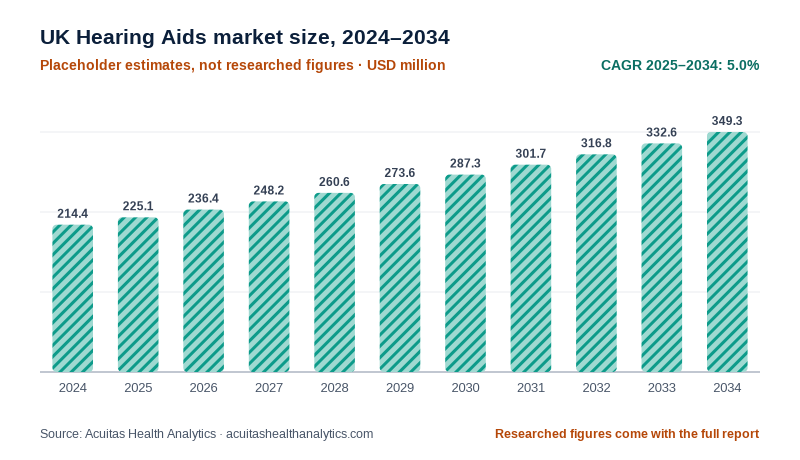
UK Hearing Aids market size, 2024–2034. Placeholder estimates; researched figures come with the full report. Source: Acuitas Health Analytics.
UK Hearing Aids Market Dynamics
Market Growth Drivers
An ageing population, more chronic wounds and vein and joint problems, and a shift to care at home are driving the hearing aids market.
Opportunity
Smart sensors in devices, home use and demand in emerging countries give the hearing aids market room to grow.
Market Restraints
Patients not wearing or using devices as advised, uneven insurance cover and the cost of newer products hold back the hearing aids market.
Competitive Landscape for Hearing Aids Market in the UK
The hearing aids market is moderately concentrated. Leading companies compete on product innovation, clinical evidence, pricing and geographic reach, and use partnerships and acquisitions to expand their portfolios.
Healthcare Policies and Regulatory Landscape for Hearing Aids Market in the UK
Hearing Aids in the UK: rules, payment and research
Medical devices sold in Great Britain need UKCA or CE marking and registration with the Medicines and Healthcare products Regulatory Agency (MHRA).[1] The NHS gives care that is free at the point of use; in England, NICE advises which medicines and treatments the NHS should fund.[2] ClinicalTrials.gov lists 22 studies on Hearing Aids that are recruiting, active or about to start in the UK.[3] People aged 65 and over: 19.7% of people in 2025, the latest World Bank figure for the UK.[4]
[3]ClinicalTrials.gov, Studies recruiting, active or not yet recruiting, in the UK. Retrieved 28 Nov 2026.
[4]World Bank Open Data, People aged 65 and over (% of people). Retrieved 28 Nov 2026.
Policy changes and Reimbursement scenario
Medical device rules, such as the US FDA 510(k) and PMA pathways and the EU Medical Device Regulation, govern how hearing aids products are approved and monitored. Reimbursement codes and hospital purchasing policies decide how widely they are used in the UK.
Sources:PubMed (US National Library of Medicine),
ClinicalTrials.gov,
World Bank.
Fetched 28 Nov 2026. Papers and trials are found by search words, so the counts are a guide. Titles only; read each paper at its source.
Public data, with sources
Hearing Aids in context
The UK compared
People aged 65 and over: 19.7% of people (2025). World: 10.4% of people (2025). 11th highest of the 13 countries we cover in Europe.[1]
Health spending per person: 5,860 US$ per person (2024). World: 1,317 US$ per person (2023). 7th highest of the 13 countries we cover in Europe.[2]
Doctors: 3.30 per 1,000 people (2023). World: 1.86 per 1,000 people (2022). 11th highest of the 13 countries we cover in Europe.[3]
[1]World Bank Open Data, People aged 65 and over (% of people). Retrieved 28 Nov 2026.
[2]World Bank Open Data, Health spending per person (US$ per person). Retrieved 28 Nov 2026.
Placeholder estimate: about $225.1 Mn in 2025, rising to about $349.3 Mn by 2034. These are early estimates, not researched figures; the researched values come with the full report.
How fast is the Hearing Aids market in the UK growing?
Placeholder estimate: about 5.0% a year (CAGR, 2025–2034). The researched growth rate comes with the full report.
What segments does the Hearing Aids market report cover?
The report splits the market by type (Behind-the-Ear, In-the-Ear, Receiver-in-Canal, Invisible-in-Canal) and channel (Audiology Clinics, Retail, Online).
Who are the key players in the Hearing Aids market?
Key players include Sonova Holding AG, Demant A/S, GN Store Nord, WS Audiology, Starkey Hearing Technologies and Cochlear.
What is driving the Hearing Aids market?
An ageing population, more chronic wounds and vein and joint problems, and a shift to care at home are driving the hearing aids market.
Who regulates Hearing Aids in the UK?
Medical devices sold in Great Britain need UKCA or CE marking and registration with the Medicines and Healthcare products Regulatory Agency (MHRA). Source: Medicines and Healthcare products Regulatory Agency. Checked 14 Nov 2026.
How is healthcare paid for in the UK?
The NHS gives care that is free at the point of use; in England, NICE advises which medicines and treatments the NHS should fund. Source: National Institute for Health and Care Excellence. Checked 14 Nov 2026.
How many clinical trials on Hearing Aids are running in the UK?
22 studies are recruiting, active or about to start in the UK, according to ClinicalTrials.gov. Source: ClinicalTrials.gov, Studies recruiting, active or not yet recruiting, in the UK. Retrieved 28 Nov 2026.
What does World Bank report for the UK?
People aged 65 and over: 19.7% of people in 2025, the latest World Bank figure. Source: World Bank Open Data, People aged 65 and over (% of people). Retrieved 28 Nov 2026.
How much research is published on Hearing Aids?
PubMed lists 2,619 papers on Hearing Aids added since January 2021, worldwide. Source: PubMed, Papers added since 1 January 2021 matching this market. Retrieved 28 Nov 2026.
 UK



 Germany
 Russia
 US
 China
 Canada
 Japan
 France
 Italy
 Brazil
 South Korea
 Ecuador
 Spain
 India
 Netherlands
 Saudi Arabia
 Mexico
 Switzerland
 Australia
 New Zealand
 Belgium
 Poland
 Argentina
 Sweden
 South Africa
 Turkey
 UAE
 Denmark
 Israel
 Chile
 Indonesia
 Colombia
 Vietnam
 Egypt
 Nigeria
 Philippines
 Malaysia
 Hong Kong
 Thailand
 Singapore
 Pakistan
 Qatar
 Kenya