APAC Ready-to-Use Therapeutic Food Market Industry Trends and Forecast to 2034: Segmented by (Product, Buyer, Region) - Growth, Market Size, Future Prospects & Competitive Analysis, 2024-2034
Overview
Market Dashboard
APAC · 2024–2034 · placeholder estimates
Values shown here are placeholder estimates, not researched figures. Researched 2024 historical, 2025 base-year and 2026–2034 forecast values are prepared with the
full report.
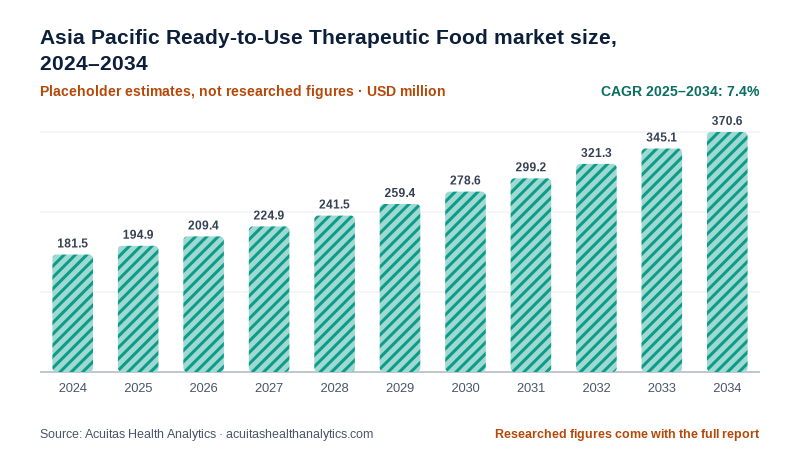
Estimate 2024$181.5 MnPlaceholder estimate
Estimate 2025$194.9 Mn21.7% of the global market
Projected 2034$370.6 Mn 90.1%Adds $175.7 Mn over 9 forecast years
CAGR 2025–20347.4%Faster than 26% of 84 OTC & Nutraceuticals markets here
Key players5Companies profiled
APAC is 21.69% of the global market.
Among regions, the largest is North America at $381.4 Mn.
Nutriset, Edesia Nutrition, Valid Nutrition, Mana Nutrition, InnoFaso (see all)
Formats
PDF, PPTX, XLSX
Sizes and growth here are placeholder estimates, not researched figures. Researched figures come with the full report.
The APAC Ready-to-Use Therapeutic Food Market Analysis Executive Summary
Ready-to-use therapeutic food is a nutrient-rich paste that treats severe child malnutrition at home.
Key segments of the ready-to-Use Therapeutic Food market include product (RUTF, RUSF and Micronutrient Powders) and buyer (UNICEF, Governments and NGOs).
Asia Pacific Ready-to-Use Therapeutic Food market size, 2024–2034. Placeholder estimates; researched figures come with the full report. Source: Acuitas Health Analytics.
Global health goals, donor and government funding, better mobile technology and focus on preventing disease are driving the ready-to-Use Therapeutic Food market.
Opportunity
Digital tools for community health, local manufacturing and public-private partnerships give the ready-to-Use Therapeutic Food market room to grow.
Market Restraints
Limited budgets, weak health systems in some regions, workforce shortages and supply chain gaps hold back the ready-to-Use Therapeutic Food market.
Competitive Landscape for Ready-to-Use Therapeutic Food Market in APAC
The ready-to-Use Therapeutic Food market is moderately concentrated. Leading companies compete on product innovation, clinical evidence, pricing and geographic reach, and use partnerships and acquisitions to expand their portfolios.
Healthcare Policies and Regulatory Landscape for Ready-to-Use Therapeutic Food Market in APAC
Ready-to-Use Therapeutic Food in APAC: rules
In some of the countries we cover here, medicines are approved by TGA (Australia)[1], NMPA (China)[2], Drug Office (Hong Kong)[3], CDSCO (India)[4], PMDA (Japan)[5], NPRA (Malaysia)[6], Medsafe (New Zealand)[7], FDA Philippines (Philippines)[8], HSA (Singapore)[9], Thai FDA (Thailand)[10], BPOM (Indonesia)[11], DRAP (Pakistan)[12], MFDS (South Korea)[13] and Drug Administration of Vietnam (Vietnam)[14]. In some of the countries we cover here, supplement rules come from TGA (Australia)[1], SAMR (China)[15], Centre for Food Safety (Hong Kong)[16], FSSAI (India)[17], Consumer Affairs Agency (Japan)[18], NPRA (Malaysia)[6], MPI (New Zealand)[19], FDA Philippines (Philippines)[8], HSA (Singapore)[9], Thai FDA (Thailand)[10], BPOM (Indonesia)[11], DRAP (Pakistan)[12], MFDS (South Korea)[13] and Vietnam Food Administration (Vietnam)[20].
Food and supplement rules, labelling and health-claim regulations govern ready-to-Use Therapeutic Food products. Authorities such as the US FDA, EFSA and national food safety bodies set what can be sold and claimed in APAC.
2.2 Market Size, Growth Prospects and Key findings
3 Market Dynamics
3.1 Market Growth Drivers Analysis
3.2 Market Restraints Analysis
4 Market Segmentation
4.1 By Product
4.2 By Buyer
5 By Market Share
5.1 Market Analysis, Insights and Forecast – By Revenue
6 Competitive Landscape
6.1 Major Top Market Players Products in Pipeline
6.2 R&D Initiatives
6.3 Notable recent Deals
6.3.1 Strategic Divestments
6.3.2 Mergers & Acquisitions
6.3.3 Partnerships
6.3.4 Joint Ventures
7 Key Company Profiles
7.1 Nutriset
7.2 Edesia Nutrition
7.3 Valid Nutrition
7.4 Mana Nutrition
7.5 InnoFaso
8 Healthcare Policies and Regulatory Landscape
8.1 Policy changes and Reimbursement scenario
8.2 Government Initiatives / Intervention programs
The ready-to-Use Therapeutic Food market can be segmented based on various criteria, including product and buyer. Here's a breakdown of the market segmentation
Sources:PubMed (US National Library of Medicine),
ClinicalTrials.gov,
World Bank.
Fetched 22 Nov 2026. Papers and trials are found by search words, so the counts are a guide. Titles only; read each paper at its source.
How big is the Ready-to-Use Therapeutic Food market in Asia Pacific?
Placeholder estimate: about $194.9 Mn in 2025, rising to about $370.6 Mn by 2034. These are early estimates, not researched figures; the researched values come with the full report.
How fast is the Ready-to-Use Therapeutic Food market in Asia Pacific growing?
Placeholder estimate: about 7.4% a year (CAGR, 2025–2034). The researched growth rate comes with the full report.
What segments does the Ready-to-Use Therapeutic Food market report cover?
The report splits the market by product (RUTF, RUSF, Micronutrient Powders) and buyer (UNICEF, Governments, NGOs).
Who are the key players in the Ready-to-Use Therapeutic Food market?
Key players include Nutriset, Edesia Nutrition, Valid Nutrition, Mana Nutrition and InnoFaso.
What is driving the Ready-to-Use Therapeutic Food market?
Global health goals, donor and government funding, better mobile technology and focus on preventing disease are driving the ready-to-Use Therapeutic Food market.
How much research is published on Ready-to-Use Therapeutic Food?
PubMed lists 112 papers on Ready-to-Use Therapeutic Food added since January 2021, worldwide. Source: PubMed, Papers added since 1 January 2021 matching this market. Retrieved 12 Nov 2026.

 US
 China
 Canada
 Japan
 Germany
 France
 Italy
 UK
 Brazil
 Spain
 India
 Ecuador
 Saudi Arabia
 Mexico
 Australia
 Russia
 New Zealand
 South Africa
 UAE
 Egypt
 Philippines
 Malaysia
 Hong Kong
 Singapore
 Thailand
 Kenya