


Australia at a glance
- Population
- 27.6 million 2025
- Life expectancy at birth
- 83.1 years, 2024
- People aged 65 and over
- 18.1 % of people, 2025
- Health spending per person
- 6,980 US$ per person, 2023
- Doctors
- 4.09 per 1,000 people, 2022
 Australia
Updated
 Reviewed by Chandani Patel
Australia Medical Foods Market Industry Trends and Forecast to 2034: Segmented by (Product, Application, Distribution Channel, Region) - Growth, Market Size, Future Prospects & Competitive Analysis, 2024-2034
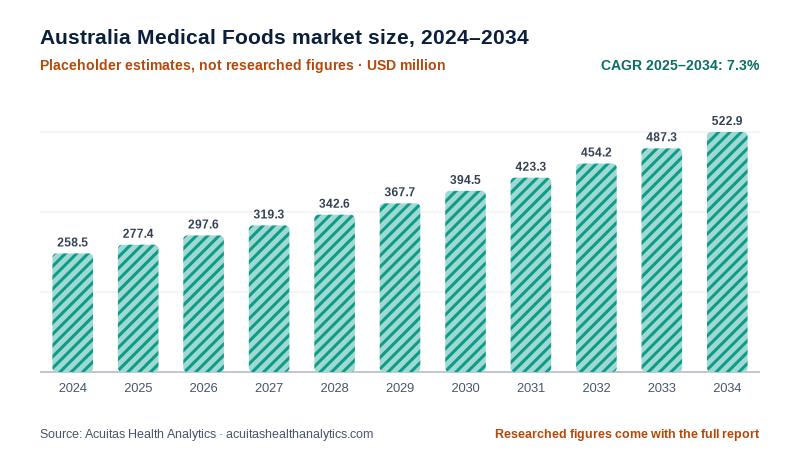
Australia · 2024–2034 · placeholder estimates
Values shown here are placeholder estimates, not researched figures. Researched 2024 historical, 2025 base-year and 2026–2034 forecast values are prepared with the full report.
 China at $1.82 Bn.
 India at 8.9% a year.
Source: Acuitas Health Analytics. Full methods, sources and usage terms come with report purchase.
$245.6 Mn total, 2026–2034
| Year | Market size | Change that year | Since 2025 |
|---|---|---|---|
| 2024 (estimate) | $258.5 Mn | — | — |
| 2025 (base) | $277.4 Mn | +$18.9 Mn | — |
| 2026 (forecast) | $297.6 Mn | +$20.2 Mn | +7.3% |
| 2027 (forecast) | $319.3 Mn | +$21.7 Mn | +15.1% |
| 2028 (forecast) | $342.6 Mn | +$23.3 Mn | +23.5% |
| 2029 (forecast) | $367.7 Mn | +$25.0 Mn | +32.6% |
| 2030 (forecast) | $394.5 Mn | +$26.8 Mn | +42.2% |
| 2031 (forecast) | $423.3 Mn | +$28.8 Mn | +52.6% |
| 2032 (forecast) | $454.2 Mn | +$30.9 Mn | +63.8% |
| 2033 (forecast) | $487.3 Mn | +$33.2 Mn | +75.7% |
| 2034 (forecast) | $522.9 Mn | +$35.6 Mn | +88.5% |
Placeholder estimates. Each year is projected from our earlier market estimate and its CAGR. Researched values come with the full report.
 US
$8.20 Bn
China
$1.82 Bn
 Canada
$1.62 Bn
 Japan
$1.12 Bn
 Germany
$630.4 Mn
 UK
$532.6 Mn
 Brazil
$546.7 Mn
 France
$523.9 Mn
 Italy
$506.5 Mn
 Ecuador
$459.8 Mn
India
$431.6 Mn
 South Korea
$406.8 Mn
 Spain
$375.9 Mn
 Saudi Arabia
$327.8 Mn
Australia (this report)
$277.4 Mn
 Netherlands
$254.6 Mn
 Mexico
$257.9 Mn
 Switzerland
$235.3 Mn
 Russia
$231.3 Mn
 New Zealand
$192.3 Mn
 Belgium
$184.7 Mn
 Sweden
$158.6 Mn
 Argentina
$151.5 Mn
 Poland
$141.7 Mn
 Turkey
$122.3 Mn
 South Africa
$121.6 Mn
 UAE
$108.5 Mn
 Denmark
$99.3 Mn
 Chile
$89.5 Mn
 Israel
$89.3 Mn
 Indonesia
$86.4 Mn
 Colombia
$85.7 Mn
 Egypt
$60.7 Mn
 Philippines
$46.5 Mn
 Vietnam
$44.3 Mn
 Nigeria
$37.6 Mn
 Hong Kong
$35.1 Mn
 Malaysia
$33.5 Mn
 Thailand
$25.0 Mn
 Singapore
$22.0 Mn
 Pakistan
$21.2 Mn
 Kenya
$14.6 Mn
 Qatar
$13.2 Mn
| Market size, 2025 | $277.4 Mn placeholder estimate |
|---|---|
| Forecast, 2034 | $522.9 Mn placeholder estimate |
| Growth (CAGR), 2025–2034 | 7.3% placeholder estimate |
| Years | 2024 historical · 2025 base year · 2026–2034 forecast |
| Segments | Product, application and distribution channel (see all) |
| Key players | Nestle, Abbott Laboratories, Danone, Fresenius Kabi AG, Mead Johnson and 1 more (see all) |
| Regulator in Australia | TGASource: Therapeutic Goods Administration. Checked 14 Nov 2026.Source: Therapeutic Goods Administration. Checked 14 Nov 2026. |
| Formats | PDF, PPTX, XLSX |
Sizes and growth here are placeholder estimates, not researched figures. Researched figures come with the full report.
Medical foods are special foods and formulas used under medical supervision to feed people with a disease or a need that normal diets cannot meet.
Key segments of the medical foods market include product (Oral Formulas, Tube-Feeding Formulas and Powders) and application (Metabolic Disorders, Neurological Disorders and Cancer).
More people taking charge of their own health, an ageing population and interest in food that does more than feed are driving the medical foods market.
Personalized products, online sales and new forms that are easier to take give the medical foods market room to grow.
Differing rules from country to country, questions over proof of benefit and price competition hold back the medical foods market.
The medical foods market is moderately concentrated. Leading companies compete on product innovation, clinical evidence, pricing and geographic reach, and use partnerships and acquisitions to expand their portfolios.
Medicines must be included in the Australian Register of Therapeutic Goods (ARTG), run by the Therapeutic Goods Administration (TGA), before they can be supplied.[1] Most vitamin, mineral and herbal products are listed complementary medicines, included in the Australian Register of Therapeutic Goods (ARTG) and regulated by the Therapeutic Goods Administration (TGA).[1]
[1] Therapeutic Goods Administration. Checked 14 Nov 2026.
Food and supplement rules, labelling and health-claim regulations govern medical foods products. Authorities such as the US FDA, EFSA and national food safety bodies set what can be sold and claimed in Australia.
What doctors and scientists are doing in Medical Foods right now, from free public sources.
Sources: PubMed (US National Library of Medicine), ClinicalTrials.gov, World Bank. Fetched 22 Nov 2026. Papers and trials are found by search words, so the counts are a guide. Titles only; read each paper at its source.
[1] World Bank Open Data, Health spending per person (US$ per person). Retrieved 23 Nov 2026.
[2] World Bank Open Data, Doctors (per 1,000 people). Retrieved 22 Nov 2026.
[3] World Bank Open Data, People aged 65 and over (% of people). Retrieved 23 Nov 2026.
From our blog
Australia · 2 shared keywords
Australia · 2 shared keywords
Australia · 2 shared keywords
Australia · 1 shared keyword
Australia · 1 shared keyword
Australia · 1 shared keyword
Pharmaceuticals · Australia
Pharmaceuticals · Australia
Pharmaceuticals · Australia
Pharmaceuticals · Australia
Pharmaceuticals · Australia
Pharmaceuticals · Australia