US Men's Health Supplements Market Industry Trends and Forecast to 2034: Segmented by (Form, Application, Region) - Growth, Market Size, Future Prospects & Competitive Analysis, 2024-2034
Overview
Market Dashboard
US · 2024–2034 · placeholder estimates
Values shown here are placeholder estimates, not researched figures. Researched 2024 historical, 2025 base-year and 2026–2034 forecast values are prepared with the
full report.
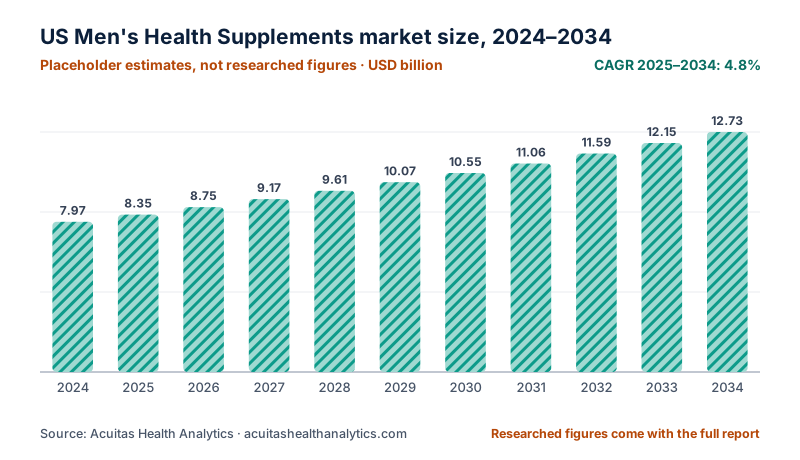
Estimate 2024$7.97 BnPlaceholder estimate
Estimate 2025$8.35 Bn40.4% of the global market
Projected 2034$12.73 Bn 52.5%Adds $4.38 Bn over 9 forecast years
CAGR 2025–20344.8%Faster than 48% of 83 OTC & Nutraceuticals markets here
Sizes and growth here are placeholder estimates, not researched figures. Researched figures come with the full report.
The US Men's Health Supplements Market Analysis Executive Summary
Men's health supplements are dietary products specifically formulated to address the unique nutritional needs and health concerns of men. These supplements often include a combination of vitamins, minerals, amino acids, and herbal extracts designed to support various aspects of male health, including testosterone levels, prostate health, sexual function, and overall vitality. Common ingredients found in men's health supplements include zinc, vitamin D, omega-3 fatty acids, and saw palmetto. These supplements aim to enhance physical performance, improve energy levels, and support mental well-being.
Globally, the scenario for men's health supplements is characterized by a growing recognition of the importance of male-specific health issues. Research indicates that men are increasingly seeking ways to improve their health and prevent chronic diseases. For example, studies show that approximately 30% of men over the age of 40 experience low testosterone levels, driving demand for supplements that can help mitigate this issue. Additionally, the rise in awareness about conditions such as prostate cancer has led to increased interest in supplements that support prostate health. The adoption of these products is further fuelled by the aging population and a cultural shift towards preventive healthcare, with many men incorporating dietary supplements into their daily routines to enhance their overall well-being
US Men's Health Supplements market size, 2024–2034. Placeholder estimates; researched figures come with the full report. Source: Acuitas Health Analytics.
US Men's Health Supplements Market Dynamics
Market Growth Drivers
The adoption of men's health supplements globally is positively influenced by an increasing awareness of health and wellness, particularly as men seek to address specific health concerns related to aging and lifestyle. Research indicates that many men are becoming more proactive about their health, with studies showing that conditions such as low testosterone and prostate issues are prevalent among older males. For instance, approximately 30% of men over 40 experience low testosterone levels, prompting interest in supplements that can help mitigate these issues. Additionally, the rise in health education and public awareness campaigns has encouraged men to explore dietary supplements as a means of enhancing their vitality and overall well-being. The growing acceptance of preventive healthcare practices further drives the adoption of these products, as men look for ways to maintain their health and improve quality of life.
Opportunity
There is a rising awareness among consumers of the benefits of the health supplements. As more men become educated on the benefits of these products there will be more opportunities to gain a larger market share. There is also an opportunity to create novel products such as edible men’s health supplements.
Market Restraints
A significant concern is the lack of robust scientific evidence supporting the efficacy of many products on the market. Research indicates that while some ingredients may have beneficial effects, others do not consistently deliver results, leading to scepticism among potential users. Additionally, safety concerns regarding side effects and interactions with prescription medications can deter men from using these supplements. The perception that dietary supplements are unnecessary or inferior to traditional medical treatments may also limit their adoption. Furthermore, the vast array of products available can create confusion among consumers about which supplements are genuinely effective for their specific needs, ultimately impacting their willingness to incorporate these products into their health regimen.
Competitive Landscape for Men's Health Supplements Market in the US
In September 2025, a novel supplement “Mighty Mojo” was released by Olly a health food brand that claims this product can balance testosterone levels
In February 2022, BE ONE a vitality supplement for men was launched by Lupin in order to provide men with the optimum protein intake. Ingredients like ashwagandha were used in order to boost the immune system.
Healthcare Policies and Regulatory Landscape for Men's Health Supplements Market in the US
Men's Health Supplements in the US: rules
New drugs need approval from the US Food and Drug Administration (FDA); many over-the-counter medicines are sold under FDA monographs instead.[1] Dietary supplements do not need FDA approval before sale; under the Dietary Supplement Health and Education Act of 1994 (DSHEA), the FDA acts against unsafe or mislabelled products.[2]
Men's Health Supplements are considered dietary supplements in most regions, so they must meet the safety requirements, labelling standards and product certifications set out by the various regulatory bodies. Although laws around dietary supplements are similar across continents, they are not identical and this makes launching products simultaneously in different countries difficult. Additionally all health claims made about Men's Health Supplements must be substantiated by scientific proof in order for companies to get approval to launch their products. Another issue when regulating these products is the drug interaction problems that these supplements have with other medications. This might lead regulatory bodies to apply more stringent laws on companies within this market in order to ensure that these products are safe and will not harm consumers.
8.2 Government Initiatives / Intervention programs
The Men's Health Supplements Market is divided into following segments:Form, Application, and Region. As these segments grow, you will be able to analyze the industries' meagre growth areas and give users useful market insights and an overview to aid in their strategic decision-making when it comes to selecting key market applications.
Sources:PubMed (US National Library of Medicine),
ClinicalTrials.gov,
World Bank.
Fetched 9 Nov 2026. Papers and trials are found by search words, so the counts are a guide. Titles only; read each paper at its source.
Public data, with sources
Men's Health Supplements in context
The US compared
Health spending per person: 13,473 US$ per person (2023). World: 1,317 US$ per person (2023).[1]
Doctors: 3.68 per 1,000 people (2022). World: 1.86 per 1,000 people (2022).[2]
People aged 65 and over: 18.4% of people (2025). World: 10.4% of people (2025).[3]
[1]World Bank Open Data, Health spending per person (US$ per person). Retrieved 19 Nov 2026.
How big is the Men's Health Supplements market in the US?
Placeholder estimate: about $8.35 Bn in 2025, rising to about $12.73 Bn by 2034. These are early estimates, not researched figures; the researched values come with the full report.
How fast is the Men's Health Supplements market in the US growing?
Placeholder estimate: about 4.8% a year (CAGR, 2025–2034). The researched growth rate comes with the full report.
What segments does the Men's Health Supplements market report cover?
The report splits the market by form (Capsules, Gummies, Liquids, Powders and more) and application (Anti-Aging Supplements, Bone and Joint Supplements, Heart Health Supplements, Fertility Supplements and more).
Who are the key players in the Men's Health Supplements market?
Key players include Biotest LLC, BioThrive Sciences LLC, Botanic Supplements Private Limited, Custom Nutra LLC, Irwin Naturals and Markers Nutrition LLC, among 10 companies the report profiles.
What is driving the Men's Health Supplements market?
The adoption of men's health supplements globally is positively influenced by an increasing awareness of health and wellness, particularly as men seek to address specific health concerns related to aging and lifestyle.
Who regulates Men's Health Supplements in the US?
New drugs need approval from the US Food and Drug Administration (FDA); many over-the-counter medicines are sold under FDA monographs instead. Dietary supplements do not need FDA approval before sale; under the Dietary Supplement Health and Education Act of 1994 (DSHEA), the FDA acts against unsafe or mislabelled products. Source: US Food and Drug Administration. Checked 14 Nov 2026.Source: US Food and Drug Administration. Checked 14 Nov 2026.
 US



 Canada
 China
 Japan
 Germany
 France
 UK
 Brazil
 Italy
 Ecuador
 Spain
 India
 Saudi Arabia
 Mexico
 Australia
 South Africa
 UAE
 Egypt
 Philippines
 Malaysia
 Hong Kong
 Singapore
 Thailand
 Kenya