 Sun Pharmaceutical Industries Ltd.
 Aurobindo Pharma
Breast Cancer Therapeutics
APAC
Updated
 Reviewed by Vidhi Upadhyay
APAC Antifungal Drugs Market Industry Trends and Forecast to 2034: Segmented by (Drug Class, Infection, End User, Region) - Growth, Market Size, Future Prospects & Competitive Analysis, 2024-2034
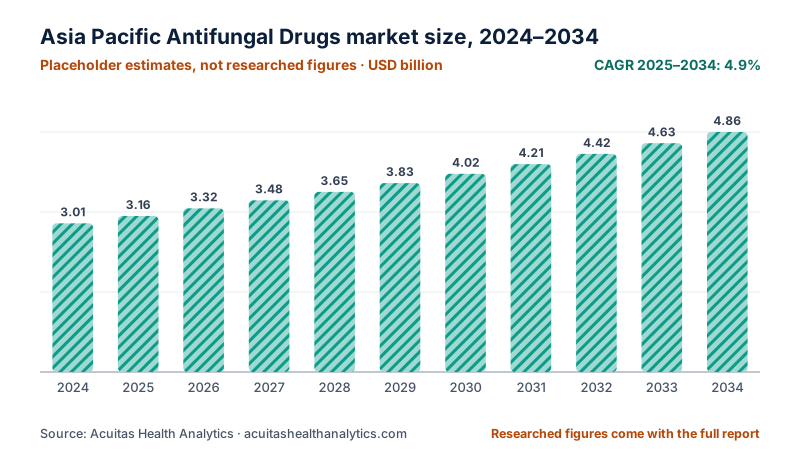
Values shown here are placeholder estimates, not researched figures. Researched 2024 historical, 2025 base-year and 2026–2034 forecast values are prepared with the full report.


Source: Acuitas Health Analytics. Full methods, sources and usage terms come with report purchase.
$1.70 Bn total, 2026–2034
| Year | Market size | Change that year | Since 2025 |
|---|---|---|---|
| 2024 (estimate) | $3.01 Bn | — | — |
| 2025 (base) | $3.16 Bn | +$147.7 Mn | — |
| 2026 (forecast) | $3.32 Bn | +$154.9 Mn | +4.9% |
| 2027 (forecast) | $3.48 Bn | +$162.5 Mn | +10% |
| 2028 (forecast) | $3.65 Bn | +$170.4 Mn | +15.4% |
| 2029 (forecast) | $3.83 Bn | +$178.8 Mn | +21.1% |
| 2030 (forecast) | $4.02 Bn | +$187.6 Mn | +27% |
| 2031 (forecast) | $4.21 Bn | +$196.7 Mn | +33.2% |
| 2032 (forecast) | $4.42 Bn | +$206.4 Mn | +39.8% |
| 2033 (forecast) | $4.63 Bn | +$216.5 Mn | +46.6% |
| 2034 (forecast) | $4.86 Bn | +$227.1 Mn | +53.8% |
Placeholder estimates. Each year is projected from our earlier market estimate and its CAGR. Researched values come with the full report.
 US
$6.22 Bn
 China
$1.37 Bn
 Canada
$1.24 Bn
 Japan
$921.2 Mn
 Germany
$511.7 Mn
 UK
$446.8 Mn
 Brazil
$461.9 Mn
 France
$442.5 Mn
 Italy
$374.9 Mn
 Ecuador
$375.0 Mn
 Spain
$308.7 Mn
 Mexico
$269.1 Mn
 Saudi Arabia
$270.7 Mn
 India
$265.5 Mn
 Australia
$223.4 Mn
 Russia
$173.2 Mn
 New Zealand
$170.8 Mn
 South Africa
$111.1 Mn
 UAE
$87.1 Mn
 Egypt
$51.8 Mn
 Philippines
$34.6 Mn
 Hong Kong
$26.2 Mn
 Malaysia
$24.6 Mn
 Singapore
$22.1 Mn
 Thailand
$18.5 Mn
 Kenya
$11.8 Mn
| Market size, 2025 | $3.16 Bn placeholder estimate |
|---|---|
| Forecast, 2034 | $4.86 Bn placeholder estimate |
| Growth (CAGR), 2025–2034 | 4.9% placeholder estimate |
| Years | 2024 historical · 2025 base year · 2026–2034 forecast |
| Segments | Drug class, infection and end user (see all) |
| Key players | Pfizer Inc., Astellas Pharma Inc., Merck & Co., Inc., Mundipharma, Basilea Pharmaceutica (see all) |
| Formats | PDF, PPTX, XLSX |
Sizes and growth here are placeholder estimates, not researched figures. Researched figures come with the full report.
Antifungal drugs treat infections caused by fungi, from skin and nail infections to life-threatening infections in hospital patients.
Key segments of the antifungal Drugs market include drug class (Azoles, Echinocandins and Polyenes) and infection (Superficial and Invasive).
Rising antimicrobial resistance, outbreaks of new and returning diseases, climate change spreading infections and strong global funding for prevention are driving the antifungal Drugs market.
New vaccines, rapid tests and public-private funding for neglected diseases give the antifungal Drugs market room to grow, especially in Asia, Africa and Latin America.
Low prices in poorer markets, weak returns for new antibiotics, vaccine hesitancy and cold-chain problems hold back the antifungal Drugs market.
The antifungal Drugs market is moderately concentrated. Leading companies compete on product innovation, clinical evidence, pricing and geographic reach, and use partnerships and acquisitions to expand their portfolios.
In some of the countries we cover here, medicines are approved by TGA (Australia)[1], NMPA (China)[2], Drug Office (Hong Kong)[3], CDSCO (India)[4], PMDA (Japan)[5], NPRA (Malaysia)[6], Medsafe (New Zealand)[7], FDA Philippines (Philippines)[8], HSA (Singapore)[9] and Thai FDA (Thailand)[10]. How care is paid for in some of these countries: Medicare and the PBS (Australia)[11], basic medical insurance (China)[12], the Hospital Authority (Hong Kong)[13], Ayushman Bharat PM-JAY (India)[14], public health insurance (Japan)[15], subsidised public care (Malaysia)[16], Pharmac (New Zealand)[17], PhilHealth (Philippines)[18], MediShield Life (Singapore)[19] and the Universal Coverage Scheme (Thailand)[20].
[1] Therapeutic Goods Administration. Checked 14 Nov 2026.
[2] National Medical Products Administration. Checked 14 Nov 2026.
[3] Drug Office, Department of Health. Checked 14 Nov 2026.
[4] Central Drugs Standard Control Organisation. Checked 14 Nov 2026.
[5] Pharmaceuticals and Medical Devices Agency. Checked 14 Nov 2026.
[6] National Pharmaceutical Regulatory Agency. Checked 14 Nov 2026.
[7] Medsafe. Checked 14 Nov 2026.
[8] Food and Drug Administration Philippines. Checked 14 Nov 2026.
[9] Health Sciences Authority. Checked 14 Nov 2026.
[10] Thai Food and Drug Administration. Checked 14 Nov 2026.
[11] Pharmaceutical Benefits Scheme. Checked 14 Nov 2026.
[12] National Healthcare Security Administration. Checked 14 Nov 2026.
[13] Hospital Authority. Checked 14 Nov 2026.
[14] National Health Authority (PM-JAY). Checked 14 Nov 2026.
[15] Ministry of Health, Labour and Welfare. Checked 14 Nov 2026.
[16] Ministry of Health Malaysia. Checked 14 Nov 2026.
[17] Pharmac. Checked 14 Nov 2026.
[18] PhilHealth. Checked 14 Nov 2026.
[19] CPF Board, MediShield Life. Checked 14 Nov 2026.
[20] National Health Security Office. Checked 14 Nov 2026.
Regulators such as the US FDA, the European Medicines Agency and national drug authorities set approval, pricing and safety rules for antifungal Drugs. Reimbursement decisions by public payers and insurers shape how fast new therapies reach patients in APAC.
What doctors and scientists are doing in Antifungal Drugs right now, from free public sources.
Sources: PubMed (US National Library of Medicine), ClinicalTrials.gov. Fetched 12 Nov 2026. Papers and trials are found by search words, so the counts are a guide. Titles only; read each paper at its source.
From our blog
APAC
APAC
APAC
APAC
APAC
APAC
Medical Devices · APAC
Medical Devices · APAC
Digital Health · APAC
Medical Devices · APAC
Healthcare Services · APAC
OTC & Nutraceuticals · APAC