Europe PD-1 and PD-L1 Inhibitors Market Industry Trends and Forecast to 2034: Segmented by (Drug, Indication, End User, Region) - Growth, Market Size, Future Prospects & Competitive Analysis, 2024-2034
Overview
Market Dashboard
Europe · 2024–2034 · placeholder estimates
Values shown here are placeholder estimates, not researched figures. Researched 2024 historical, 2025 base-year and 2026–2034 forecast values are prepared with the
full report.
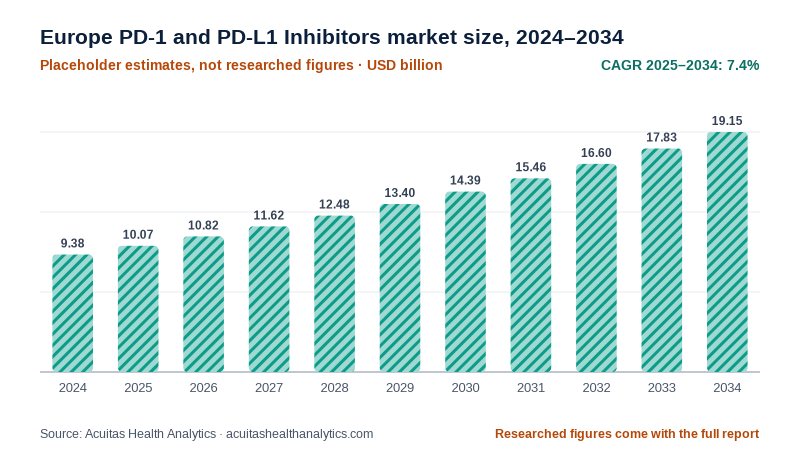
Estimate 2024$9.38 BnPlaceholder estimate
Estimate 2025$10.07 Bn17% of the global market
Projected 2034$19.15 Bn 90.1%Adds $9.08 Bn over 9 forecast years
CAGR 2025–20347.4%Faster than 57% of 188 Pharmaceuticals markets here
194 in EuropeSource: ClinicalTrials.gov, Studies recruiting, active or not yet recruiting, in Europe. Retrieved 12 Nov 2026.
Formats
PDF, PPTX, XLSX
Sizes and growth here are placeholder estimates, not researched figures. Researched figures come with the full report.
The Europe PD-1 and PD-L1 Inhibitors Market Analysis Executive Summary
PD-1 and PD-L1 inhibitors are checkpoint drugs that release the brakes on the immune system so it can attack cancer.
Key segments of the PD-1 and PD-L1 Inhibitors market include drug (Pembrolizumab, Nivolumab and Atezolizumab) and indication (Lung Cancer, Melanoma and Kidney Cancer).
Europe PD-1 and PD-L1 Inhibitors market size, 2024–2034. Placeholder estimates; researched figures come with the full report. Source: Acuitas Health Analytics.
Europe PD-1 and PD-L1 Inhibitors Market Dynamics
Market Growth Drivers
Rising cancer cases, earlier detection, precision medicine and a strong pipeline of targeted and immune therapies are driving the PD-1 and PD-L1 Inhibitors market. Faster approvals and new combinations are improving survival.
Opportunity
Biomarker-led treatment, earlier lines of therapy and expansion into emerging markets offer strong growth for the PD-1 and PD-L1 Inhibitors market.
Market Restraints
High treatment costs, drug resistance, side effects and unequal access to cancer centres hold back the PD-1 and PD-L1 Inhibitors market, especially in low- and middle-income countries.
Competitive Landscape for PD-1 and PD-L1 Inhibitors Market in Europe
The PD-1 and PD-L1 Inhibitors market is moderately concentrated. Leading companies compete on product innovation, clinical evidence, pricing and geographic reach, and use partnerships and acquisitions to expand their portfolios.
Healthcare Policies and Regulatory Landscape for PD-1 and PD-L1 Inhibitors Market in Europe
PD-1 and PD-L1 Inhibitors in Europe: rules, payment and research
In the EU, many new medicines are authorised once for every member state by the European Commission, after review by the European Medicines Agency (EMA).[1] In the countries we cover here, medicines are approved by ANSM (France)[2], BfArM (Germany)[3], AIFA (Italy)[4], Ministry of Health (Russia)[5], AEMPS (Spain)[6], MHRA (UK)[7], CBG-MEB (Netherlands)[8], FAMHP (Belgium)[9], Swissmedic (Switzerland)[10], Läkemedelsverket (Sweden)[11], Danish Medicines Agency (Denmark)[12], URPL (Poland)[13] and TITCK (Turkey)[14]. Each country runs its own health system and decides prices and reimbursement; since January 2025, EU countries also share joint clinical assessments of some new medicines.[15] ClinicalTrials.gov lists 194 studies on PD-1 and PD-L1 Inhibitors that are recruiting, active or about to start in Europe.[16]
[16]ClinicalTrials.gov, Studies recruiting, active or not yet recruiting, in Europe. Retrieved 12 Nov 2026.
Policy changes and Reimbursement scenario
Regulators such as the US FDA, the European Medicines Agency and national drug authorities set approval, pricing and safety rules for PD-1 and PD-L1 Inhibitors. Reimbursement decisions by public payers and insurers shape how fast new therapies reach patients in Europe.
2.2 Market Size, Growth Prospects and Key findings
3 Market Dynamics
3.1 Market Growth Drivers Analysis
3.2 Market Restraints Analysis
4 Market Segmentation
4.1 By Drug
4.2 By Indication
4.3 By End User
5 By Market Share
5.1 Market Analysis, Insights and Forecast – By Revenue
6 Competitive Landscape
6.1 Major Top Market Players Products in Pipeline
6.2 R&D Initiatives
6.3 Notable recent Deals
6.3.1 Strategic Divestments
6.3.2 Mergers & Acquisitions
6.3.3 Partnerships
6.3.4 Joint Ventures
7 Key Company Profiles
7.1 Merck & Co.
7.2 Bristol Myers Squibb
7.3 Roche
7.4 AstraZeneca
7.5 BeiGene
7.6 Innovent Biologics
8 Healthcare Policies and Regulatory Landscape
8.1 Policy changes and Reimbursement scenario
8.2 Government Initiatives / Intervention programs
The PD-1 and PD-L1 Inhibitors market can be segmented based on various criteria, including drug, indication and end user. Here's a breakdown of the market segmentation
Other companies that free public records show in this market: trials they lead, US approvals and WHO prequalification. They are not part of our key players research. Each count opens its source.
Also active in this area, from free public records
Source: ClinicalTrials.gov, Active studies (recruiting, about to start or running) each company leads, found with this market's trial search, worldwide. Retrieved 13 Nov 2026.
Source: Drugs@FDA, US approvals each company holds for medicines on the market whose FDA label lists this use. Retrieved 13 Nov 2026.
Beyond the market numbers
Research, trials and patients
What doctors and scientists are doing in PD-1 and PD-L1 Inhibitors right now, from free public sources.
Clinical trials
194 active trials in UK, Germany, France, Italy, Spain, Netherlands, Belgium, Switzerland, Sweden, Denmark, Poland, Turkey and Russia
Recruiting, about to start, or running now. Counted across the 13 countries we report on in Europe.
Sources:PubMed (US National Library of Medicine),
ClinicalTrials.gov.
Fetched 12 Nov 2026. Papers and trials are found by search words, so the counts are a guide. Titles only; read each paper at its source.
How big is the PD-1 and PD-L1 Inhibitors market in Europe?
Placeholder estimate: about $10.07 Bn in 2025, rising to about $19.15 Bn by 2034. These are early estimates, not researched figures; the researched values come with the full report.
How fast is the PD-1 and PD-L1 Inhibitors market in Europe growing?
Placeholder estimate: about 7.4% a year (CAGR, 2025–2034). The researched growth rate comes with the full report.
What segments does the PD-1 and PD-L1 Inhibitors market report cover?
The report splits the market by drug (Pembrolizumab, Nivolumab, Atezolizumab, Durvalumab and more), indication (Lung Cancer, Melanoma, Kidney Cancer, Other Solid Tumors) and end user (Hospitals, Specialty Clinics, Retail Pharmacies, Online Pharmacies).
Who are the key players in the PD-1 and PD-L1 Inhibitors market?
Key players include Merck & Co., Inc., Bristol-Myers Squibb, Roche, AstraZeneca, BeiGene and Innovent Biologics.
What is driving the PD-1 and PD-L1 Inhibitors market?
Rising cancer cases, earlier detection, precision medicine and a strong pipeline of targeted and immune therapies are driving the PD-1 and PD-L1 Inhibitors market. Faster approvals and new combinations are improving survival.
Who regulates PD-1 and PD-L1 Inhibitors in Europe?
In the EU, many new medicines are authorised once for every member state by the European Commission, after review by the European Medicines Agency (EMA). Source: European Medicines Agency. Checked 14 Nov 2026.
How is healthcare paid for in Europe?
Each country runs its own health system and decides prices and reimbursement; since January 2025, EU countries also share joint clinical assessments of some new medicines. Source: European Commission, health technology assessment. Checked 14 Nov 2026.
How many clinical trials on PD-1 and PD-L1 Inhibitors are running in Europe?
194 studies are recruiting, active or about to start in Europe, counted across the 13 countries we report on there, according to ClinicalTrials.gov. Source: ClinicalTrials.gov, Studies recruiting, active or not yet recruiting, in Europe. Retrieved 12 Nov 2026.
How much research is published on PD-1 and PD-L1 Inhibitors?
PubMed lists 1,230 papers on PD-1 and PD-L1 Inhibitors added since January 2021, worldwide. Source: PubMed, Papers added since 1 January 2021 matching this market. Retrieved 12 Nov 2026.



 US
 China
 Canada
 Japan
 Germany
 France
 UK
 Italy
 Brazil
 Spain
 Saudi Arabia
 Ecuador
 India
 Mexico
 Australia
 New Zealand
 Russia
 South Africa
 UAE
 Egypt
 Philippines
 Hong Kong
 Malaysia
 Singapore
 Thailand
 Kenya
 Regeneron Pharmaceuticals
 Dr Reddy’s Laboratories
 Aurobindo Pharma